Home
Class 11
PHYSICS
A rail track made of steel having length...

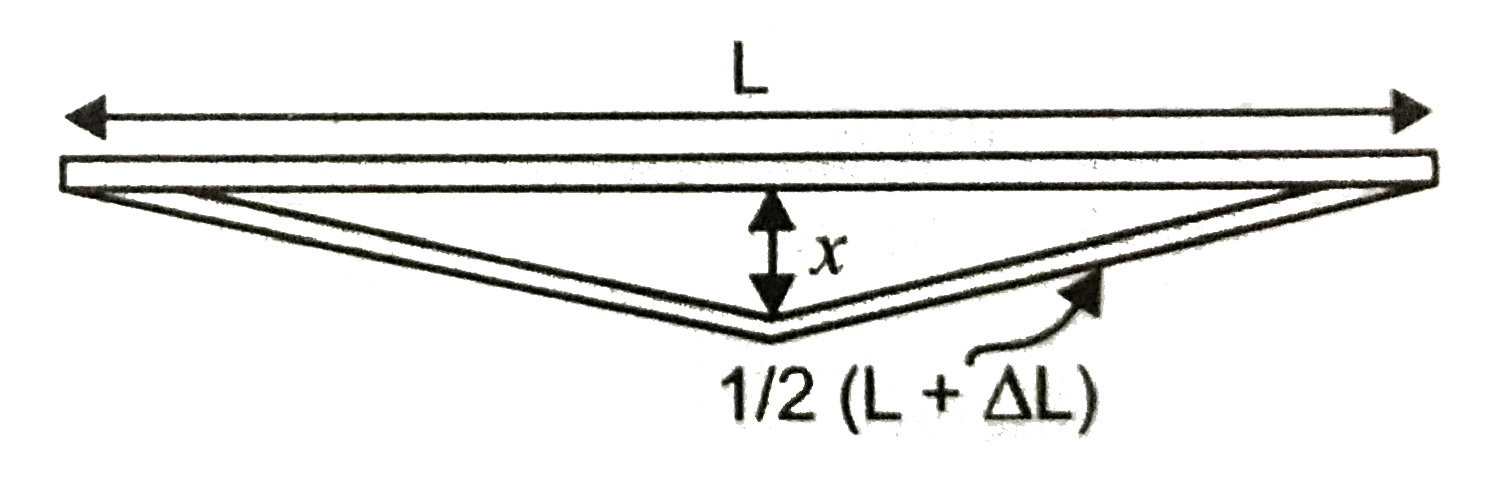
A rail track made of steel having length 10 m is clamped on a railway line at its two ends

on a summer day due to rise in temperature by `20^@C,` it is deformed as shown in fig. Find x (displacement of the centre) if `alpha_(steel) = 1.2 xx 10^(-5)//^@C.`

Text Solution

Verified by Experts

From the given fing
`x = sqrt(((L + Delta L)/(2))^2 - ((L)/(2))^2) = (1)/(2) sqrt((L + Delta L)^2 - L^2) = (1)/(2)[ DeltaL^2+ 2L Delta L]^(1//2)` Since `Delta L` is a small quantity the term wich `Delta L^2` being very small can be neglected. `:. X =(1)/(2) [ 2 L Delta L]^(1//2)`
Now `Delta L = L alpha Delta theta`
`x = (1)/(2) [2 L xx L alpha Delta theta]^(1//2) = (10)/(2) [2xx(1.2 xx 10^(-5))xx 20]^(1//2) = 10[1.2 xx10^(-4)]^(1//2)`
` = 10 xx 10^(-2) xx 1.1m ~~ 0.11 m`
Promotional Banner

Similar Questions

Explore conceptually related problems

A rail track made of steel having length 10 m is clamped on a railway line at its two end (figure). On a summer day due to rise in temperatue by 20^(@)C . It is deformed as shown in figure. Find x (displacement of the centre) if alpha_("steel") = 1.2 xx 10^(-5)//^(@)C

A rail track made of steel having 20m is clamped on a railway line at its two ends as show in Fig. 7(d). 17. On a summer day due to rise in temperature by 22^(@)C , it is deformed as show in Fig. 7(d). 17 .Find displacement of the center (x) . Given cofficient of liner expansion of steel is 1.2xx10^(-5) .^(@)C^(-1) .

A steel wire of length 1 m and mass 0.1 kg and having a uniform cross-sectional area of 10^(-6) m^(2) is rigidly fixed at both ends. The temperature of the wire is lowered by 20^(@)C . If the wire is vibrating in fundamental mode, find the frequency (in Hz). (Y_(steel)=2xx 10^(11) N//m^(2),alpha_(steel)=1.21 xx 10^(-5)//.^(@)C) .

A rod has been laid by using alternate rails of steel and aluminium each 12m long in a winter season when temperature is .-2^(@)C . The maximum temprature which can must be left be-tween advance rules of they are just to touch on a summer day (alpha_("steel") = 1.2 xx 10^(-5) ^(0)C^(-1) alpha_(Al) = 2.4 xx 10^(-5) ^(0)C^(-1)

A steel tape is correctly calibrated at 20^(@)C and is used to measure the length of a table at 30^(@)C . Find the percentage error in the measurement of length. [alpha_(steel) = 11 xx 10^(-5)//.^(@)C]

A horizontal steel railroad track has a length of 100 m when the temperature is 25^(@)C . The track is constrained from expanding or bending. The stress on the strack on a hot summer day, when the temperature is 40^(@)C , is (Note : the linear coefficient of thermal expansion for steel is 1.1xx10^(-5)//.^(@)C and the Young's modulus of steel is 2xx10^(11) Pa)

The scale on a steel on a steel meter stick is calibrated at 15^@ C . What is the error in the reading of 60 cm at 27^@C ? alpha_(steel) =1.2 xx 10^-5 (.^@ C)^-1 .

A concrete slab has a length of 10 m on a winter night when the temperature is 0^C . Find the lenth of the slab on a summer day when the temperature is 35^C . The coefficient of linear expansion of concrete is 1.0 XX 10^(-5) 0^ C^(-1) .

A steel rail 30m long is firmly attached to the road be only at its ends. The sun raises the temperature of the rail by 50^(0)C , causing the rail to buckle. Assuming that the buckled rail consitst of two straight parts metting in the centre, calculate how much the centre of the rail rise? Given, alpha_(steel) = 12 xx 10^(-6//@)C.
