Home
Class 11
PHYSICS
A sample of 2 kg of monoatomic helium (a...

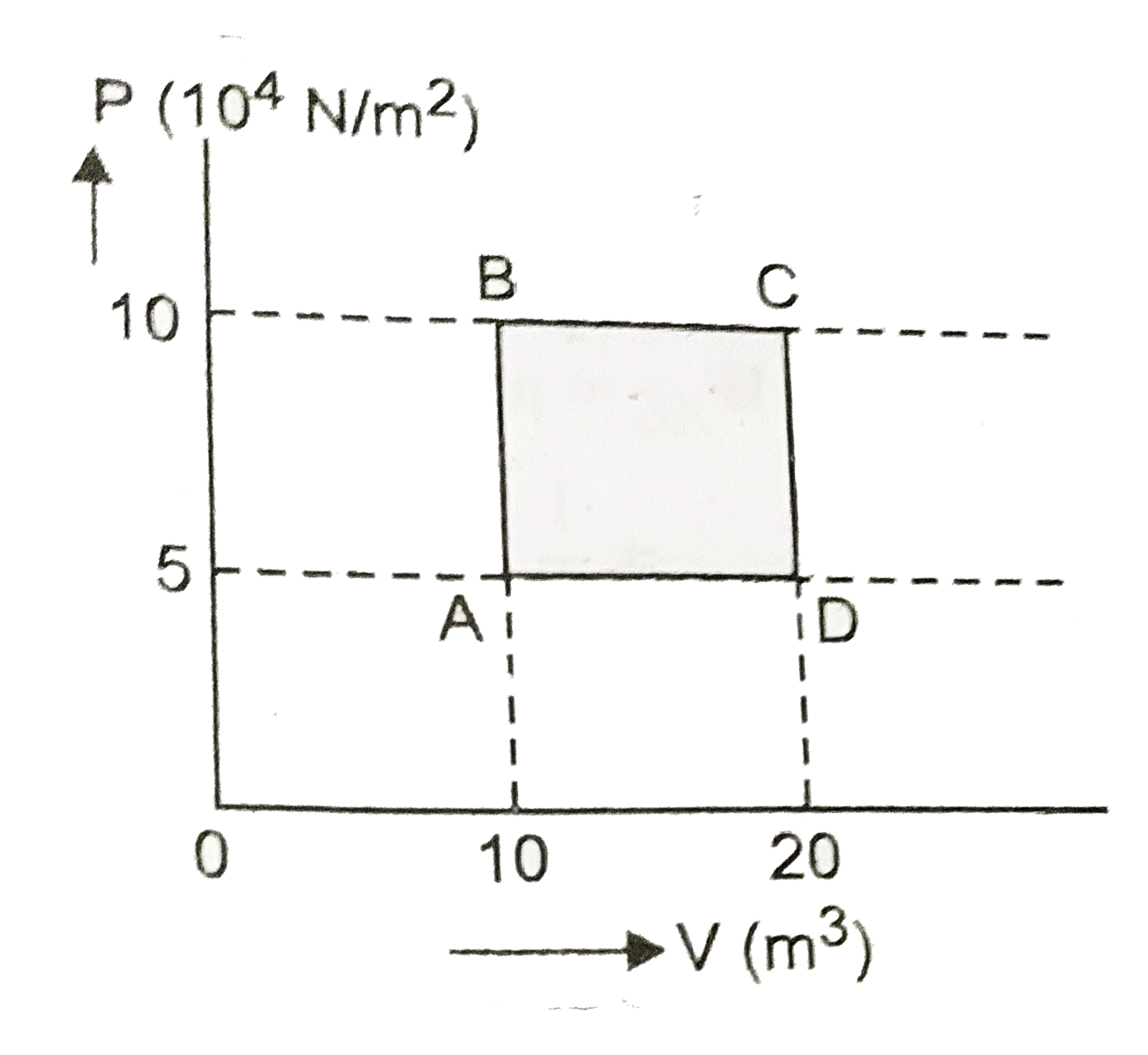
A sample of `2 kg` of monoatomic helium (assumed ideal) is taken through the process ABC and another sample of `2 kg` of the same gas is taken through the process ACD as shown in (figure). Given molecular mass of He `= 4 and R = 8.3J mol e^(-1)K^(-1)`
(i) What is the temperature of `He` in each of the states A, B, C and D?
(ii) How much is the heat involves in process , ABC and ADC?

Text Solution

Verified by Experts

Here, mass of `He = 2 kg = 2000g`
`:.` Number of moles `= (2000)/4= 500`
As `P_(A)V_(A)=nRT_(A)`
`:. T_(A)=(P_(A)V_(A))/(nR)=(5xx10^(4)xx10)/(500xx8.3)=120K`
In going from A to B, volume is constant.
`:. (T_(B))/(T_(B))=(P_(B))/(P_(A)), T_(B)= T_(A)xx(P_(B))/(P_(A))=120.5xx(10xx10^(4))/(5xx10^(4))=241K`
In going from B to C, pressure is constant
`:. T_(C)/(T_(B))=(V_(C))/(V_(B)). T_(C)=T_(B)xx(V_(C))/(V_(B))=241xx(20)/(10)= 482K`
Similarly, `(T_(D))/(T_(C))=(P_(D))/(P_(C)), T_(D)=T_(C)xx(P_(D))/(P_(C))= 482xx(5xx10^(4))/(10xx10^(4))= 241K`
Heat involved in the process ABC
`DeltaQ=DeltaU+DeltaW=nC_(v)(T_(C)-T_(A))+P(DeltaV)`
`DeltaQ=500xx3/2R(T_(C)-T_(A))+P(20-10)`
`=500xx3/2xx8.3(482-120.5)+10xx10^(4)xx10`
`DeltaQ= 2.25xx10^(6)+10^(6)= 3.25xx10^(6)J`
Heat involved in process ADC
`DeltaQ= DeltaU'+DeltaW' = nC_(V)(T_(C)-T(A))+P(DeltaV)`
`=500xx3/2xx8.3(482-120.5)+5xx10^(4)(20-10)`
`DeltaQ'= 2.25xx10^(6)+0.5xx10^(6)= 2.75xx10^(6)J`
Promotional Banner

Topper's Solved these Questions

  • THERMODYNAMICS

    PRADEEP|Exercise Value based Questions|4 Videos
  • THERMODYNAMICS

    PRADEEP|Exercise NCERT Questions|10 Videos
  • THERMODYNAMICS

    PRADEEP|Exercise Long answer questions(NCERT)|5 Videos
  • SYSTEMS OF PARTICLES AND ROTATIONAL MOTION

    PRADEEP|Exercise Assertion- Reason Type questions|20 Videos
  • WORK, ENERGY AND POWER

    PRADEEP|Exercise Assertion-Reason Type Questions|24 Videos

Similar Questions

Explore conceptually related problems

Ideal gas is taken through a process as shown in figure

Ideal gas is taken through the process shown in the figure :

A sample of 2kg of helium (assumed ideal) is taken through the process ABC and another sample of 2kg of the same gas is taken through the process ADC . Then the temperature of the states A and B are (given R = 8.3J mol^(-1)K^(-1))

A sample of 2 kg of monatomic helium (assumed ideal) is taken through the process ABC another sample of 2 kg of the same gas is taken through the process ADC as shown in Fig. Given molecular mass of helium = 4. a. What is the temperature of helium in each of the states A, B, C and D ? b. Is there any way of telling afterwards which sample of helium went through the process ABC and which went through the process ADC ? Write yes or no. How much is the heat involved in each of the process ABC and ADC ?

Ideal gas is taken through process shown in figure

A sample of 2 kg of helium (assumed ideal) is taken through the process ABC and another sample of 2 kg of the same gas is taken through the process ADC. Then, the temperature of the states A and B are : (Given R = 8.3 J//"mol"-K) :

A sample of 2 kg of helium (assumed ideal) is taken through the process ABC and another sample of 2 kg of the same gas is taken through the process ADC . Then the temperature of the states A and B are (Given R=8.3 "joules//mol"K ):

A sample of 2 kg monoatomic helium (assumed ideal ) is taken from A to C through the process ABC and another sample of 2 kg of the same gas is taken through the process ADC (seefig). Given molecular mass of helium = 4 . (i) What is the temperature of helium in each of the states A ,B , C and D ? (ii) Is there any way of telling afterwards which sample of helium went through the process ABC and which went through the process ADC ? Write Yes and No. How much is the heat involved in the process ABC and ADC ?

A sample of 2kg monoatomic helium gas (assumed ideal) is taken through the process ABC and another samples of 2 kg of the same gas is taken through the process ADC. Given that the molecular mass of helium = 4 amu, find the temperature of helium in the state D. [Take the universal gas constant R= 25/3 J mol^(-1) K^(-1) ]
