Home
Class 11
PHYSICS
One mole of an ideal gas goes from an in...

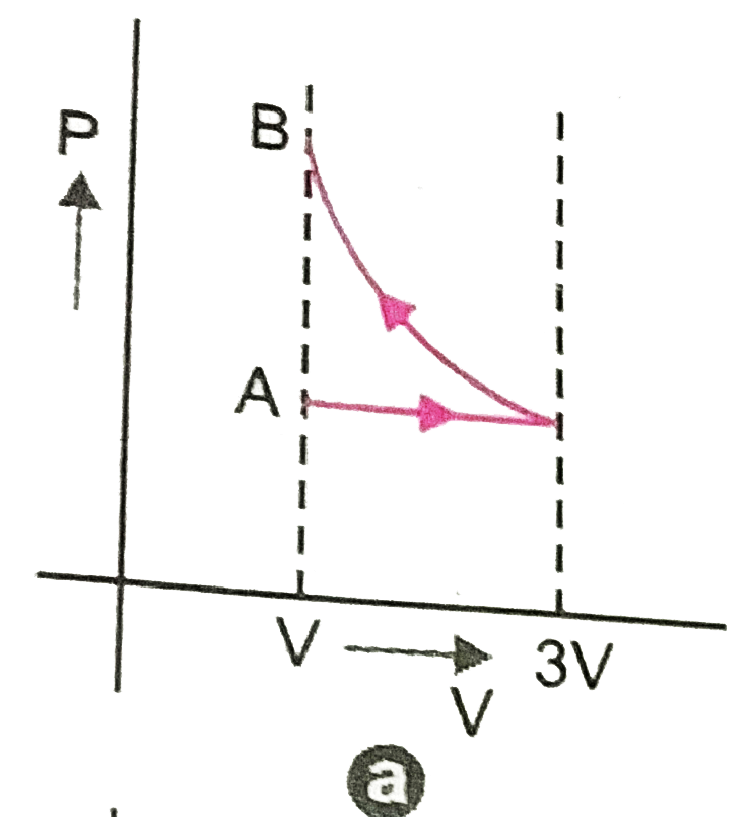
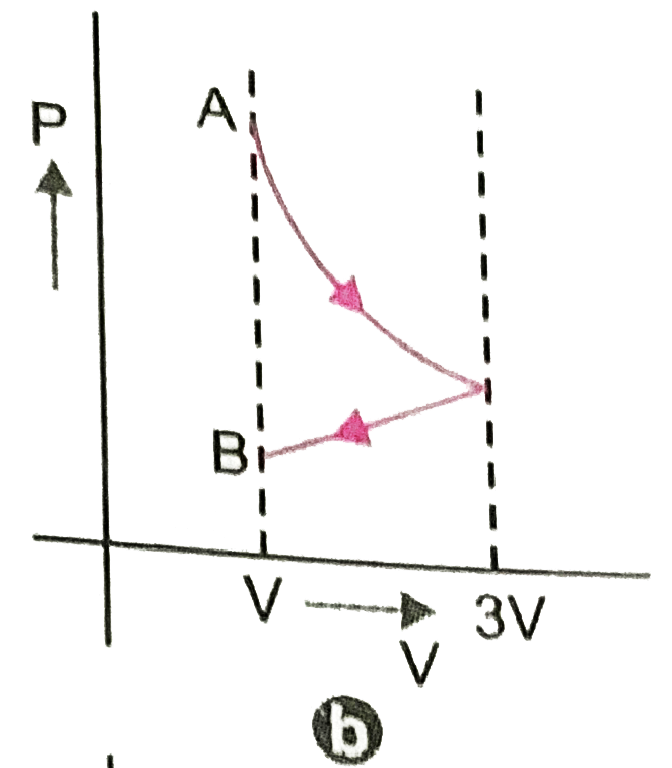
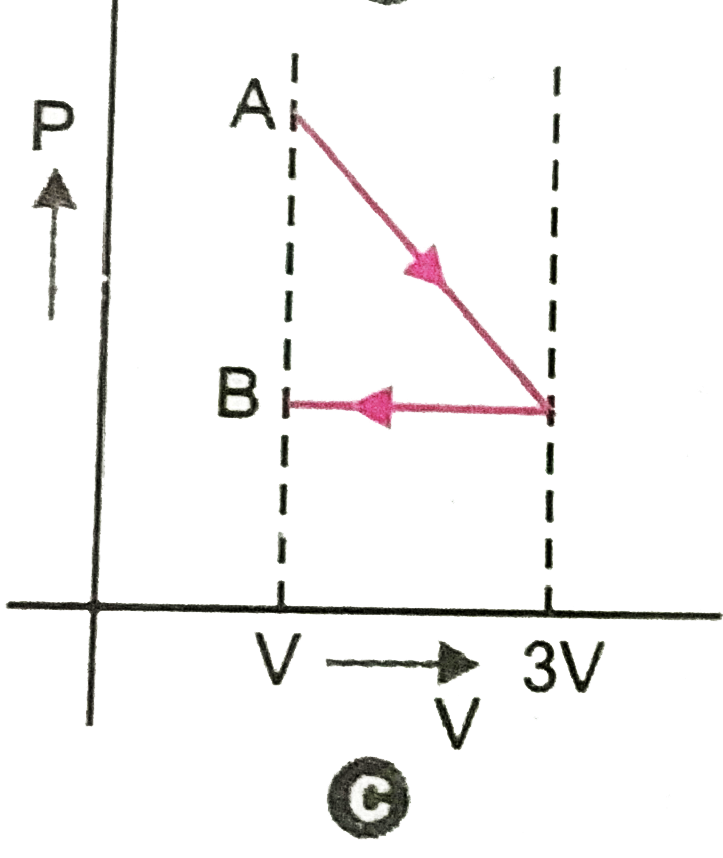
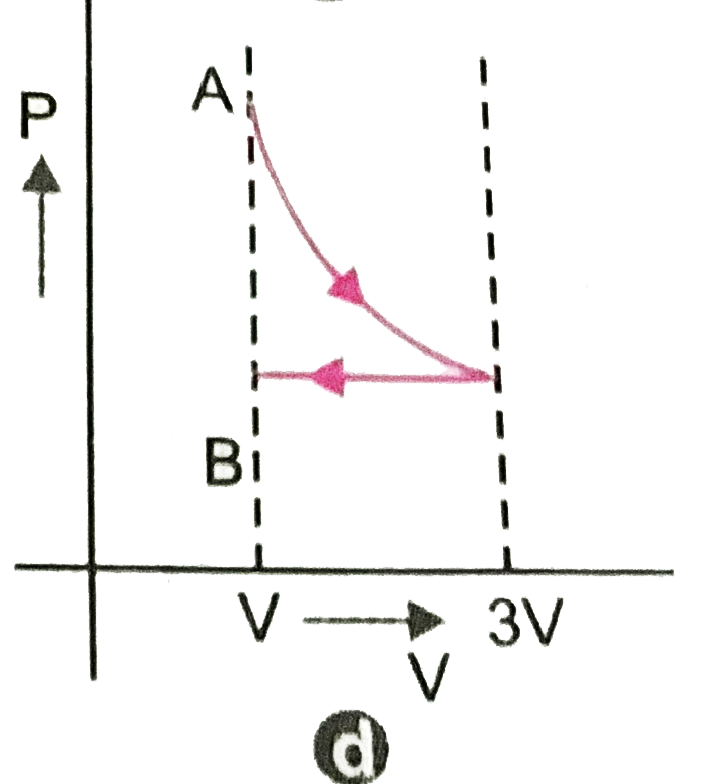
One mole of an ideal gas goes from an initial state A to final state B via two processs : It first undergoes isothermal expansion from volume `V` to `3 V` and then its volume is reduced from `3 V` to `V` at constant pressure. The correct `P-V` diagram representing the two process in (figure)

A

B

C

D

Text Solution

AI Generated Solution

The correct Answer is:

To solve the problem, we need to analyze the two processes that the ideal gas undergoes and how they are represented on a P-V diagram. ### Step-by-Step Solution: 1. **Identify the Initial and Final States**: - The initial state (A) is at volume \( V \) and some pressure \( P_A \). - The final state (B) is at volume \( V \) after undergoing two processes. 2. **Process 1: Isothermal Expansion**: - The gas undergoes isothermal expansion from volume \( V \) to \( 3V \). - During an isothermal process, the temperature remains constant, and we can use the ideal gas law \( PV = nRT \). Since \( n \) and \( R \) are constants, \( P \) is inversely proportional to \( V \). - As the volume increases from \( V \) to \( 3V \), the pressure decreases from \( P_A \) to \( P_B \) (where \( P_B \) is the pressure at volume \( 3V \)). - This process will be represented as a hyperbolic curve on the P-V diagram, moving from point A to point C. 3. **Process 2: Isobaric Compression**: - After reaching volume \( 3V \), the gas is compressed back to volume \( V \) at constant pressure. - Since the pressure remains constant during this process, the line on the P-V diagram will be horizontal. - This process will move from point C to point B. 4. **Combine the Two Processes**: - The complete path from A to B on the P-V diagram consists of: - A downward curve from A to C (isothermal expansion). - A horizontal line from C to B (isobaric compression). 5. **Identify the Correct P-V Diagram**: - Among the given options, we need to identify the one that shows a downward curve followed by a horizontal line. - The correct option will be the one that represents the isothermal expansion followed by the isobaric compression. ### Conclusion: The correct P-V diagram representing the two processes is option D, which shows the isothermal expansion from \( V \) to \( 3V \) followed by isobaric compression from \( 3V \) back to \( V \).

To solve the problem, we need to analyze the two processes that the ideal gas undergoes and how they are represented on a P-V diagram. ### Step-by-Step Solution: 1. **Identify the Initial and Final States**: - The initial state (A) is at volume \( V \) and some pressure \( P_A \). - The final state (B) is at volume \( V \) after undergoing two processes. ...
Promotional Banner

Topper's Solved these Questions

  • THERMODYNAMICS

    PRADEEP|Exercise Interger Type questions|11 Videos
  • THERMODYNAMICS

    PRADEEP|Exercise Assertion- Reason Type Questions|19 Videos
  • THERMODYNAMICS

    PRADEEP|Exercise Multiple choice questions (NCERT)|10 Videos
  • SYSTEMS OF PARTICLES AND ROTATIONAL MOTION

    PRADEEP|Exercise Assertion- Reason Type questions|20 Videos
  • WORK, ENERGY AND POWER

    PRADEEP|Exercise Assertion-Reason Type Questions|24 Videos

Similar Questions

Explore conceptually related problems

A gas at initial temperature T undergoes sudden expansion from volume V to 2V. Then -

P - V diagram of an ideal gas is shown. The gas undergoes from initial state A to final state B such that initial and final volumes are same. Select the correct alternative for given process AB.

The initial state of certain gas (P_(i)V_(i)T_(i)) .It undergoes expansion till its volume becomes V_(f) at constant temperature T. The correct plot of P-V diagram for it is

Two moles of an ideal gas have an initial kelvin temperature T_i and absolute pressure P_i the gas undergoes a reversible isothermal compression from an initial volume V_i to a final volume 0.5 V_i How much heat is exchanged with the environment? If heat is exchanged, is it absorbed or released?

n mole a perfect gas undergoes a cyclic process ABCA (see figure) consisting of the following processes. A to B : Isothermal expansion at temperature T so that the volume is doubled from V_1 to V_2 = 2V_1 and pressure changes from P_1 to P_2 B to C : Isobaric compression at pressure P_2 to initial volume V_1 C to A : Isochoric change leading to change of pressure from P_2 to P_1 . Total work done in the complete cycle ABCA is :

If n moles of an ideal gas are expanded is isothermally and reversibly from an initial state in which it has pressure p_(1) and volume V_(1) to the final state of volume V_(2) and pressure P_(2) , then

One mole of a monatomic ideal gas has an initial pressure, volume, and temperature of P_0 , V_0 , and 438 K, respectively. It undergoes an isothermal expansion that triples the volume of the gas. Then, the gas undergoes an isobaric compression back to its original volume. Finally, the gas undergoes an isochoric increase in pressure, so that the final pressure, volume, and temperature are p_0 V_0 and 438 K, respectively. Find the total heat for this three-step process, and state whether it is absorbed by or given off by the gas.

PRADEEP-THERMODYNAMICS-Multiple choice questions.
  1. Two moles of ideal helium gas are in a rubber balloon at 30^@C. The ba...

    Text Solution

    |

  2. Helium gas goes through a cycle ABCDA (consisting of two isochoric and...

    Text Solution

    |

  3. One mole of an ideal gas goes from an initial state A to final state B...

    Text Solution

    |

  4. An ideal gas goes from State A to state B via three different process ...

    Text Solution

    |

  5. During an adiabatic process, the pressure of a gas is found to be prop...

    Text Solution

    |

  6. The amount of heat energy required to raise the temperature of 1 g of ...

    Text Solution

    |

  7. A gas is taken through the cycle A rarrB rarr C rarr A, as shown in fi...

    Text Solution

    |

  8. Steam at 100^(@)C is passed into 20 g of water at 10^(@)C when water a...

    Text Solution

    |

  9. A body at a temperature of 727^(@)C and having surface area 5 cm^(2), ...

    Text Solution

    |

  10. A black body emit heat at the rate of 20 W, when its tempertaure is 22...

    Text Solution

    |

  11. According to Wien's law

    Text Solution

    |

  12. On observing light from three different stars P, Q and R, it was found...

    Text Solution

    |

  13. In (figure). shows two path that may be taken by a gas to go from a st...

    Text Solution

    |

  14. The two ends of a metal rod are maintained at temperature 100^(@)C and...

    Text Solution

    |

  15. An ideal gas is compressed to half its initial volume by means of seve...

    Text Solution

    |

  16. The value of coefficient of volume expansion of glycerin is 5 xx 10^(-...

    Text Solution

    |

  17. The balck body specturm of an object O(1) is such that its radiant int...

    Text Solution

    |

  18. Three rods of Copper, Brass and Steel are welded together to from a Y ...

    Text Solution

    |

  19. A solid body of constant heat capacity 1J//^@C is being heated by keep...

    Text Solution

    |

  20. A gas is compressed isothermally to half its initial volume. The same ...

    Text Solution

    |
