Home
Class 11
PHYSICS
Three rods of Copper, Brass and Steel ar...

Three rods of Copper, Brass and Steel are welded together to from a Y shaped structure. Area of cross-section of each rod `=4cm^2`. End of copper rod is maintained at `100^@C` where as ends of brass and steel are kept at `0^@C`. Lengths of the copper, brass and steel rods are 46, 13 and 12 cm respectively. The rods are thermally insulated from surroundings excepts at ends. Thermal conductivities of copper, brass and steel are 0.92, 0.26 and 0.12 CGS units respectively. Rate of heat flow through copper rod is :

A

`4.8 cal//s`

B

`6.0 cal//s`

C

`1.2 cal//s`

D

`2.4 cal//s`

Text Solution

Verified by Experts

The correct Answer is:
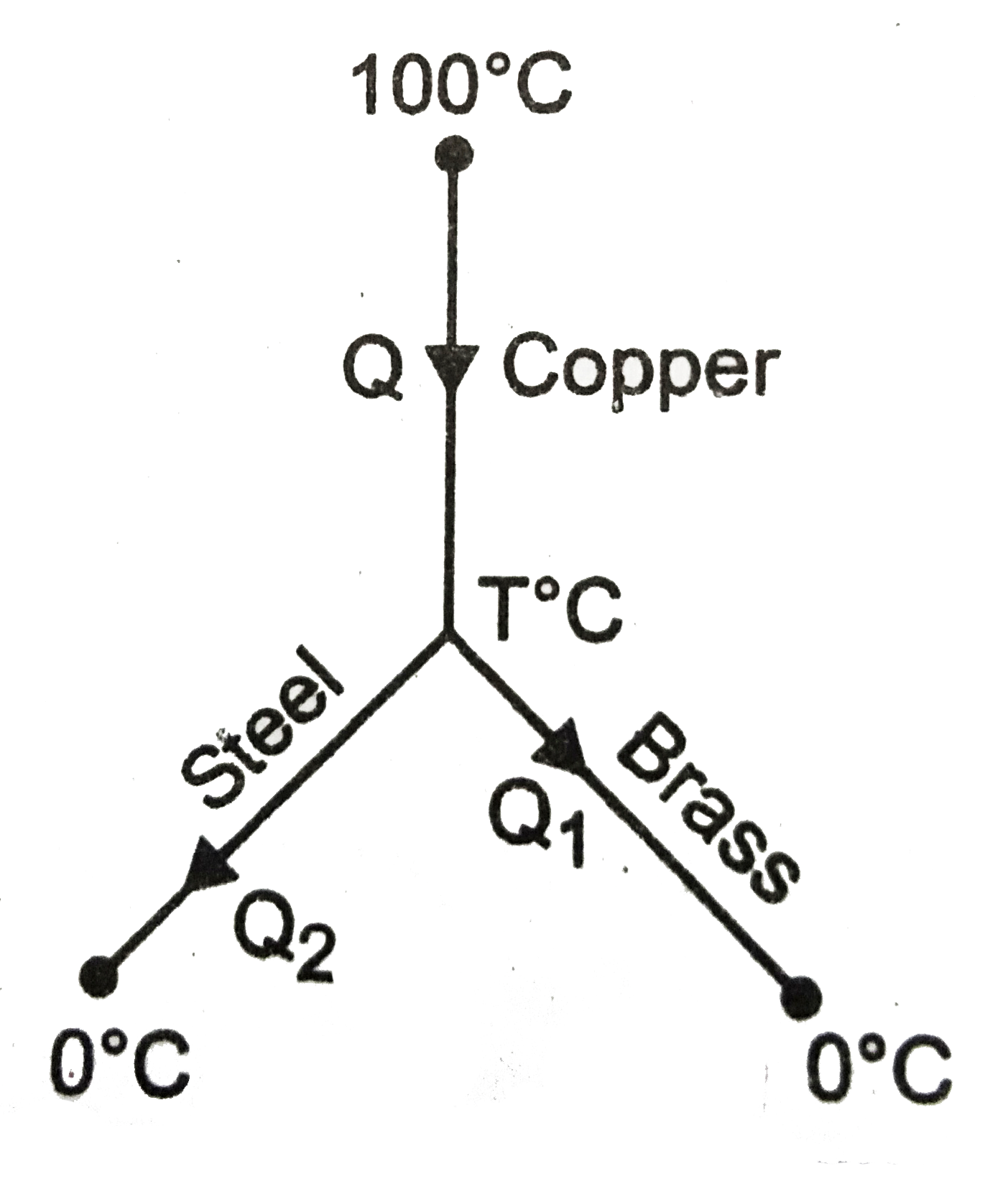
A

Here,

`Q= Q_(1)+Q_(2)`
`(0.92xx4xx(100-T))/(46)=(0.26xx4(T-0))/(13)+(0.12xx4xxT)/(12)`
On solving, `T=40^(@)C`
`:. Q=(0.92xx4xx60)/(46)= 4.8 cal//s`
Promotional Banner

Topper's Solved these Questions

  • THERMODYNAMICS

    PRADEEP|Exercise Interger Type questions|11 Videos
  • THERMODYNAMICS

    PRADEEP|Exercise Assertion- Reason Type Questions|19 Videos
  • THERMODYNAMICS

    PRADEEP|Exercise Multiple choice questions (NCERT)|10 Videos
  • SYSTEMS OF PARTICLES AND ROTATIONAL MOTION

    PRADEEP|Exercise Assertion- Reason Type questions|20 Videos
  • WORK, ENERGY AND POWER

    PRADEEP|Exercise Assertion-Reason Type Questions|24 Videos

Similar Questions

Explore conceptually related problems

Three rods of copper, brass and steel are welded togeher to from a Y -shaped structure. Area of cross-section of each rod =4 cm^(2) . End of copper rod is maintained at 100^(@)C whereas the ends of brass and steel are at 0^(@)C . Lengths of copper, brass and steel rods are 46, 13 and 12 cm respectively. The rods are thermally insulated from surroundings except at ends. Thermal conductivities of copper, brass and steel are 0.92, 0.26 and 0.12 CGS units respectively. Rate of heat flow through copper rod is

Three rods of Copper Branss and Steel are welded together to form a Y-shaped structure Area of cross -section of each rod is 4cm^(-2) End of copper rod is maintained at 100^(@)C , where as ends of brass, steel are kept at 0^(@)C Lenths of the copper brass and steel rods are 46,13 andd 12cms respectively The rods are thermally insulated from surroundings except at ends Thermal conductivities of copper, brass and steel are 0.92,0.26 and 0.12 CGS units respectively Rate of heat flow through coper rod is .

Three rods of copper, brass and steel are welded together to form a Y -shaped structure. The cross-sectional area of each rod is 4 cm^2 . The end of copper rod is maintained at 100^@C and the ends of the brass and steel rods at 80^@C and 60^@C respectively. Assume that there is no loss of heat from the surfaces of the rods. The lengths of rods are : copper 46 cm, brass 13 cm and steel 12 cm. (a) What is the temperature of the junction point? (b) What is the heat current in the copper rod? K(copper) = 0.92, K (steel) = 0.12 and K(brass) = 0.26 cal//cm-s^@C .

Three rods of copper, brass and steel are joined together to form T shape as shown in figure. The cross sectional area of each rod is 4cm^(2) the end of copper rod is maintained at 10^(@)C and the ends of brass and steel rods at 0^(@)C assume there is no loss of heat to surrounding. What is temperature of junction point A in .^(@)C

Coefficient of linear expansion of brass and steel rods are alpha_(1) and alpha_(2) . Length of brass and steel rods are l_(1) and l_(2) respectively. If (l_(2) - l_(1)) is maintained same at all temperature, which one of the following relations holds good?

The ends of a copper rod of length 1m and area of cross-section 1cm^2 are maintained at 0^@C and 100^@C . At the centre of the rod there is a source of heat of power 25 W. Calculate the temperature gradient in the two halves of the rod in steady state. Thermal conductivity of copper is 400 Wm^-1 K^-1 .

The temperature of hot and cold end of a 20 cm long rod in thermal steady state are at 100^(@)C and 20^(@)C respectively. Temperature at the centre of the rod is

Cylinder copper rod of length 1m and a cylinder steel rod of length 1.5m are joined together end to end. The cross sectional area of eac rod is 3.14cm . The free ends of steel rod and copper rods are maintained at 0^(@)C and 100^(@)C respectively. The surfaces of rods are thermally insulated. Find the temperature of copper steel junction. (Given thermal conductivity of steel =46J//m-s.^(@)C and the thermal conductivity of copper =386J//m-s.^(@)C )

Two rods of copper and brass having the same length and cross - section are joined end to end. The free end of the copper is at 0^(@)C and of brass is at 80^(@)C in steady-state. If thermal conductivity of copper is 4 times of that of brass find the temp. at junction of two rods

PRADEEP-THERMODYNAMICS-Multiple choice questions.
  1. The value of coefficient of volume expansion of glycerin is 5 xx 10^(-...

    Text Solution

    |

  2. The balck body specturm of an object O(1) is such that its radiant int...

    Text Solution

    |

  3. Three rods of Copper, Brass and Steel are welded together to from a Y ...

    Text Solution

    |

  4. A solid body of constant heat capacity 1J//^@C is being heated by keep...

    Text Solution

    |

  5. A gas is compressed isothermally to half its initial volume. The same ...

    Text Solution

    |

  6. n' moles of an ideal gas undergoes a process AtoB as shown in the figu...

    Text Solution

    |

  7. In a given process on an ideal gas, dW=0 and dQlt0. Then for the gas

    Text Solution

    |

  8. When a system is taken from state i to state f along the path iaf, it ...

    Text Solution

    |

  9. In (figure). shows two path that may be taken by a gas to go from a st...

    Text Solution

    |

  10. How much heat energy should be added to a mixture of 10 g of hydrogen...

    Text Solution

    |

  11. If C(p) and C(v) denote the specific heats (per unit mass of an ideal ...

    Text Solution

    |

  12. An ideal gas under goes a quasi static, reversible process in which it...

    Text Solution

    |

  13. A Carnot engine, having an efficiency of eta=1//10 as heat engine, is ...

    Text Solution

    |

  14. The temperature T(1) and T(2) of heat reservoirs in the ideal carnot e...

    Text Solution

    |

  15. A Carnot engine, having an efficiency of eta=1//10 as heat engine, is ...

    Text Solution

    |

  16. Certain quantity of water cools from 70^(@)C to 60^(@)C in the first 5...

    Text Solution

    |

  17. The cofficient of performance of a refrigerator is 5. If the temperatu...

    Text Solution

    |

  18. A refrigerator works between 4^(@)C and 30^(@)C. It is required to rem...

    Text Solution

    |

  19. A carnot engine working between 300 K and 600 K has work output of 800...

    Text Solution

    |

  20. A Carnot engine takes 3xx10^6cal. of heat from a reservoir at 62^@C, a...

    Text Solution

    |

