Home
Class 11
PHYSICS
When a system is taken from state i to s...

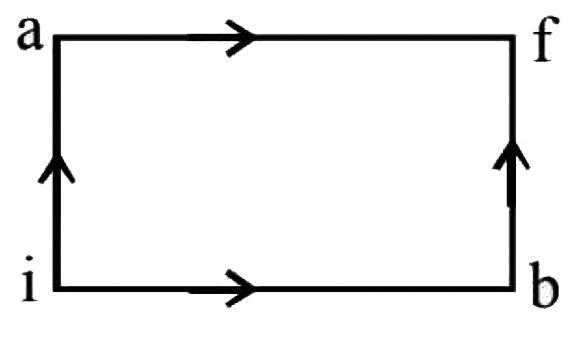
When a system is taken from state i to state f along the path iaf, it is found that `Q=50 cal and W=20 cal`. Along the path ibf `Q=36cal`. W along the path ibf is

A

`14 cal.`

B

`6 cal.`

C

`16 cal.`

D

`66 cal.`

Text Solution

Verified by Experts

The correct Answer is:

B

Along the path `iaf`,
Increase in internal energy,
`U_(1)=Q_(1)-W_(1)= 50-20= 30Cal.`
Along the path `ibf`
Increase in inernal energy,
`U_(2)=Q_(2)-W_(2)`
`U_(2)= 36-W`
As `U_(2)=U_(1) :. 36-W= 30`
`W= 36-30= 6 Cal`
Promotional Banner

Topper's Solved these Questions

  • THERMODYNAMICS

    PRADEEP|Exercise Interger Type questions|11 Videos
  • THERMODYNAMICS

    PRADEEP|Exercise Assertion- Reason Type Questions|19 Videos
  • THERMODYNAMICS

    PRADEEP|Exercise Multiple choice questions (NCERT)|10 Videos
  • SYSTEMS OF PARTICLES AND ROTATIONAL MOTION

    PRADEEP|Exercise Assertion- Reason Type questions|20 Videos
  • WORK, ENERGY AND POWER

    PRADEEP|Exercise Assertion-Reason Type Questions|24 Videos

Similar Questions

Explore conceptually related problems

When a system is taken from state i to state f alone the path iaf, it is found that Q=50 cal and W=20 cal. Along the path ibf, Q=36 cal (figure) (a) What is W along the path ibf ? (b) If W=-13 cal for the curved return path f i , what is Q for this path ? (c) Take U_(i)=10 cal. What is U_(f) ? (d) If U_(b)=22 cal, what is Q for the process in and for the process bf ?

When a system is taken from state I to state f along path iaf in fig - 21.23 Q = 100 cal and W = 40 cal Along path ibf Q = 72 cal . (a) what is W along path ibf ?

When a system is taken from a state i to a state f in Figure, along the path iaf , we find DeltaQ=50cal and DeltaW=20cal while during the path ibf , DeltaQ=36cal . If U_i=10cal . (a) What is U? What is W along the path ibf ? (c ) If W=-13cal , along the curved path fi , what is DeltaQ for this path? (d) If U_b=22cal , what is DeltaQ for the process ib ? for bf ?

When a system is taken from state 1 to 2 along the path 1 a 2 it absorbs 50 cal of heat and work done is 20 cal . Along tha path 1 b 2 . Q = 36 cal . What is the work done along 1 b 2 ?

When a system is taken from state 'a' to state 'b' along the path 'acb', it is found that a quantity of heat Q = 200 J is absorbed by the system and a work W = 80 J is done by it. Along the path 'adb', Q = 144 J In the above question, if U_(d)=88J , heat absorbed for the path 'db' is

When a system is taken from state 'a' to state 'b' along the path 'acb', it is found that a quantity of heat Q = 200 J is absorbed by the system and a work W = 80 J is done by it. Along the path 'adb', Q = 144 J In above question, if U_(a)=40J , value of U_(b) will be

When a system is taken from state 'a' to state 'b' along the path 'acb', it is found that a quantity of heat Q = 200 J is absorbed by the system and a work W = 80 J is done by it. Along the path 'adb', Q = 144 J In the above question, if the work done on the system along the curved path 'ba' is 52J, heat absorbed is

When a system is taken from state f along path iaf, Q = 50 J and W = 20 J . Along path ibf, Q = 35 J . If W = -13 J for the curved return path f I, Q for this path is

When a system is taken from state 'a' to state 'b' along the path 'acd', is is found that a quantity of heat Q = 200J is absorbed by the system and a work W = 80 J is done by it. Along the path 'adb', Q = 144J . The work done along the path 'adb' is

PRADEEP-THERMODYNAMICS-Multiple choice questions.
  1. n' moles of an ideal gas undergoes a process AtoB as shown in the figu...

    Text Solution

    |

  2. In a given process on an ideal gas, dW=0 and dQlt0. Then for the gas

    Text Solution

    |

  3. When a system is taken from state i to state f along the path iaf, it ...

    Text Solution

    |

  4. In (figure). shows two path that may be taken by a gas to go from a st...

    Text Solution

    |

  5. How much heat energy should be added to a mixture of 10 g of hydrogen...

    Text Solution

    |

  6. If C(p) and C(v) denote the specific heats (per unit mass of an ideal ...

    Text Solution

    |

  7. An ideal gas under goes a quasi static, reversible process in which it...

    Text Solution

    |

  8. A Carnot engine, having an efficiency of eta=1//10 as heat engine, is ...

    Text Solution

    |

  9. The temperature T(1) and T(2) of heat reservoirs in the ideal carnot e...

    Text Solution

    |

  10. A Carnot engine, having an efficiency of eta=1//10 as heat engine, is ...

    Text Solution

    |

  11. Certain quantity of water cools from 70^(@)C to 60^(@)C in the first 5...

    Text Solution

    |

  12. The cofficient of performance of a refrigerator is 5. If the temperatu...

    Text Solution

    |

  13. A refrigerator works between 4^(@)C and 30^(@)C. It is required to rem...

    Text Solution

    |

  14. A carnot engine working between 300 K and 600 K has work output of 800...

    Text Solution

    |

  15. A Carnot engine takes 3xx10^6cal. of heat from a reservoir at 62^@C, a...

    Text Solution

    |

  16. The door of a running refrigerator inside a room is left open. The cor...

    Text Solution

    |

  17. A cannot engine has efficiency (1)/(6). If temperature of sink is decr...

    Text Solution

    |

  18. An ideal gas heat engine operates in Carnot cycle between 227^(@)C and...

    Text Solution

    |

  19. A Carnot engine whose sinl is at 300K has an efficiency of 40%. By how...

    Text Solution

    |

  20. A cannot engine has efficiency (1)/(6). If temperature of sink is decr...

    Text Solution

    |
