Home
Class 11
PHYSICS
Consider a rectangular block of wood mo...

Consider a rectangular block of wood moving with a velocity `v_(0)` in a gas at temperature T and mass density p. Assume the velocity is along x-axis and the are of cross-section of the block perpendicular to `v_(0)` is A. show that the drag force on the block is `4rAv_(0)sqrt((kT)/(m))` where,m is the mass of the gas molecule.

Text Solution

Verified by Experts
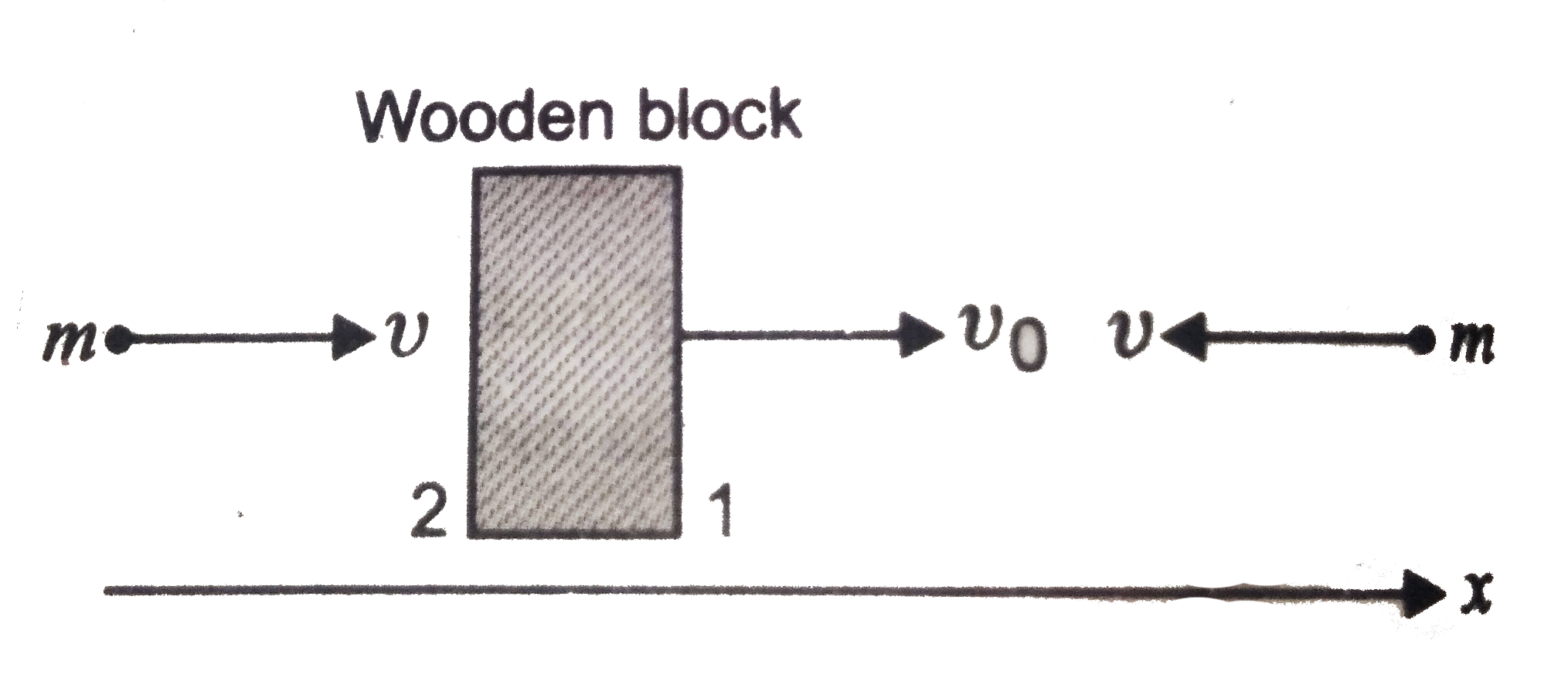
In fig., we have shown a rantangular wooden block of cross sectional area A moving with velocity `upsilon_(0)` along X-axis. m is mass of gas molecules moving with velocity `upsilon` along X-axis.
Number of collisions//sec = collision frequency
`f =1/2 ` (surface area `xx` velocity `xx` number of molecules//vol.)
`1/2 A (upsilon+upsilon_(0))xxn` (The factor 1/2 is due to molecules moving away from the block )
Momentum transferred by a molicule during one collision with face `1 = 2 m(upsilon+upsilon_(0))`
`:.` Total force acting on face 1 of block
`F_(1) = 2m(upsilon+upsilon_(0)) xx f = 2m (upsilon+upsilon_(0)) 1/2 A(upsilon+upsilon_(0)) xxn`
`= rho A(upsilon+upsilon_(0))^(2)`
similary, force acting on face 2 of block, `F_(2) =rho A (upsilon+upsilon_(0))^(2)`
Where `(upsilon+upsilon_(0))` is relative speed of molecules w.r.t. face 2 of block
`:.` net force acting on the block (i.e., drag force),
`F =F_(1)-F_(2) = rho A(upsilon+upsilon_(0))^(2) - rho A (upsilon+upsilon_(0))^(2) = rho A (4upsilon upsilon_(0)) = 4 rho A upsilon_(0) upsilon` ...(i)
As motion is along X-axis only, therefore, from law of equipartition of energy
`1/2 m upsilon^(2) = 1/2 k_(B)T` or `upsilon = sqrt((k_(B)T)/(m))`
Putting in (i) we get ` F =4 rho A upsilon_(0)sqrt((k_(B)T)/(m))`.
Promotional Banner

Similar Questions

Explore conceptually related problems

A rectangular block of size (bbxxh) moving with velocity v_(0) enters on a rough surface where the coefficient of friction is mu as shown in figure. Identify the correct statement.

A bullet of mass m moving with velocity v strikes a suspended wooden block of mass M . If the block rises to a height h , the initial velocity of the block will be (

A block of mass m moving with a velocity v_(0) collides with a stationary block of mass M to which a spring of stiffness k is attached, as shown in Fig. Choose the correct alternative(s)

In the fig 4.24 a block of mass m moves with velocity v_(0) toward a stationaly block of a mass M on a smooth horizontal surface. Find the maximum compression in the spring of stiffnesss constant K.

A bullet of mass m moving with velocity v strikes a block of mass M at rest and gets embedded into it. The kinetic energy of the composite block will be

A block of mass m moving with velocity v_(0) on a smooth horizontal surface hits the spring of constant k as shown. Two maximum compression in spring is

A block of mass m moving with a velocity v_(0) on a rough horizontal surface from x=0 coefficient of friction is given by mu=mu_(0)=ax . Find the kinetic energy of the block as function of x before it comes to rest.

