Home
Class 11
PHYSICS
A moles of a monoatomic ideal gas are at...

A moles of a monoatomic ideal gas are at pressure `3xx10^(5)Nm^(-2)` and temperature 100K (state A, say). Is is head heated isobarically to temperature 400K (state B, say). Next it undergoes isothermal expansion to pressure `1 xx 10^(5) Nm^(-2)` (state C). It is then cooled isobarically to 100 K (state D). Finally, it is compressed isothermal to returm to its initial state A. Draw P-T : P-V and V-T diagrams for the whole process.

Text Solution

Verified by Experts
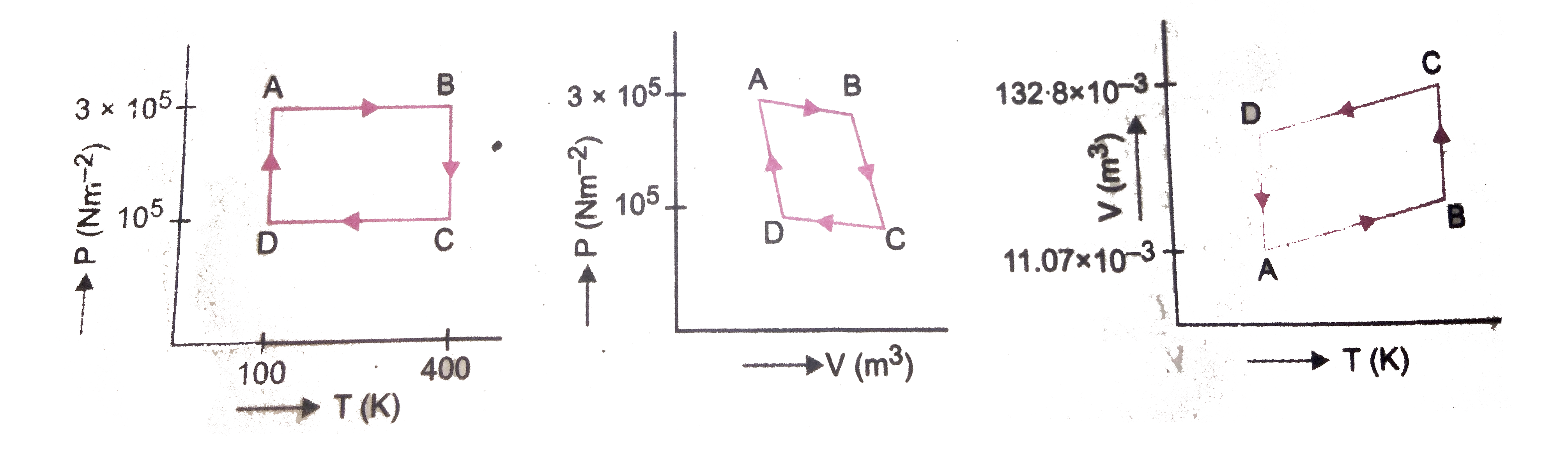
Here `mu = 4`
At state `A, P= 3 xx 10^(5)Nm^(-2), T = 100 K`
Using `PV = mu RT`
`V = (mu RT)/(P) = (4 xx 8.3 xx 100)/(3 xx 10^(5)) = 11.07 xx 10^(-3)m^(3)`
This is the volume of gas at A.
In going from state B to state C,
Process is isothermal i.e., `T = consta nt = 400K`
At `C, P = 1 xx 10^(5)Nm^(-2)`
`:.` Volume of gas at state C,
`V = (mu RT)/(P) = (4 xx 8.3 xx400)/(1 xx 10^(5)) = 132.8 xx 10^(-3)m^(3)`
In going from state C to D the pressure is isobaric
`:. P = 1 xx 10^(5) Nm^(-2) , T = 100K`
`:.` Volume of gas at state D,
`V = (mu RT)/(P) = (4 xx 8.3 xx 100)/(1 xx 10^(5)) = 33.2 xx 10^(-3)m^(3)`
Promotional Banner

Topper's Solved these Questions

  • BEHAVIOUR OF PERFECT GAS & KINETIC THEORY

    PRADEEP|Exercise Value Based Questions|15 Videos
  • BEHAVIOUR OF PERFECT GAS & KINETIC THEORY

    PRADEEP|Exercise Fill in the blanks|10 Videos
  • BEHAVIOUR OF PERFECT GAS & KINETIC THEORY

    PRADEEP|Exercise NCERT questions|13 Videos
  • GRAVIATION

    PRADEEP|Exercise Assertion-Reason Type Questions|19 Videos

Similar Questions

Explore conceptually related problems

An ideal monatomic gas expands isobarically from state A to state B. It is then compressed isothermally from state B to state C and finally cooled at constant volume until it returns to its initial state A. What is the temperature of the gas when it is in state B?

An ideal monatomic gas expands isobarically from state A to state B. It is then compressed isothermally from state B to state C and finally cooled at constant volume until it returns to its initial state A. How much work is done by the gas in expanding isobarically from A to B?

An ideal monatomic gas expands isobarically from state A to state B. It is then compressed isothermally from state B to state C and finally cooled at constant volume until it returns to its initial state A. How much work is done on the gas in going from B to C?

n moles of an ideal mono atomic gas is initially at pressure 32 P_(0) and volume V_(0) . Its volume is doubled by an isobaric process. After this the gas is adiabatically expanded so as to make its volume 16V_(0) . Now the gas is isobarically expanded. Finally, the gas is made to return to its initial state by an isothermal process. (a) Represent the process on a P–V diagram. (b) Calculate work done by the gas in one cycle.

One mole of a monatomic ideal gas has an initial pressure, volume, and temperature of P_0 , V_0 , and 438 K, respectively. It undergoes an isothermal expansion that triples the volume of the gas. Then, the gas undergoes an isobaric compression back to its original volume. Finally, the gas undergoes an isochoric increase in pressure, so that the final pressure, volume, and temperature are p_0 V_0 and 438 K, respectively. Find the total heat for this three-step process, and state whether it is absorbed by or given off by the gas.

An ideal gas at pressure 4 xx 10^(5)Pa and temperature 400K occupies 100cc . It is adiabatically expanded to double of its original volume. Calculate (a) the final pressure (b) final temperature and (c ) work done by the gas in the process (gamma = 1.5)

An ideal gas undergoes isothermal process from some initial state i to final state f . Choose the correct alternatives.

The volume occupied by 2 mole of an ideal gas at 3 xx 10^(5) Nm^(-2) pressure and 300 K temperature ( R = 8.314 J K^(-1) mol^(-1)) is

I mole of an ideal monoatomic gas is expanded till the temperature of the gas is doubled under the process V^(2)T=contant . The initial temperature of the gas is 400K . In terms of R find total work done in the process.

Four moles of an ideal gas is initially in state A having pressure 2 xx 10^(5) N//m^(2) and temperature 200 K . Keeping the pressure constant the gas is taken to state B at temperature of 400K . The gas is then taken to a state C in such a way that its temperature increases and volume decreases. Also from B to C , the magnitude of dT//dV increases. The volume of gas at state C is eqaul to its volume at statem A . Now gas is taken to initial state A keeping volume constant. A total 1000 J of heat is withdrawn from the sample of the cyclic process . Take R=8.3 J// K// mol . The volume of gas at state C is

