Home
Class 11
PHYSICS
A trolley of mass 3.0 kg is connected to...

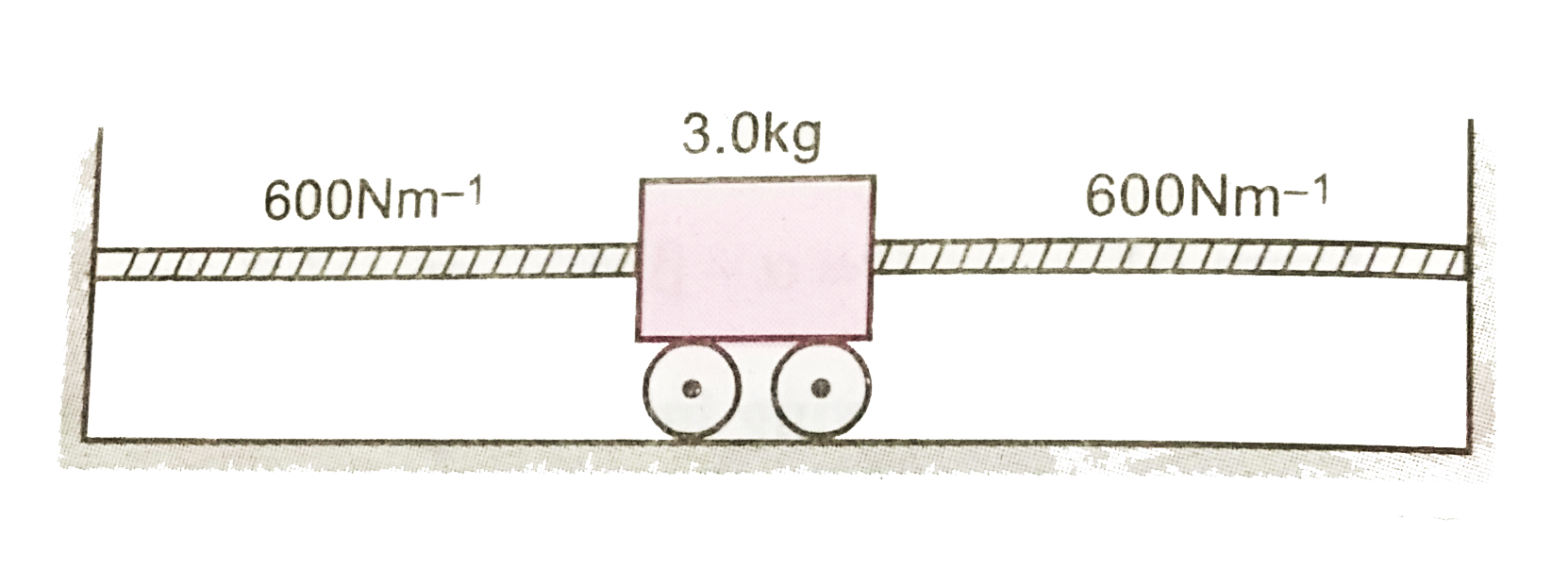
A trolley of mass 3.0 kg is connected to two identical rubber bands each of force constant `600Nm^(-1)` as shown in figure. If the trolley is displaced from an equilibrium position by 5.0 cm and released, what is the period of ensuing oscillations?

Text Solution

Verified by Experts

When the trolley is displaced a little to one side, one rubber band gets stretched and provides restoring force whereas othe rband becomes slag and provides no restoring force. Thus the effective restoring force in this case is due to one rubber band.
Hence, force constant, `k=600Nm^(-1) :. T=2pisqrt((m)/(k))=2pisqrt((3)/(600))=0.45s`
Promotional Banner

Topper's Solved these Questions

  • OSCILLATIONS AND WAVES

    PRADEEP|Exercise Value Based Questions|5 Videos
  • OSCILLATIONS AND WAVES

    PRADEEP|Exercise Multiple Choice Question|20 Videos
  • OSCILLATIONS AND WAVES

    PRADEEP|Exercise NCERT CHAPTER|26 Videos
  • MATHEMATICAL TOOLS

    PRADEEP|Exercise Fill in the blanks|5 Videos
  • PHYSICAL WORLD AND MEASUREMENT

    PRADEEP|Exercise Competiton Focus Jee Medical Entrance|18 Videos

Similar Questions

Explore conceptually related problems

A tolley of mass 3.0kg is connected to two identical spring each of force constant 600Nm^(-1) as shown in figure. If the trolley is displaced from its equilibrium position by 5.0 cm and released, what is (a) the period of ensuing oscillation? (b) the maximum speed of trolley? (c) How much is the total energy dissipated as heat by the time the trolley comes to rest due to damping forces?

A mass of 1.5 kg is connected to two identical springs each of force constant 300 Nm^(-1) as shown in the figure. If the mass is displaced from its equilibrium position by 10 cm, then maximu speed of the trolley is

A mass of 1.5 kg is connected to two identical springs each of force constant 300 Nm^(-1) as shown in the figure. If the mass is displaced from its equilibrium position by 10cm, then the period of oscillation is

A trolley of mass M is connected to two springs of force constant K_(1) and K_(2) as shown in the figure When the trolley is displacement from its equilibrium postion by a distance a and released , it executes S.H.M of frequency f. If it comes to rest after somtimes due to friction, the total energy dissipated as heat is (Dampling forces are weak)

A 2.5 kg collar attached to a spring of foce constant 1000 Nm^(-1) slides without friction on a horizontal rod. The collar is displaced from its equilibrium position by 5.0 cm and released. Calculate (i) the period of oscillation (ii) the maximum speed of the collar and (iii) the maximum acceleration of the collar.

A 5 kg collar is attached to a spring of spring constant 500 N m^(-1) . It slides without friction over a horizontal rod. The collar is displaced from its equilibrium position by 10 cm and released. The time period of oscillation is

A 10 kg metal block is attached to a spring constant 1000 Nm^(-1) . A block is displaced from equilibrium position by 10 cm and released. The maximum acceleration of the block is

A particle of mass 'm' is attached to three identical springs A,B and C each of force constant 'K' as shown in figure. If the particle of mass 'm' is pushed slightly against the spring 'A' and released the period of oscillations is

A block of mass m is connected with two ideal pullies and a massless spring of spring constant K as shown in figure. The block is slightly displaced from its equilibrium position. If the time period of oscillation is mupisqrt(m/K) . Then find the value of mu .
