Home
Class 11
PHYSICS
The vibrations of a string of length 60c...

The vibrations of a string of length `60cm` fixed at both ends are represented by the equation----------------------------
`y = 4 sin ((pix)/(15)) cos (96 pit)`
Where `x` and `y` are in `cm` and `t` in seconds.
(i) What is the maximum displacement of a point at `x = 5cm`?
(ii) Where are the nodes located along the string?
(iii) What is the velocity of the particle at `x = 7.5 cm` at `t = 0.25 sec`.?
(iv) Write down the equations of the component waves whose superpositions gives the above wave.

Text Solution

Verified by Experts
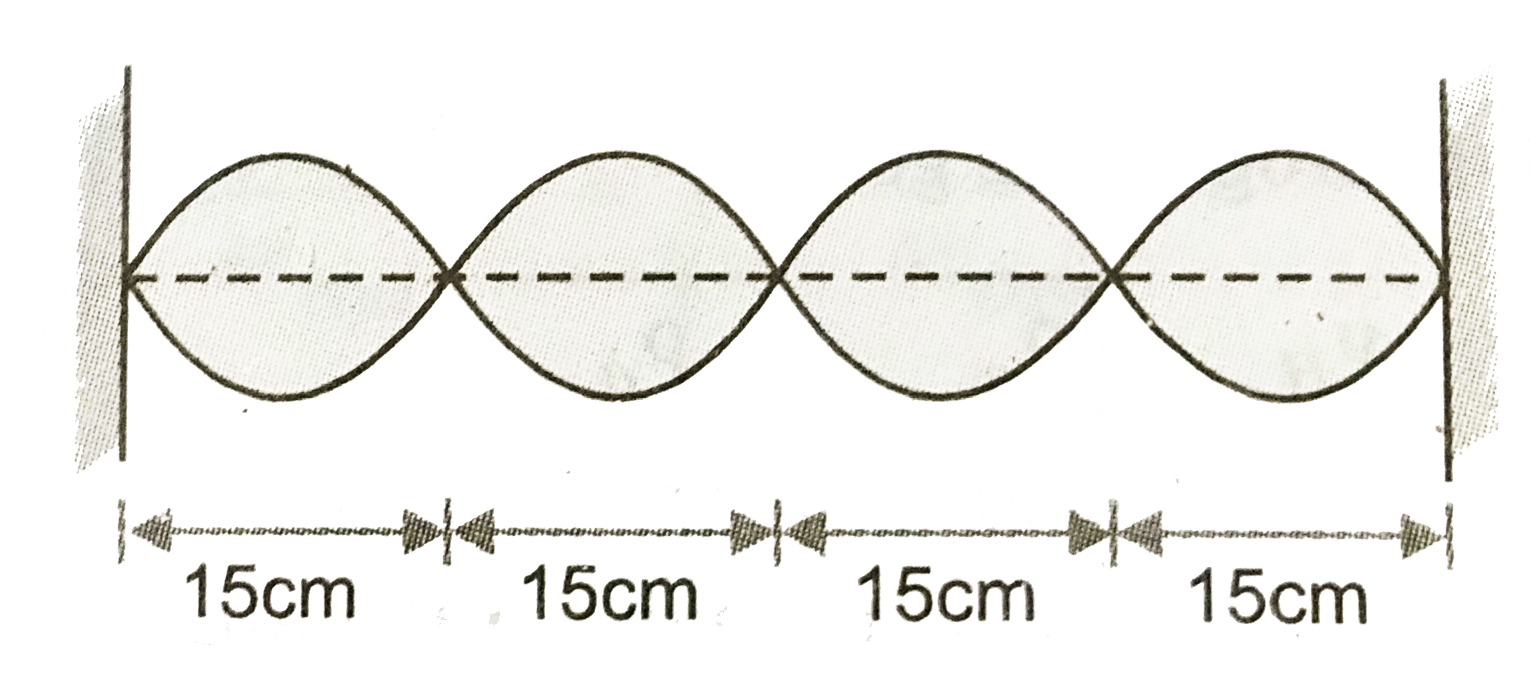
Compare the given eqn. With standard form of eqn. of stationary wave:
`y=2rsin((2pix)/(lambda))cos((2pi)/(T)t)`
we find `2r=4, r=2cm, (2pi)/(lambda)=(pi)/(15), lambda=30cm.`
Hence the string will vibrate in 4 segments, with each segment `=(lambda)/(2)=(30)/(2)=15cm` as shown in figure,
The nodes are at 0,15cm, 30cm, 45cm and 60cm as shown in figure
(ii) Velocity of particle
`upsilon=(dy)/(dt)=-4sin((pix)/(15))sin96pitxx96pi`
At `x=7.5 cm and t =0.25s`
`upsilon=-4xx96pisinpi//2sin(96pixx0.25)=Zero`
(iii) The component waves of the given stationary wave are
`y_(1)=2sin((pix)/(15)+96pit),` and
`y_(2)=2sin((pix)/(15)-96pit)`
Promotional Banner

Topper's Solved these Questions

  • OSCILLATIONS AND WAVES

    PRADEEP|Exercise Multiple Choice Question-I|21 Videos
  • OSCILLATIONS AND WAVES

    PRADEEP|Exercise Multiple Choice Question-II|14 Videos
  • OSCILLATIONS AND WAVES

    PRADEEP|Exercise Fill In The Blanks|20 Videos
  • MATHEMATICAL TOOLS

    PRADEEP|Exercise Fill in the blanks|5 Videos
  • PHYSICAL WORLD AND MEASUREMENT

    PRADEEP|Exercise Competiton Focus Jee Medical Entrance|18 Videos

Similar Questions

Explore conceptually related problems

The vibrations of a string of length 60 cm fixed at both ends are represented by the equation y=4sin((pix)/15) cos (96 pi t) , where x and y are in cm and t in seconds. (a)What is the maximum displacement of a point at x = 5cm ? (b)Where are the nodes located along the string? (c)What is the velocity of the particle at x=7.5cm and t=0.25s? (d)Write down the equations of the component waves whose superposition gives the above wave.

The vibrations of a string of length 600cm fixed at both ends are represented by the equation y=4 sin (pi (x)/(15)) cos (96 pi t ) where x and y are in cm and t in seconds.

The vibrations of a string of length 60 cm fixed at both ends are represented by the equation y=4 sin (pix//15) cos (96 pit) where x and y are in cm and t in seconds. The maximum displacement at x = 5 cm is–

The vibrations of a string of length 60 cm fixed at both the ends are represented by the equation y = 2 "sin"((4pix)/(15)) "cos" (96 pit) where x and y are in cm. The maximum number of loops that can be formed in it is

The vibrations of string of length 60 cm fixed at both ends are presented by the equations y = 4 sin ( pi x//15) cos ( 96 pi t) where x and y are in cm and t in s . The maximum displacement at x = 5 cm is

The vibration of a string of length 60cm fixed at both ends are represented by displacedment y=4sin ((pix)/(15)) cos (96pi) where x and y are in cm and t in second. The particle velocity at x=22.5 and t=0.25 is

The vibration of a string of length 60 cm is represented by the equation, y = 3 cos (pix//20) cos(72pit) where x & y are in cm and t in sec. (i) Write down the compoent waves whose superposition gives the above wave. (ii) Where are the nodes and antinodes located along the string. (iii) What is the velocity of the particle of the string at the position x = 5 cm & t = 0.25 sec.

The vibrations of a string fixed at both ends are represented by y=16sin((pix)/(15))cos(96pit) . Where 'x' and 'y' are in cm and 't' in seconds. Then the phase difference between the points at x=13cm and x=16 in radian is

PRADEEP-OSCILLATIONS AND WAVES-PROBLEMS FOR PRACTICE
  1. A displacement wave is represented by xi=0.25xx10^(-3)sin(500t-0.025...

    Text Solution

    |

  2. A simple harmonic travelling wave is represented by y=50sinpi(20t-0.08...

    Text Solution

    |

  3. The vibrations of a string of length 60cm fixed at both ends are repre...

    Text Solution

    |

  4. The consitutent waves of a stationary wave on a string fixed at two en...

    Text Solution

    |

  5. What are the three lowest frequencies for standing waves on a wire 10m...

    Text Solution

    |

  6. The standing waves are set up by the superimposition of two waves: y...

    Text Solution

    |

  7. The mass of 1m long steel wire is 20 g. The wire is stretched under a ...

    Text Solution

    |

  8. A string vibrates with a frequency of 200Hz. Its length iss doubled an...

    Text Solution

    |

  9. A metal wire of linear mass density of 9.8g//m is stretched with a ten...

    Text Solution

    |

  10. The length of a sonometer wire is 0.75m, and density 9xx10^(3)m. It ca...

    Text Solution

    |

  11. The fundamental frequency of a sonometer wire increases by 5Hz, if its...

    Text Solution

    |

  12. A sonometer wire is under a tension of 40N and the length between the ...

    Text Solution

    |

  13. Two wires of the same material are stretched with the same force. Thei...

    Text Solution

    |

  14. A guitar string is 90 cm long and has a fundamental frequency of 124 H...

    Text Solution

    |

  15. A 100 cm long wire of mass 40 g supports a mass of 1.6 kg as shown in...

    Text Solution

    |

  16. The speed of a transverse wave going on a wire having a length 50 cm ...

    Text Solution

    |

  17. An open pipe is suddenly closed at one end with the result that the fr...

    Text Solution

    |

  18. An open organ pipe has a fundamental frequency of 300 H(Z) . The first...

    Text Solution

    |

  19. A brass rod 1 metre long is firmly clampled in the middle and one end ...

    Text Solution

    |

  20. A resonance tube is resonated with tuning fork of frequency 512 Hz. Tw...

    Text Solution

    |

