
Home
Class 11
PHYSICS
A particle is in linear simple harmonic ...

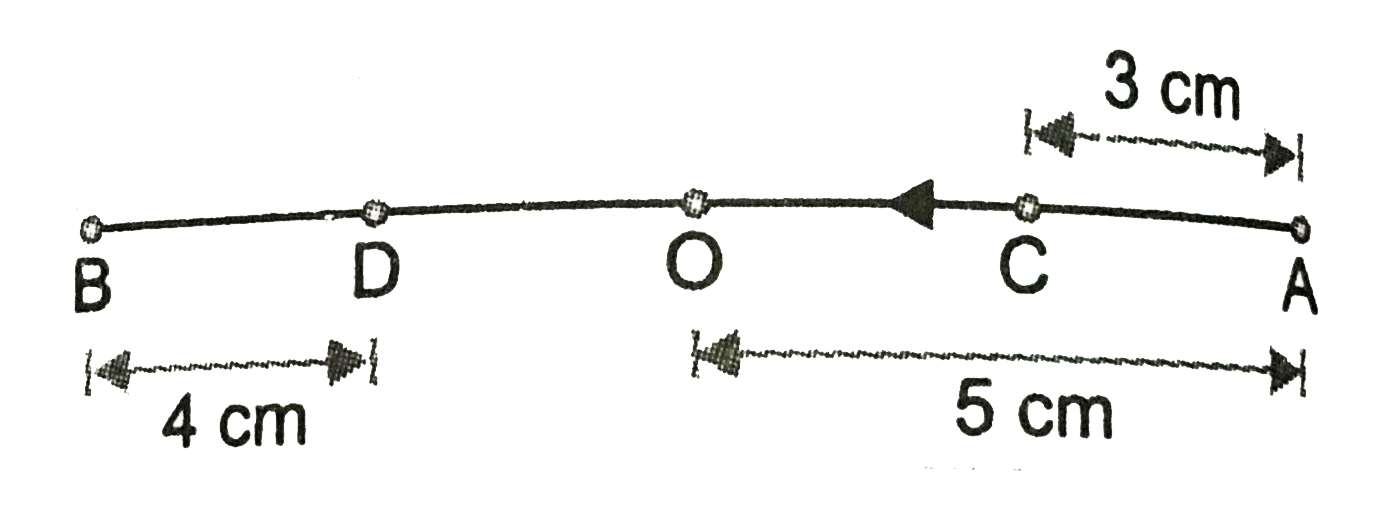
A particle is in linear simple harmonic motion between two points A and B, 10 cm apart (figure) . Take the direction from A to B as the `+ve` direction and choose the correct statements.

A

The sign of velocity, acceleration and force on the particle when it is 3 cm away from A going towards B are positive.

B

The sign of velocity of the particle at C going towards O is negative.

C

The sign of velocity acceleration and force on the particle when it is 4 cm away from B going towards A are negative.

D

The sign of acceleration and force on the particle when it is at point B is negative.

Text Solution

Verified by Experts

The correct Answer is:
A, D

As per question, the direction from A to B, i.e., from A towards mean position O is positive, therefore if a particle starting from A reaches at C, where `AC=3cm` then its direction of motion is towards the mean positin O. Hence, its velocity is positive, acceleration is positive and force is positive.
When a particle from B reached point D, weher `BD=4cm`, then its direction of motion is towards BS i.e., along BO, then velocity, acceleration and force are negative.
When particle reaches at B, its velocity becomes zero but its acceleration and force are towards BA, i.e., negative
Promotional Banner

Topper's Solved these Questions

  • OSCILLATIONS AND WAVES

    PRADEEP|Exercise JEE mains adv..(multiple choice quection)|150 Videos
  • OSCILLATIONS AND WAVES

    PRADEEP|Exercise integer type question|8 Videos
  • OSCILLATIONS AND WAVES

    PRADEEP|Exercise Multiple Choice Question-I|21 Videos
  • MATHEMATICAL TOOLS

    PRADEEP|Exercise Fill in the blanks|5 Videos
  • PHYSICAL WORLD AND MEASUREMENT

    PRADEEP|Exercise Competiton Focus Jee Medical Entrance|18 Videos

Similar Questions

Explore conceptually related problems

A particle is in linear simple harmonic motion between two points A and B 10cm apart (figure). Take the direction form A to B as positive direction and choose the correct statements. AO =OB = 5cm BC =8cm

A particle is in linear simple harmonic motion between two points. A and B, 10 cm apart (figure.) take direction from A to B as the positive direction and choose the correct statements. AO= OB= 5cm BC=8cm

A particle is in linear S.H.M. between two points A and B, 10 cm apart. Take the direction from A to B as the positive direction and give the signs of velocity, acceleration and force on the particle when it is. (a) at the end (A) at the end B, (c) at the mid point of AB going towards A, (d) at 2 cm away from B going towards A, (e) at 3 cm away from A goiing towards B, and (f) at 4 cm away from A going towards A.

A particle is executing simple harmonic motion between exterme positions given by (-1,-2,-3)cm and (1,2,1)cm . Its amplitude of oscillation is

The energy of a particle executing simple harmonic motion is given by E=Ax^2+Bv^2 where x is the displacement from mean position x=0 and v is the velocity of the particle at x then choose the correct statement(s)

A particle executes linear simple harmonic motion with an amplitude of 2 cm . When the particle is at 1 cm from the mean position the magnitude of its velocity is equal to that of its acceleration. Then its time period in seconds is

A particle executes linear simple harmonic motion with an amplitude of 3 cm . When the particle is at 2 cm from the mean position, the magnitude of its velocity is equal to that of its acceleration. Then, its time period in seconds is

A simple pendulum is oscillating between two points A and B as shown in Figure 13.5. Is the motion of the bob uniform or non-uniform?

A particle is executing simple harmonic motion with maximum velocity of 20 cm/s. Calculate the average velocity during its motion from one extreme to another.

Two particles execute simple harmonic motion of the same amplitude and frequency along close parallel lines. They pass each other moving in opposite directions each time their displacement is half their amplitude. Their phase difference is

