Home
Class 11
PHYSICS
Two independent harmonic oscillators of ...

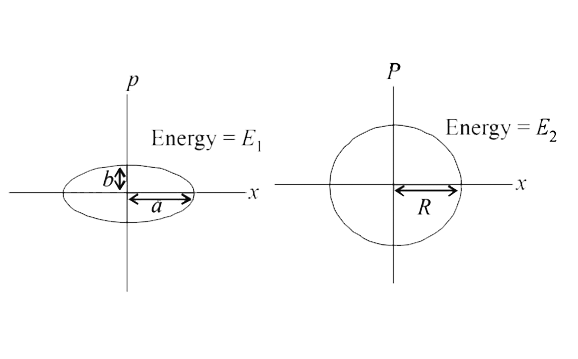
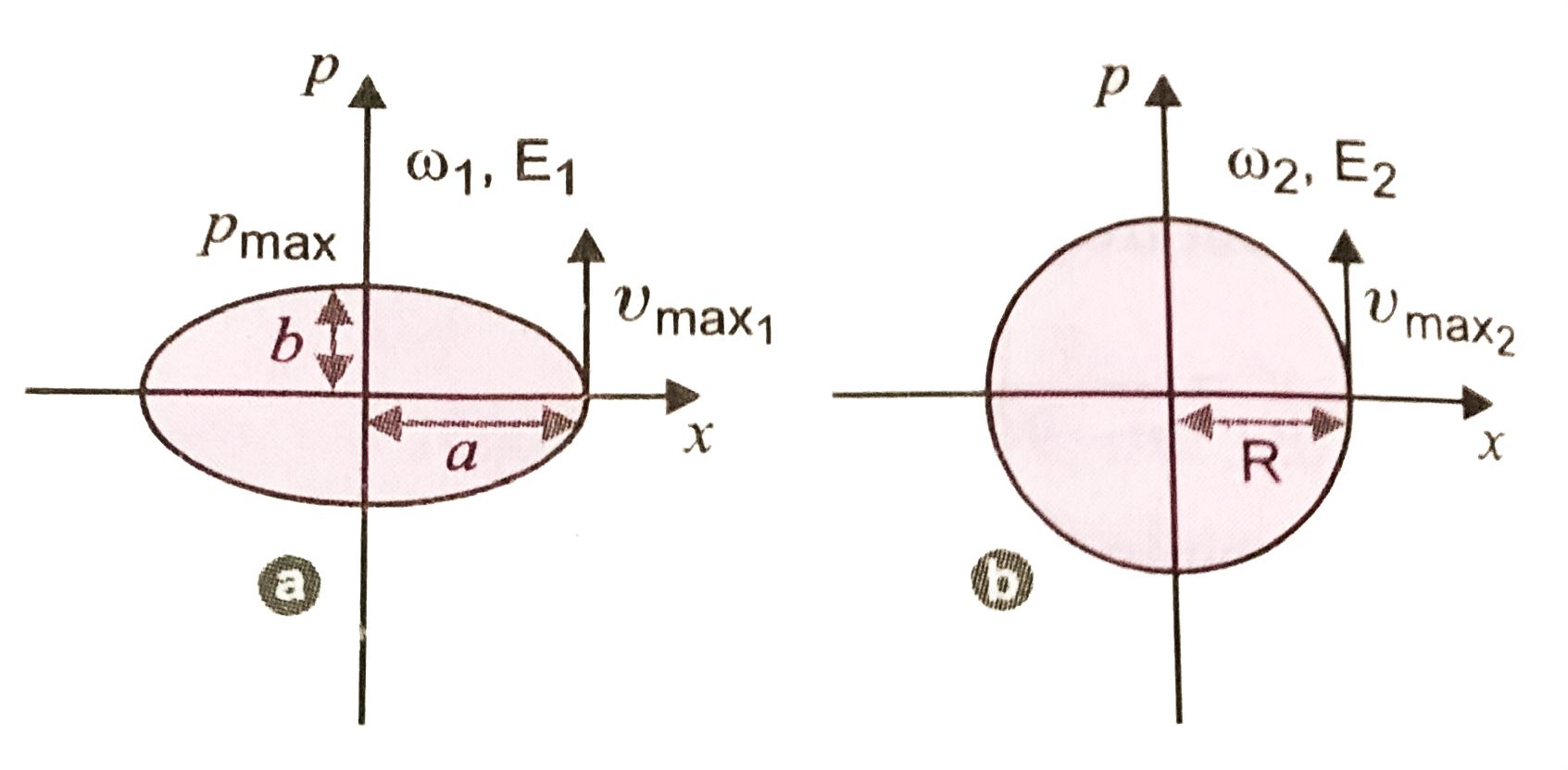
Two independent harmonic oscillators of equal mass are oscillating about the origin with angular frequencies `(omega_1) and (omega_2) and have total energies (E_1 and E_2), respectively. The variations of their momenta (p) with positions (x) are shown (s) is (are).

A

`E_(1)omega_(1)=E_(2)omega_(2)`

B

`(omega_(2))/(omega_(1))=n^(2)`

C

`omega_(1)omega_(2)=n^(2)`

D

`(E_(1))/(omega_(1))=(E_(2))/(omega_(2))`

Text Solution

Verified by Experts

The correct Answer is:
B, D

Refer of figure,
amplitude `A=a`
`p_(max)=b `or `m upsilon_(max)=b`
or `ma omega_(1)=b` ...(i)
`E_(1)=(1)/(2)ma^(2)omega_(1)^(2)` ...(ii)
Refer to figure
`p_(max)=R,` amplitude `A=R`
`m upsilon_(max)_(2))=R` or `m R omega_(2)=R` or `momega_(2)=1` ...(iii)
`E_(2)=(1)/(2)mR^(2)omega_(2)^(2)` ...(iv)
From (ii) and (iv),
`(E_(1))/(E_(2))=(a^(2)omega_(1)^(2))/(R^(2)omega_(2)^(2))=(n^(2)omega_(1)^(2))/(omega_(2)^(2))` ...(v)
`[:. (a)/(R)=n]`
From (i) and (iii)
`(aomega_(1))/(omega_(2))=(b)/(2)` or `(omega_(1))/(omega_(2))=(b)/(a)=(1)/(n^(2))` ..(vi)
or `(omega_(2))/(omega_(1))=n^(2)` `[`options (b) is true `]`
Putting the above value in (v) , we get
`(E_(1))/(E_(2))=(omega_(2))/(omega_(1))xx(omega_(1)^(2))/(omega_(2)^(2))=(omega_(1))/(omega_(2))` or `(E_(1))/(omega_(1))=(E_(2))/(omega_(2))`
Hence, option (d) is true.
Promotional Banner

Topper's Solved these Questions

  • OSCILLATIONS AND WAVES

    PRADEEP|Exercise integer type question|8 Videos
  • OSCILLATIONS AND WAVES

    PRADEEP|Exercise Assertion-Reason Type Questions|23 Videos
  • OSCILLATIONS AND WAVES

    PRADEEP|Exercise Multiple Choice Question-II|14 Videos
  • MATHEMATICAL TOOLS

    PRADEEP|Exercise Fill in the blanks|5 Videos
  • PHYSICAL WORLD AND MEASUREMENT

    PRADEEP|Exercise Competiton Focus Jee Medical Entrance|18 Videos

Similar Questions

Explore conceptually related problems

Two independent harmonic oscillators of equal mass are oscillating about the origin with angular frequencies omega_(1) and omega_(2) and have total energies E_(1) and E_(2) repsectively. The variations of their momenta p with positions x are shown in figures. If (a)/(b) = n^(2) and (a)/(R) = n , then the correc t equation(s) is (are) :

Two bodies of different masses m_(1) and m_(2) have equal momenta. Their kinetic energies E_(1) and E_(2) are in the ratio

Two bodies of masses m_1 and m_2 have equal kinetic energies. What is the ratio of their linear momenta?

Two physical pendulums perform small oscillations about the same horizontal axis with frequencies omega_(1) and omega_(2) . Their moments of inertia relative to the given axis are equal to I_(1) and I_(2) respectively. In a state of stable equilibium the pendulums were fastened rigifly together. What will be the frequency of small oscillations of the compound pendulum ?

For a linear harmonic oscillator, its potential energy, kinetic energy and total energy given by E_(P), K_(K) and E_(T) respectively. Its maximum acceleration is given by

The forced harmonic oscillations have equal displacement amplitude at frequencies omega_(1)=400 s^(-1) and omega_(2)=600 s^(-1) . Find the resonance frequency at which the displacement amplitude is maximum.

A mass m oscillates with simple harmonic motion with frequency f= omega/(2pi) and amlitude A on a spring with constant K. therefore

Two discs A and B are in contact and rotating with angular velocity with angular velocities omega_(1) and omega_(2) respectively as shown. If there is no slipping between the discs, then

What is the time period of a wave having angular frequency (omega) equal to 0.5s^(-1) ?

Find the angular frequency and the amplitude of harmonic oscillations of a particle if at distances x_(1) and x_(2) from the equalibrium position its velocity equald v_(1) and v_(2) respectively.

PRADEEP-OSCILLATIONS AND WAVES-JEE mains adv..(multiple choice quection)
  1. An observer is moving with half the speed of light towards a stationar...

    Text Solution

    |

  2. Two cars moving in opposite directio approach each other with speed of...

    Text Solution

    |

  3. Two independent harmonic oscillators of equal mass are oscillating abo...

    Text Solution

    |

  4. A mass m=100 gram is attached at the end of a light spring which osci...

    Text Solution

    |

  5. A linear harmonic oscillator of force constant 2 xx 10^6 N//m and ampl...

    Text Solution

    |

  6. For a particle executing S.H.M. which of the following statements hold...

    Text Solution

    |

  7. A block with mass (M) is connected by a massless spring with stiffness...

    Text Solution

    |

  8. If amplitude of a particle in S.H.M. is doubled, which of the followin...

    Text Solution

    |

  9. If a simple harmonic motion is given by y=(sin omegat+cosomegat)m ...

    Text Solution

    |

  10. If the different types of penulums are taken to moon, the time period ...

    Text Solution

    |

  11. Which of the following functions represents SHM

    Text Solution

    |

  12. Which of the following quantities are always zero in a S.H.M. ? Here, ...

    Text Solution

    |

  13. Which of the following statements are true for the ocsillations of the...

    Text Solution

    |

  14. Two particles A and B have a phase diference of pi when a sine wave pa...

    Text Solution

    |

  15. In a stationary wave

    Text Solution

    |

  16. A listener is at rest with respect to the source of sound. A wind star...

    Text Solution

    |

  17. The fundamental frequency of a vibrating organ pipe is 200Hz

    Text Solution

    |

  18. Function x=Asin^(2)omegat+Bcos^(2)omegat=Csinomegat cos omegat represe...

    Text Solution

    |

  19. Two blocks A and B, each of mass m, are connected by a masslesss sprin...

    Text Solution

    |

  20. When a body is suspended from two light springs separately, the period...

    Text Solution

    |

