Home
Class 11
PHYSICS
Two point masses of 3.0kg and 1.0kg are ...

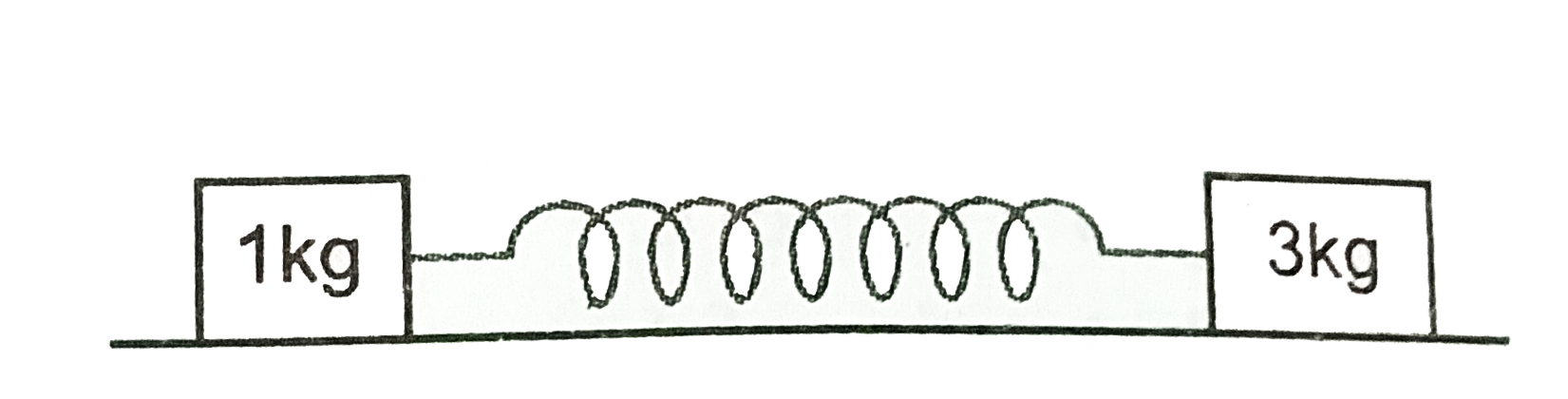
Two point masses of `3.0kg` and `1.0kg` are attached to opposite ends of a horizontal spring whose spring constant is `3Nm^(-1)` as shown in figure . The natural frequency of vibration so this system is `n//piHz`. Find the integral value of `n`.

Text Solution

Verified by Experts

The correct Answer is:

1

The reduced mass of the system,
`m=(m_(1)xxm_(2))/(m_(1)+m_(2))=(3xx1)/(3+1)=(3)/(4)kg`
So, inertia factor, `m=(3)/(4)kg.`
Here, spring factor, `k=3Nm^(-1)`
Frequency `v=(1)/(2pi)sqrt((spri ngfact o r)/(i n ertia fact o r))`
`=(1)/(2pi)sqrt((3)/((3//4)))=(1)/(pi)Hz`
As per question, `(n)/(pi)=(1)/(pi)` or `n=1`
Promotional Banner

Topper's Solved these Questions

  • OSCILLATIONS AND WAVES

    PRADEEP|Exercise Assertion-Reason Type Questions|23 Videos
  • OSCILLATIONS AND WAVES

    PRADEEP|Exercise multiple choice Questions|13 Videos
  • OSCILLATIONS AND WAVES

    PRADEEP|Exercise JEE mains adv..(multiple choice quection)|150 Videos
  • MATHEMATICAL TOOLS

    PRADEEP|Exercise Fill in the blanks|5 Videos
  • PHYSICAL WORLD AND MEASUREMENT

    PRADEEP|Exercise Competiton Focus Jee Medical Entrance|18 Videos

Similar Questions

Explore conceptually related problems

Two point masses of 3.0 kg and 1.0 kg are attached to opposite ends of a horizontal spring whose spring constant is 300Nm^(-1) as shown in the figure. The natural vibration frequency of the system is of the order of :

Two point masses of 3.0 kg and 1.0 kg are attached to opposite ends of a horizontal spring whose spring constant is 300 N m^(-1) as shown in the figure. The natural vibration frequency of the system is of the order of :

Two point masses of 3 kg and 6 kg are attached to opposite ends of horizontal spring whose spring constant is 300 Nm^(-1) as shown in the figure. The natural vibration frequency of the system is approximately

Two blocks of masses 6 kg and 3 kg are attached to the two ends of a massless spring of spring constant 2 pi^(2) N//m . If spring is compressed and released on a smooth horizontal surface then find the time period (in seconds) of each block.

A uniform thin rod has a mass 1 kg and carries a mass 2.5 kg at B. The rod is hinged at A and is maintained in the horizontal position by a spring having a spring constant 18 k "Nm"^(1) at C as shown in figure. The angular frequency of oscillation is nearly-

A body of mass 16 kg is made to oscillate on a spring of force constant 100 N kg^(-1) . Deduce the angular frequency.

A 0.20kg object mass attached to a spring whose spring constant is 500N/m executes simple harmonic motion. If its maximum speed is 5.0m/s, the amplitude of its oscillation is

The spring constant of the spring shown in the figure is 250Nm^(-1) . Find the maximum compression of the spring?

A small block of mass 2 kg is placed on a bigger block of mass 4 kg which is attached to horizontal spring of spring constant K = 500 N //m as shown in figure, coefficient of friction between block is 0.2 .Maximum amplitude of system so that there is no relative slipping between blocks.

A body of mass 2 kg is made to oscillate using a spring of force constant 8Nm^(-1) find (i) angular frequency (ii) frequency of vibration (iii) time period of vibration.
