(a) Given, `B=(mu_0IR^2N)/(2(x^2+R^2)^(3//2))`
When point is at the centre of circular coil, `x=0`.
Then, `B=(mu_0IR^2N)/(2R^3)=(mu_0IN)/(2R)`
Which is the same as the standard result.
(b) Here, `a=R`, `n=N`. Let d be the distance of point P from the mid-point O lying on the axis of the two circular coils C and D, where `dlt lt R`. In figure.
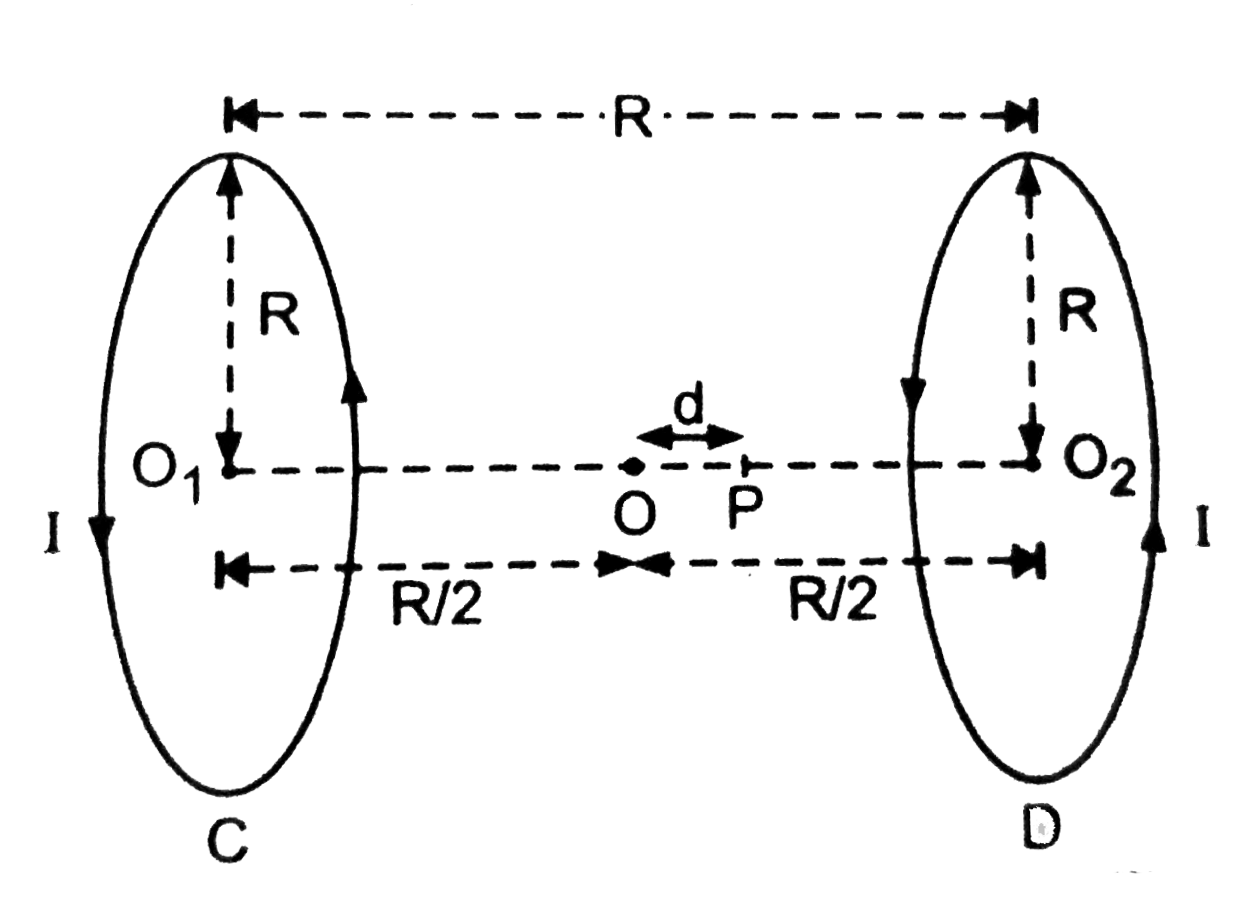
For coil C, `O_1P=x_1=R/2+d`
For coil D, `O_2P=x_2=R/2-d`
we know that magnetic field at a point on the axis of the circular coil of radius a, having n turns and carrying current I, which is at a distance x from the centre of the coil is given by
`B=(mu_0)/(4pi)(2pinIa^2)/((x^2+a^2)^(3//2))=(mu_0nIa^2)/(2(x^2+a^2)^(3//2))`
Due to coil C, magnetic field at P is
`B_1=(mu_0NIR^2)/(2(x_1^2+R^2)^(3//2))=(mu_0NIR^2)/(2[(R/2+d)^2+R^2]^(3//2))=(mu_0NIR^2)/(2)[(1)/((R^2/4+d^2+Rd+R^2)^(3//2))]`
As `d^2` can be neglected in comparison to `R^2`, therefore,
`B_1=(mu_0NIR^2)/(2)xx(1)/(((5R^2)/(4))^(3//2))[(1+(4d)/(5R))^(-3//2)]` It acts along `PO_2`.
Similarly, due to coil D, magnetic field at P is given by
`B_2=(mu_0NIR^2)/(2(x_2^2+R^2)^(3//2))=(mu_0NIR^2)/(2[(R/2-d)^2+R^2]^(3//2))=(mu_0NIR^2)/(2)xx(1)/(((5R^2)/(4))^(3//2))[(1-(4d)/(5R))^(-3//2)]`
It acts along `PO_2`.
Total magnetic field at P due to current through the coils is given by `B=B_1+B_2`
`=(mu_0NIR^2)/(2((5R^2)/(4))^(3//2))xx[(1+(4d)/(5R))^(-3//2)+(1-(4d)/(5R))^(-3//2)]=(mu_0NIR^2)/(2R^3)(4/5)^(3//2)[1-(6d)/(5R)+1+(6d)/(5R)]`
(From Binomial Theorem)
`=(4/5)^(3//2)(mu_0NI)/(R)=0*72(mu_0NI)/(R)`


