Home
Class 12
PHYSICS
A multirange current meter can be constr...

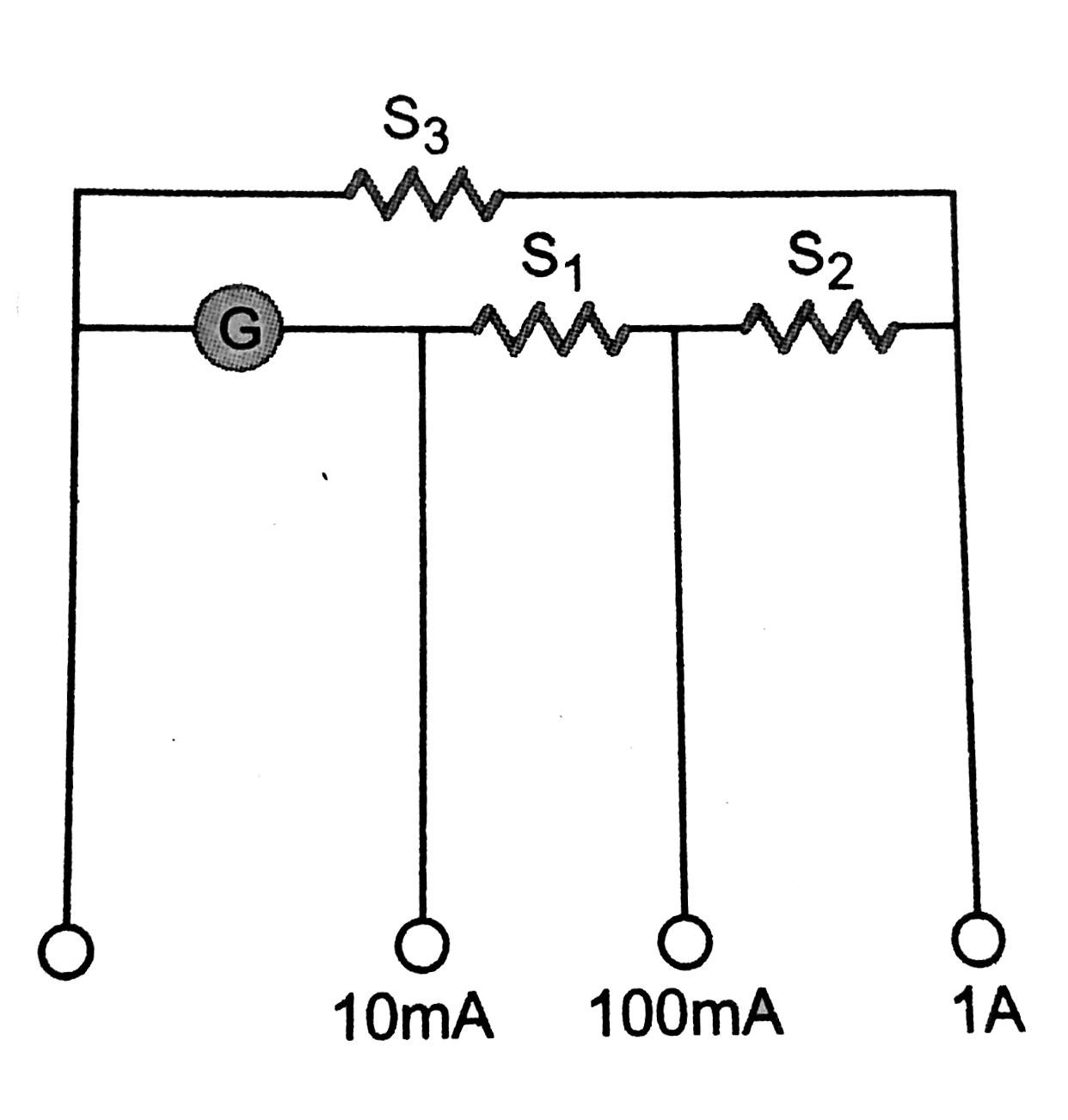
A multirange current meter can be constructed by using a galvanometer circuit as shown in figure. We want a current meter that can measure `10mA`, `100mA` and `1A` using a galvanometer of resistance `10Omega` and that produces maximum deflection for current of `1mA`. Find `S_1, S_2` and `S_3` that have to be used.

Text Solution

Verified by Experts

Here, `G=10Omega`, `I_g=1mA=10^-3A`.
To convert a galvanometer into an ammeter of given range of current 0 to I, the shunt resistance required is `S=(I_gG)/(I-I_g)`.
Case (i), `I=10mA=10xx10^-3A`, `S=S_1+S_2+S_3`.
`:. S_1+S_2+S_3=(1mAxx10Omega)/((10-1)mA)=10/9Omega`
Case (ii), When `I=100mA`, `S=S_2+S_3`, galvanometer resistance `=G+S_1`
`:. S_2+S_3=(I_(g)(G+S_1))/(I-I_g)=(1mAxx(10+S_1))/((100-1)mA)=(10+S_1)/(99)` ...(ii)
Case (iii), When `I=1A`, `S=S_3`, galvanometer resistance`=(G+S_1+S_2)`
`:. S_3=(I_g(G+S_1+S_2))/(I-I_g)=(1mA[10+S_1+S_2])/((1000-1)mA)=(10+S_1+S_2)/(999)`...(iii)
Putting the value of (ii) in (i), we get `S_1+(10+S_1)/(99)=10/9` or `S_1(1+1/99)=10/9-10/99=100/99`
`:. S_1xx100/99=100/99` or `S_1=1Omega`
From (ii), `S_2+S_3=1/99(10+1)=1/9` ...(iv)
From (iii), `S_3=(10+1+S_2)/(999)=(11+S_2)/(999)` or `S_3-S_2/999=11/999` ...(v)
Subtracting (v) from (iv), we get, `S_2=(S_2)/(999)=1/9-11/999=100/999` or `(S_2xx1000)/(999)=100/999` or `S_2=1/10=0*1Omega`
From (iv), `1/10+S_3=1/9` or `S_3=1/9-1/10=1/90` or `S_3=0*011Omega`
Promotional Banner

Topper's Solved these Questions

  • MAGNETIC EFFECT OF CURRENT AND MAGNETISM

    PRADEEP|Exercise Conceptual Problems (d)|2 Videos
  • MAGNETIC EFFECT OF CURRENT AND MAGNETISM

    PRADEEP|Exercise Very Short Answer Questions (a)|2 Videos
  • ELECTROSTATICS

    PRADEEP|Exercise ASSERTION-REASON TYPE QUESTIONS|2 Videos
  • OPTICS

    PRADEEP|Exercise Multiple choice questions|1 Videos

Similar Questions

Explore conceptually related problems

A multirange voltmeter can be constructed by using a galvanometer circuit as shown in figure. We want to construct a voltmeter that can measure 2V, 20V and 200V using a galvanometer of resistance 10Omega and that produces maximum deflection for current of 1mA . Find R_1 , R_2 and R_3 that have to be used.

A voltmeter which can measure 2 V isconstructed by using a galvanometer of resistance 12 Omega and that produces maximum deflection for the current of 2mA. Then the resistance R is

A galvanometer with a coil of resistance 50 Omega shows full-scale deflection when 10 mA current passes through it.

A galvanometer has coil resistance 30 Omega and full deflection current of 2mA. What resistance is needed to convert it into a voltmeter of 0.2V range.

A galvanometer of internal resistance 100 Omega has a full scale deflection current of 1mA. To convert it into a voltmeter of range 0-10V, the resistance to be connected is

The value of shunt to be used to pass 1//10th of the total current through a galvanometer of resistance 100Omega is

A galvanometer of internal resistance 100 Omega has a full scale deflection current of 1mA . To convert it into a voltmeter of range 0-10V , the resistance to be connected is

A galvanometer having coil resistance 8Omega shows a full scale deflection for a current of "3mA" .For it to measure a current of "8A" ,the value of the shunt should be:

Can we use galvanometer to measure alternating current ?
