Home
Class 12
PHYSICS
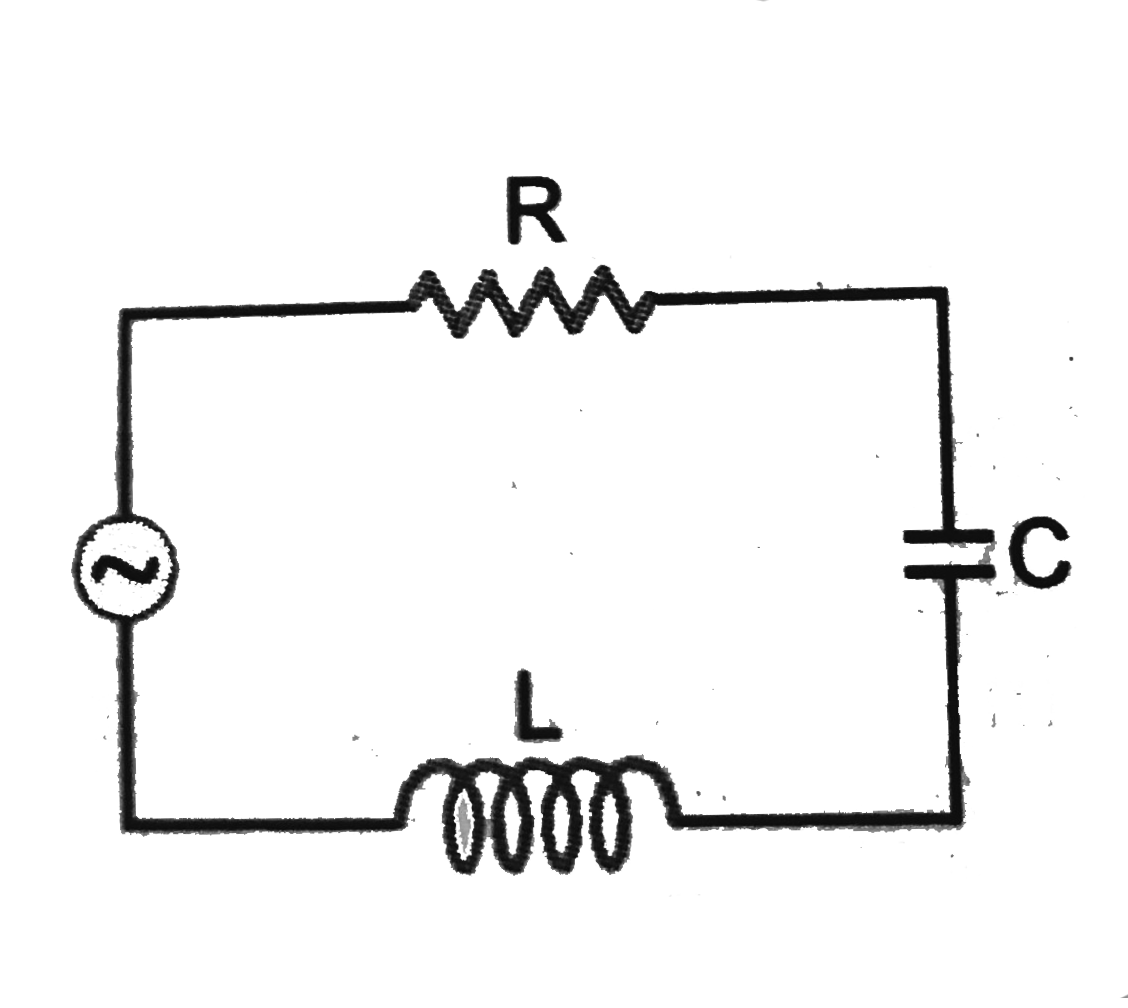
Fig. shows series LCR circuit with L = 5...

Fig. shows series LCR circuit with `L = 5.0 H, C = 80 mu F, R = 40 Omega` connected to a variable frequency 240 V source. Calculate
(i) the angular freuquency of the source which drives the circuit at resonance.
(ii) Current at the resonanting frequency.
(iii) the rms pot. drop across the capacitor at resonance.

Text Solution

Verified by Experts

Here, `L = 5.0 H`,
`C = 80 mu F = 80 xx 10^(-6) F, R = 40 ohm`
`E_(v) = 240 V, omega = ?, I = ?, V_(C ) = ?`
At resonance, `X_(L) = X_(C )`
`omega = (1)/(omega C)` or `omega = (1)/(sqrt(LC))`
`omega = (1)/(sqrt(5.0 xx 80 xx 10^(-6))) = (1000)/(20) = 50 rad//s`
(ii) At resonance. `Z = R =40 Omega`
`I_(v) = (E_(v))/(Z) = (240)/(40) = 6 A`
(iii) `V_(C ) = I_(v) X_(C )`
`= (I_(v))/(omega C) = (6)/(50 xx 80 xx 10^(-6)) = (6000)/(4) = 1500 V`
Promotional Banner

Topper's Solved these Questions

  • ELECTROMAGNETIC INDUCTION & ALTERNATING CURRENT

    PRADEEP|Exercise Solved Examples (b)|1 Videos
  • ELECTROMAGNETIC INDUCTION & ALTERNATING CURRENT

    PRADEEP|Exercise Short Answer Qusetions|2 Videos
  • DUAL NATURE OF RADIATION AND MATTER

    PRADEEP|Exercise Exercise|191 Videos
  • ELECTROMAGNETIC WAVES

    PRADEEP|Exercise II Focus multiple choice question|5 Videos

Similar Questions

Explore conceptually related problems

The figure shows a series LCR circuit with L=10.0 H_(2), C=40 mu F, R=60 Omega connected to a variable frequency 240 V source. Calculate (i) The angular frequency of the source which drives the circuit at resonance. (ii) The current at the resonating frequency. (iii) The rms potential drop across the capacitor at resonance.

A series LER circuit with C = 80 mu F , L = 5.0 H and R = 40 Omega is connected to a variable frequency 240 V a.c. source Calculate (i) angular frequency of the source which drives the circuit in resonanace. (ii) current at the resonating frequency. (iii) rms pot. drop across the capacitor.

A series LCR circuit with L = 4.0 h, C = 100 mu F and R = 60 Omega is connected to a varialbe frequency 240 V source. Calcalate (i) angular frequency of the source which drives the circuit in resonace, (ii) current at the resonating frequency, (iii) rms potential drop across the inductro at resonance.

A series LCR circuit with L = 80 mH, C = 50 mu F and R = 60 ohm is connected to a variable frequency 220 V source. Determine (i) the source frequency which drives the circuitin resonance (iii) the quality factor Q of the circuit.

A series L-C-R circuit with R = 44 Omega, C = 8 muF and L = 50 H is connected to a variable frequency 220 V ac suppy. Calculate angular frequency, impedance and current at resonance condition.

Figure shows a series LCR circuit connected to a variable frequency 230 V source. The source frequency which drives the circuit the circuit in resonance is

A series LCR circuit containing 5.0 H inductor, 80 mu F capacitor and 40 Omega resistor is connected to 230 V variable frequency ac source. The angular frequencies of the source at which power transfered to circuit is half the power at resonant angular frequency are likely to be.

In a series LCR circuit with value of R = 15 Omega , L = 5 H , C = 100 muF an AC power supply with variable frequency is connected . Calculate the value of angular frequency of the source at which the circuit is in resonance and current at the same frequency . The V_("rms") value of voltage in the circuit is 220 V.

Fig. show a series LCR circuit with L = 0.1 H l, X_(C ) = 14 Omega and R = 12 Omega connected to a 50 Hz, 200 V source. Calculate (i) current in the circuit and (ii) phase angle between current and voltage. Take pi = 3

A variable frequency 230 V alternating voltage source is connected across a series combination of L = 5.0 H, C = 80 mu F and R = 40 Omega (i) Calculate the angurla frequency fo the source which drives the circuitin resonance. (ii) Obtain r.m.s. the impedance of the circuit and amplitude of current at resonance frequency (iii) Obtain r.m.s. potential drop across the three elements of the circuit at resonating frequency. (iv) How do you explain the observation that the algerbraic sum of voltages across the three elements obtained is greater than the supplied voltage.
