Home
Class 12
PHYSICS
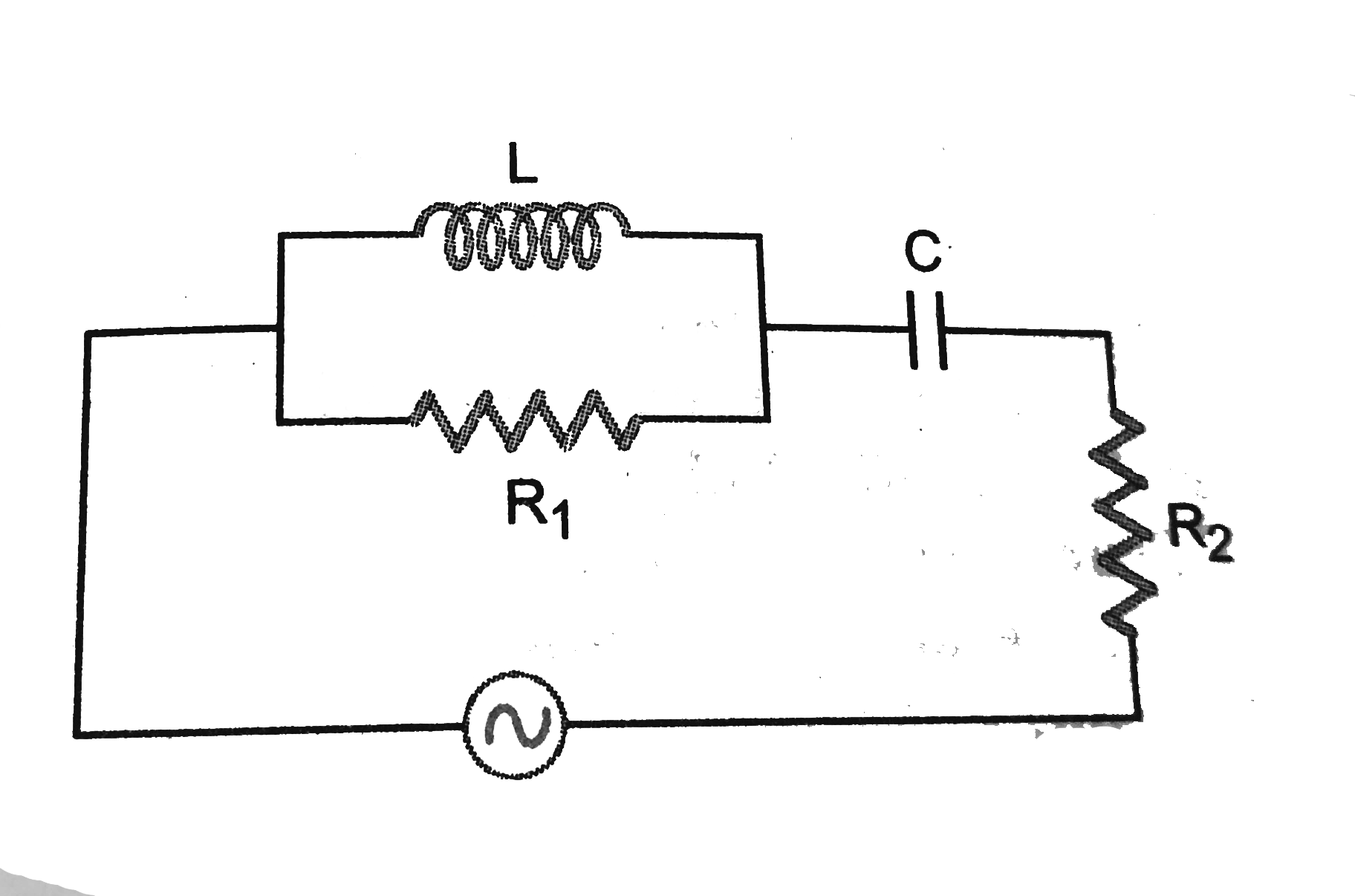
In the circuit shown in Fig. (i) find th...

In the circuit shown in Fig. (i) find the phase difference between the currents through L and `R_(1)`
(ii) find the phase difference between potential differece across C and `R_(2)`

Text Solution

Verified by Experts

(i) In Fig. as L and `R_(1)` are in parallel the potential difference acorss them are equal and in phase with eachother.
Further, in resistance `R_(1)`, current and petentail difference are in phase with eachother, while in inductance, current lags behind the potential difference by a phase angle `pi//2`
Hence, current through inductance L lags behind the current through `R_(1)` by a phase `pi//2` (ii) As C and `R_(2)` are in series, same current passes through them and is same phase, In `R_(2)`, current and potential difference are in phase with eachother. While n a capacitor potential difference lags behind the current by a phase angle `pi//2`.
Hence, potential difference across the capacitor C lags behind the current in `R_(2)` by a phase anlge `pi//2`.
Promotional Banner

Topper's Solved these Questions

  • ELECTROMAGNETIC INDUCTION & ALTERNATING CURRENT

    PRADEEP|Exercise Solved Examples (b)|1 Videos
  • ELECTROMAGNETIC INDUCTION & ALTERNATING CURRENT

    PRADEEP|Exercise Short Answer Qusetions|2 Videos
  • DUAL NATURE OF RADIATION AND MATTER

    PRADEEP|Exercise Exercise|191 Videos
  • ELECTROMAGNETIC WAVES

    PRADEEP|Exercise II Focus multiple choice question|5 Videos

Similar Questions

Explore conceptually related problems

In resonant circuits, at resonance, the phase difference between current and emf is

The phase difference between voltage and current in an LCR series circuit is

In an AC circuit X_(C)=X_(L) . The phase differe3nce between the current and voltage will be

For the given circuit find current 'I' and phase difference between V & I

The phase difference between voltage and current in series L-C circuit is

Phase difference between voltages across L and C in series is

In a LCR series circuit, if the phase difference between applied voltage and current is zero then
