Home
Class 12
PHYSICS
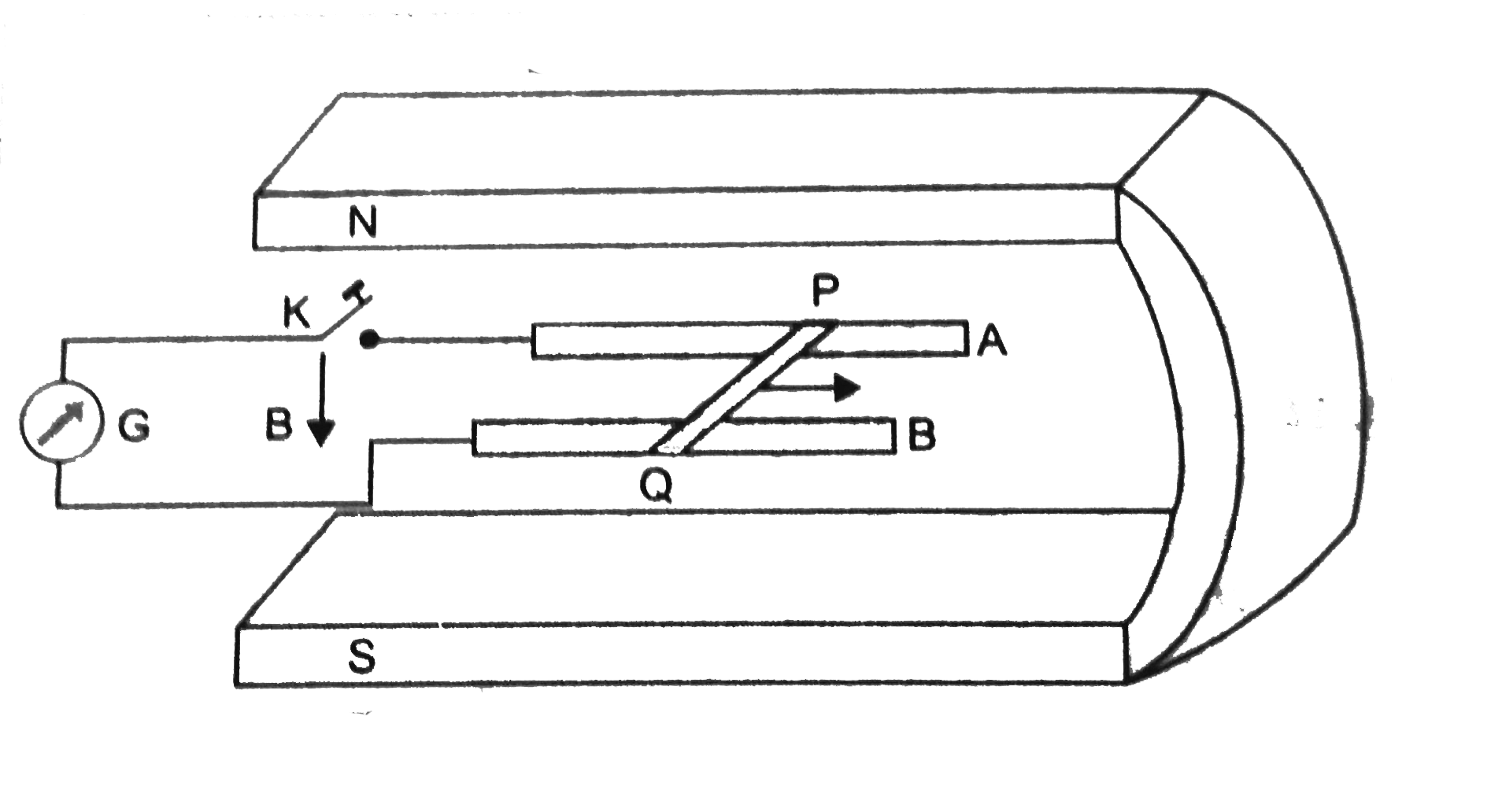
Fig. shows a metal rod PQ resting on the...

Fig. shows a metal rod PQ resting on the rails A, B and positoned between the poles of a permanent magnet. The rails, the rod and the magnetic field are in three mutually perperdicular directions. A galvanometer connects the rails through a switch K. Length of the rod = 15 cm, B = 0.50 T, resistance of closed loop containing the rod `= 9.0 m Omega` Answer the following questions.
(a) Suppose K is open and the rod moves with a speed of `12 cm//s` in the direction shown, Give the polarity and magnitude of induced e.m.f
(b) Is there on excess charge built up at the ends of rods when K is open ? What if K is closed ?
(c ) With K open and the rod moving uniformly, there is no net force on the electron in the rod PQ even though they do experience magnetic froce due to the motion of the rod Explain.
(d) What is the retarding force on the rod when K is closed?
(e) How much powe s required (by an external agent) to keep the rod moving at the same speed `( = 12 cm//s)` when K is closed. (f) How much power is dissipated as heat in the closed circuit ? What is the source of this power?
(g) What is the induced e.m.f. in the following in the moving rod when the permanent magnet is rotated to a vertical position so that the field is parallel to the rails instead of being perpendicular ?

Text Solution

Verified by Experts

Here, `l = 15 cm = 15 xx 10^(-2) m, B = 0.50 T, R = 9.0 M Omega, upsilon = 12 cm s^(-1) = 12 xx 10^(-2) ms^(-1)`
(a) Magnitude of induced e.m.f. is `e = B upsilon l = 0.5 xx 12 xx 10^(-2) xx 15 xx 10^(-2) = 9 xx 10^(-3)` volt.
According to Fleming's left hand rule, the direction of Lorentz force on electrons in PQ is from P toQ. Therefore, P would acquire positive develops at P and an equal negative excess charge develops at Q, when K is open.
When key K is closed, induced current flows and maintains the excess charge.
(c ) This is because the presence of excess charge at the ends P an Q sets up an electric field `vec E` such that force due to electric field `(q vec E)` is balanced by Lorentz magnetic force q `(vec upsilon xx vec B)`. Here, q is charge on electron.
(d) Induced current, `I = (e)/(R ) = (9 xx 10^(-3))/(9 xx 10^(-3)) = 1` ampere.
Retarding force on the rod `=B I l = 0.5 xx 1 xx 0.15 = 7.5 xx 10^(-2) N`
(e) Power = Retarding force`xx` velocity `= (7.5 xx 10^(-2)) xx (12 xx 10^(-2)) = 9 xx 10^(-3) W`
(f) Power dissipated as heat `= I^(2) R = 1^(2) (9 xx 10^(-3)) = 9 xx 10^(-3) W`
(g) When a field is made parallel to the rail,`thet = 0^(@)`. Therefore, induced e.m.f. `e = B upsilon l sin theta = V upsilon l sin 0^(@) =` zero. This is becasue in such a situation, moving rod will not cut the field lines so that flux change = 0 and hence e =0.
Promotional Banner

Topper's Solved these Questions

  • ELECTROMAGNETIC INDUCTION & ALTERNATING CURRENT

    PRADEEP|Exercise Solved Examples (b)|1 Videos
  • ELECTROMAGNETIC INDUCTION & ALTERNATING CURRENT

    PRADEEP|Exercise Short Answer Qusetions|2 Videos
  • DUAL NATURE OF RADIATION AND MATTER

    PRADEEP|Exercise Exercise|191 Videos
  • ELECTROMAGNETIC WAVES

    PRADEEP|Exercise II Focus multiple choice question|5 Videos
