Consider a closed loop C in a magnetic field, Fig. The flux passing through the loop is defined by choosing a surface whose edge coincides with the loop and using the formula `phi = B_(1) .dA_(1) + B_(2). Da_(2) +`……..Now if we chose two different surfaces `S_(1)` and `S_(2)` having C as their edge, would we get the same answer for flux. Justify your answer.
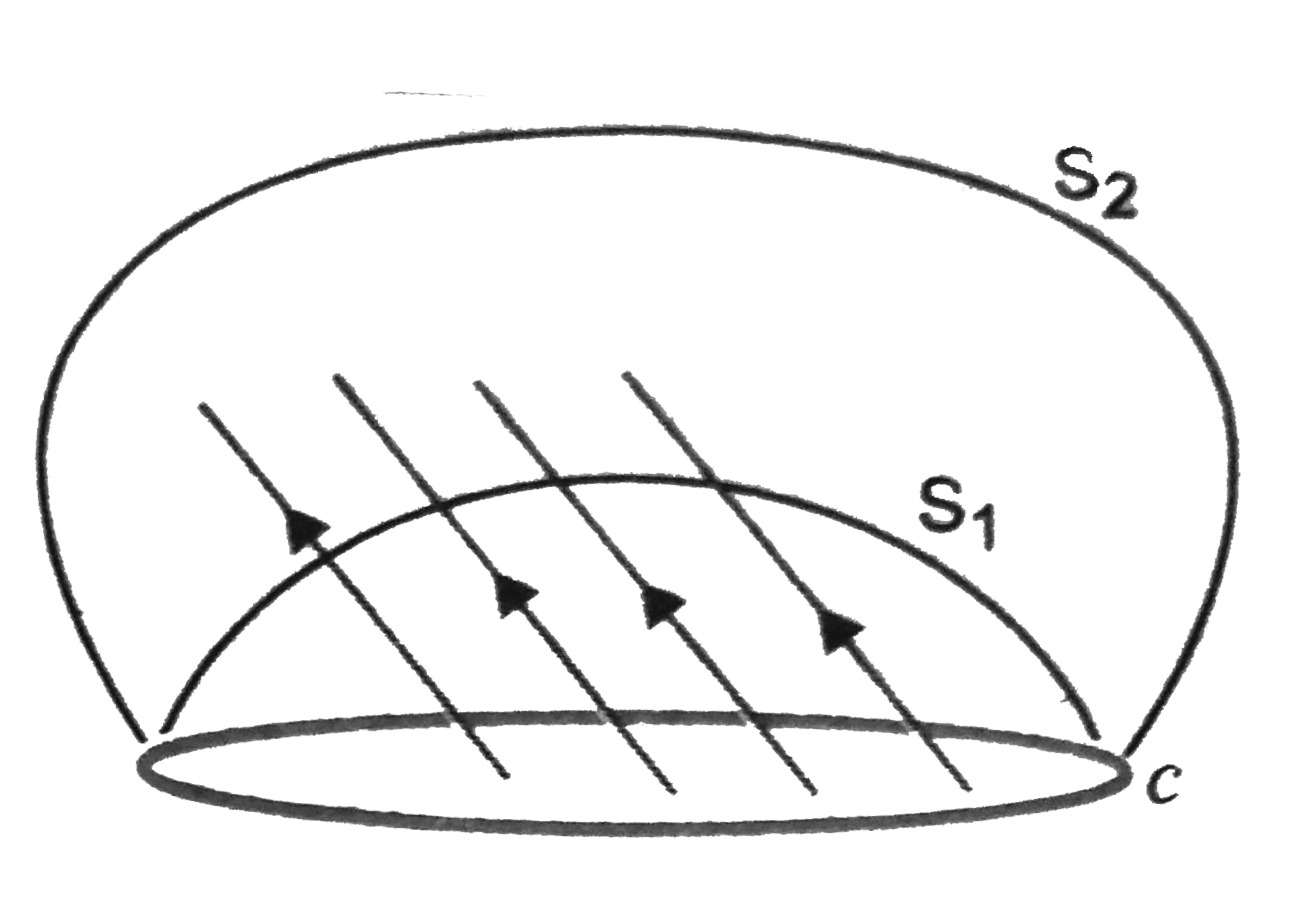
Consider a closed loop C in a magnetic field, Fig. The flux passing through the loop is defined by choosing a surface whose edge coincides with the loop and using the formula `phi = B_(1) .dA_(1) + B_(2). Da_(2) +`……..Now if we chose two different surfaces `S_(1)` and `S_(2)` having C as their edge, would we get the same answer for flux. Justify your answer.
Text Solution
Verified by Experts
We would get the same answer for magnetic flux. This is because magnetic flux = number of magnetic field lines passing through the surface `(d phi = vec B. Delta vec S)`. As magnetic field lines form closed continuos loops and cannot end or start in space, therefore in Fig. number of magnetic lines passing through surface `S_(1)` must be the same as the number of magnetic lines through the surface `S_(2)`.



Topper's Solved these Questions
ELECTROMAGNETIC INDUCTION & ALTERNATING CURRENT
PRADEEP|Exercise Solved Examples (b)|1 VideosELECTROMAGNETIC INDUCTION & ALTERNATING CURRENT
PRADEEP|Exercise Short Answer Qusetions|2 VideosDUAL NATURE OF RADIATION AND MATTER
PRADEEP|Exercise Exercise|191 VideosELECTROMAGNETIC WAVES
PRADEEP|Exercise II Focus multiple choice question|5 Videos
Similar Questions
Explore conceptually related problems
The current through the solenoid is changing in such way that flux through it is given by phi=varepsilon t .The solenoid is surrounded by a loop having resistance R_(1) and R_(2) as shown.Then the reading of the two voltmeters V_(1) and V_(2) differ by :
Consider the hemispherical closed surface as shown in Fig. 3.19. if the hemisphere is a uniform magnetic field that makes an angle theta with the vertical, calculate the magnetic flux (a) through the flat surface S_(1) . (b) through the hemisphere surface S_(2) .
The magnetic flux across a loop of resistance 10Omega is given by phi=5t^(2)-4t^(2)+1Wb . How much current is induced in the loop after 0.2 s?
A long solenoid having n = 200 turns per metre has a circular cross-section of radius a_(1) = 1 cm . A circular conducting loop of radius a_(2) = 4 cm and resistance R = 5 (Omega) encircles the solenoid such that the centre of circular loop coincides with the midpoint of the axial line of the solenoid and they have the same axis as shown in Fig. A current 't' in the solenoid results in magnetic field along its axis with magnitude B = (mu)ni at points well inside the solenoid on its axis. We can neglect the insignificant field outside the solenoid. This results in a magnetic flux (phi)_(B) through the circular loop. If the current in the winding of solenoid is changed, it will also change the magnetic field B = (mu)_(0)ni and hence also the magnetic flux through the circular loop. Obvisouly, it will result in an induced emf or induced electric field in the circular loop and an induced current will appear in the loop. Let current in the winding of solenoid be reduced at a rate of 75 A //sec . Magnetic of induced electric field strength in the circular loop is nearly We know that there is magnetic flux through the circular loop because of the magnetic field of current in the solenoid. For the purpose of circular loop, let us call it the external magnetic field. As current in the solenoid is reducing, external magnetic field for the circular loop also reduced resulting in induced current in the loop. Finally, as the solenoid current becomes zero, external field for the loop also becomes zero and stop changing. However, induced current in the loop will not stop at the instant at which the external field stops changing. This is because induced current itself produces a magnetic field that results in a flux through the loop. External field becoming zero without any further change will compel the induced current in the loop to become zero and so magnetic flux through the loop due to change in induced current will also change resulting in a further induced phenomenon that sustains currents in the loop even after the external field becomes zero.
Consider a closed surface of arbitatry shape as shown in figure. Suppose a single charge Q_1 is located at some point within the surface and second charge Q_2 is located outside the surface. a. What is the total flux passing through the surface due to charge Q_1 ? b. What is the total flux passing through the surface due to charge Q_2 ?
Figure shows four charges q_1,q_2,q_3,and q_4 fixed is space. Then the total flux of the electric field through a closed surface S, due to all the charges, is
The flux of magnetic field through a closed conducting loop changes with time according to the equation, Phi = at^2 + bt+ c. (a) Write the SI units of a,b and c. (b) if the magnitudes of a,b and c are 0.20, 0.40 and 0.60 respectely, find the induced emf at t = 2 s.
A loop of area 1m^2 is placed in a magnetic field B=2T , such that plane of the loop is parallel to the magnetic field. If the loop is rotated by 180^@ , the amount of net charge passing through any point of loop, it its resistance is 10Omega is
An electric field vecE=4xhati-(y^(2)+1)hatjN//C passes through the box shown in figure. The flux of the electric field through surface ABCD and BCGF are marked as phi_1)and phi_(11) respecticvely. The differentce between (phi_(1)-phi_(1)) is in Nm^(2) /C)