Home
Class 12
PHYSICS
A conducting wire XY of mass M and negli...

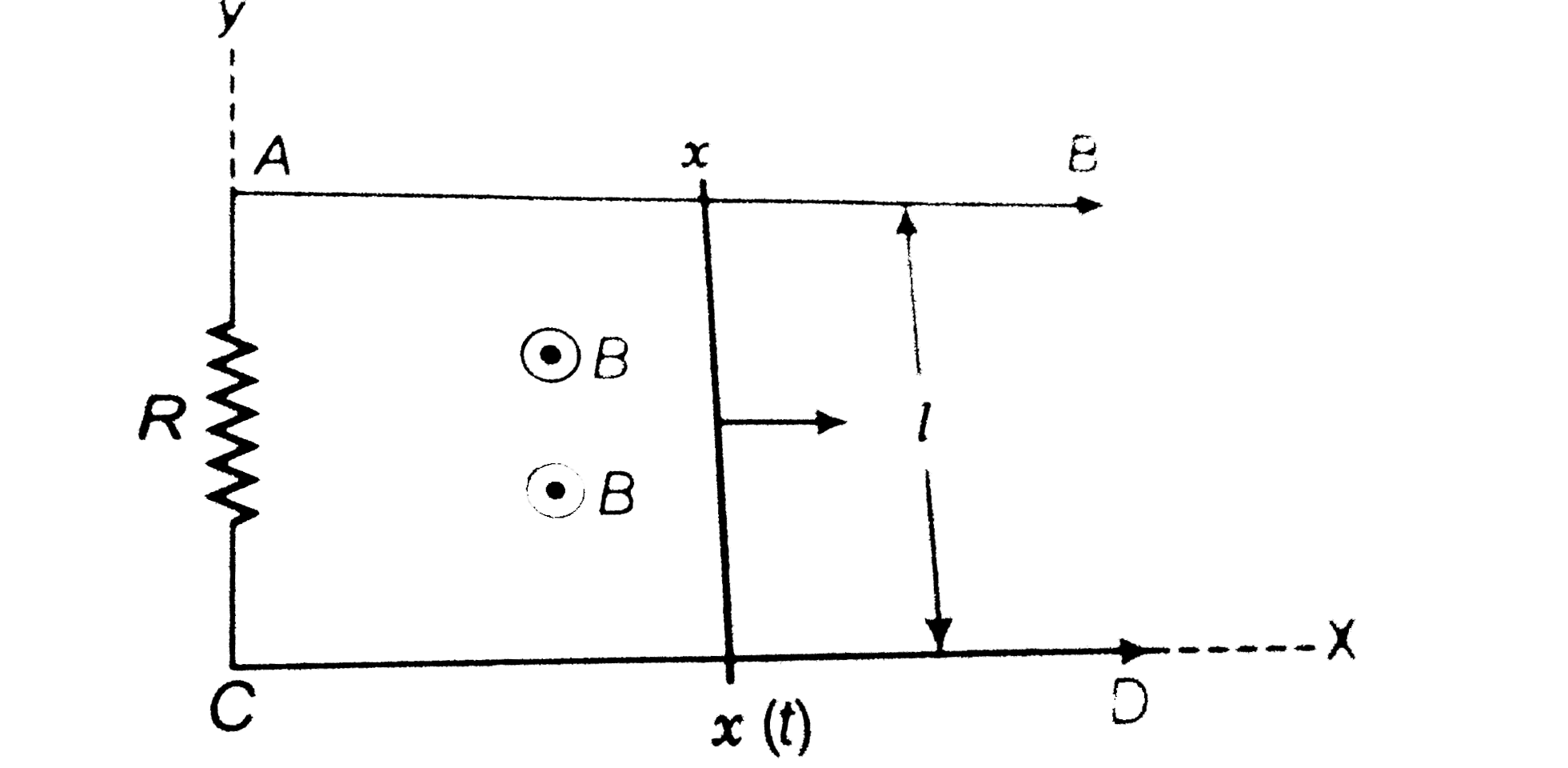
A conducting wire XY of mass M and negligible resistance slides smothly on two parallel conducting wires as shown in figure. The closed circuit has a resistance R due to AC. AB and CD are perfect conductors. There is a magnetic field `B=B(t)hatk`

Text Solution

Verified by Experts

Fig. shows a conducting wire XY of mass m and negligible resistance sliding smoothly over two parallel conducting wires AB and CD. The magneitic field applied is `vec B = B (t) hat k`
(i) At time t, suppose XY is at x = x (t)
Magnetic flux associated with area ACYX
`phi = B (t).l.x.(t)`
emf induced, `e = (d phi)/(dt) = - [(dB)/(dt) lx (t) + B (t) l.v. (t)]`
current induced , `i = (e)/(R )`
Force on XY, `F = B i l = B ((e)/(R )) l` or `m (d^(2) x)/(dt) = (B(t).l)/(R ) [ -(dB)/(dt) lx (t) - B (t).l.upsilon (t)]`
`:.` Acceleration of wire ,`(d^(2) x)/(dt^(2)) = -(l^(2) B)/(mR) (dB)/(dt) x (t) = (l^(2) B^(2))/(mR) ((dx)/(dt))`
(ii) When B is independent of time, it is constant w.r.t. time. Therefore, `(dB)/(dt) = 0`
From (ii), `(d^(2) x)/(dt^(2)) + (l^(2) B^(3))/( m R) (dx)/(dt) = 0` or `(d upsilon)/(dt) + (l^(2) B^(2))/(m R) upsilon = 0`. `:. upsilon = A exp (-(l^(2) B^(2) t)/(m R))`
At `t = 0, upsilon = u_(0) = A` `:. upsilon (t) = u_(0) exp (-(l^(2) b^(2) t)/(mR))`
(iii) Now, `I^(2) R = (B^(2) l^(2) upsilon^(2) (t))/(R^(2)) xx R` using (iii) `I^(2) R = (B^(2) l^(2))/(R ) u_(0)^(2) exp (-(2 l^(2) B^(2) t)/(mR))`
Power lost `= int_(0)^(t) I^(2) R dt = (B^(2) l^(2))/(R ) u_(0)^(2) (mR)/(2 l^(2) B^(2)) [1 - e^(-l^(2) b^(2) t//mR)] = (m)/(2) u_(2) - (m)/(2) upsilon^(2) (t)`
=decrease in KE of wire XY, which was to proved.
Promotional Banner

Topper's Solved these Questions

  • ELECTROMAGNETIC INDUCTION & ALTERNATING CURRENT

    PRADEEP|Exercise Very Short Answer Qusetions|1 Videos
  • ELECTROMAGNETIC INDUCTION & ALTERNATING CURRENT

    PRADEEP|Exercise Value Based Questions|2 Videos
  • ELECTROMAGNETIC INDUCTION & ALTERNATING CURRENT

    PRADEEP|Exercise NCERT Question|4 Videos
  • DUAL NATURE OF RADIATION AND MATTER

    PRADEEP|Exercise Exercise|191 Videos
  • ELECTROMAGNETIC WAVES

    PRADEEP|Exercise II Focus multiple choice question|5 Videos

Similar Questions

Explore conceptually related problems

A conductor of mass m and length l is sliding smoothly an two vertical conducting rails AB and CD as shown in figure. The top ends of two conducting rails are joined by a capacitor of capacitance C . The conductor is relased from rest when it is very close to AC i.e., y = 0 . A uniform magnetic field B_(0) perpendicular to plane of figure existing. Neglect the resistance of rails and connecting wires. Take acceleration due to gravity to be g . Based on above information answer the following questions: Current in the circuit is

A conductor of mass m and length l is sliding smoothly an two vertical conducting rails AB and CD as shown in figure. The top ends of two conducting rails are joined by a capacitor of capacitance C . The conductor is relased from rest when it is very close to AC i.e., y = 0 . A uniform magnetic field B_(0) perpendicular to plane of figure existing. Neglect the resistance of rails and connecting wires. Take acceleration due to gravity to be g . Based on above information answer the following questions: Mark the correct statement about the motion of conductor

A conductor of mass m and length l is sliding smoothly an two vertical conducting rails AB and CD as shown in figure. The top ends of two conducting rails are joined by a capacitor of capacitance C . The conductor is relased from rest when it is very close to AC i.e., y = 0 . A uniform magnetic field B_(0) perpendicular to plane of figure existing. Neglect the resistance of rails and connecting wires. Take acceleration due to gravity to be g . Based on above information answer the following questions: Charge on the capacitor as a function of distance travelled y is given by

A rod of mass m and resistance R slides smoothly over two parallel perfectly conducting wires kept sloping at an angle theta with respect to the horiaontal, Fig. The circuit is closed through a perfert conductor at the top. There is a constant magnetic field B along the vertical direction. If the rod is initially at rest, find the velocity of the rod as a function of time.

A wire ab of length l, mass m and resistance R slides on a smooth thick pair of metallic rails joined at the bottom as shown in fig. The plane of the rails makes an angle theta with the horizontal. A vertical magnetic field B exist in the region. If the wire slides on the rails at a constant speed v, then the value of B is -

Thermal conductivity of the conductor shown in figure is K. Find thermal resistance between points a and b. .

A horizontal wire is free to slide on the verticle rails of a conducting frame as shown in figure. The wire has a mass m and length l and the resistance of the circuit is R . If a uniform magnetic field B is directed perpendicular to the frame, the terminal speed of the wire as it falls under the force of gravity is

A conducting wire is moving towards right in a magnetic field B . The direction of induced current in the wire is shown in the figure. The direction of magenetic field will be
