Home
Class 12
PHYSICS
ODBAC is a fixed rectangular conductor o...

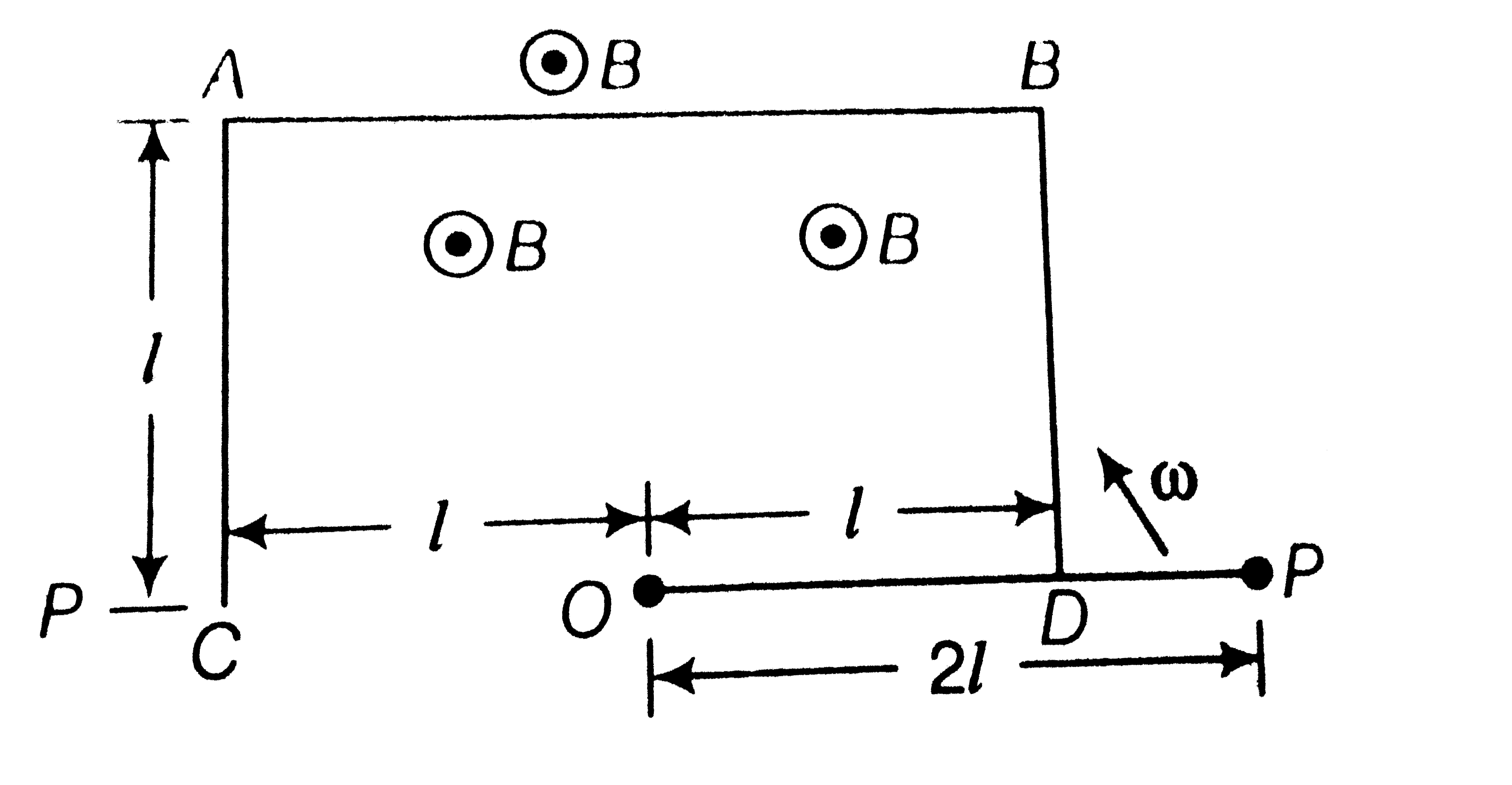
ODBAC is a fixed rectangular conductor of negligible resistance (C0 is not connected) and 0P is a conductor which clockwise with an angular velocity `omega` (figure). The entire system is in a uniform magnetic field B whose direction is along the normal to the surface of the rectangular conductor ABDC. The conductor OP is in electirc contact with ABDC. The rotaating conductor has a resistance of `lambda ` per unit length. Find the current in the rotating conductor, as it rotates by `180^@`.

Text Solution

Verified by Experts
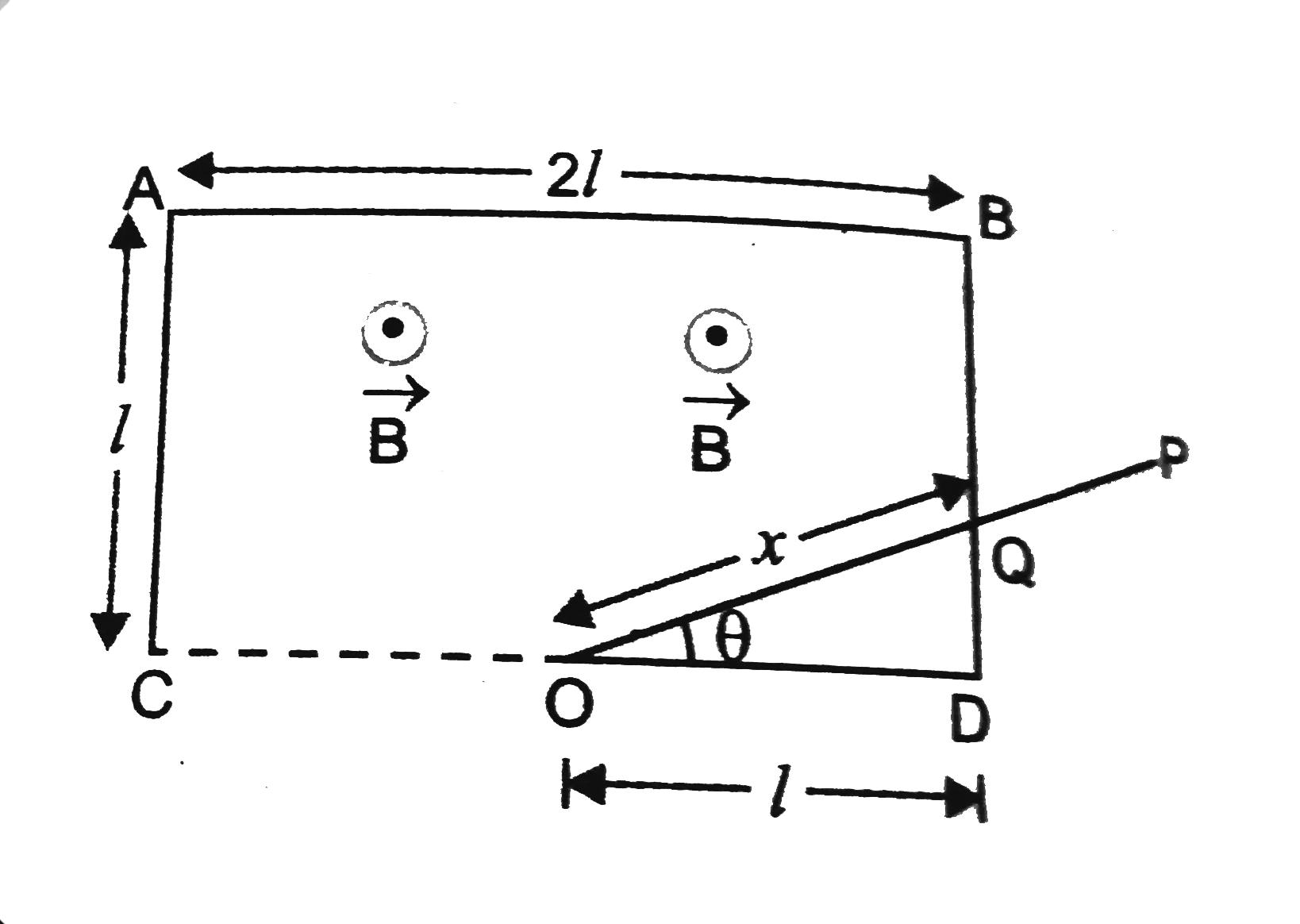
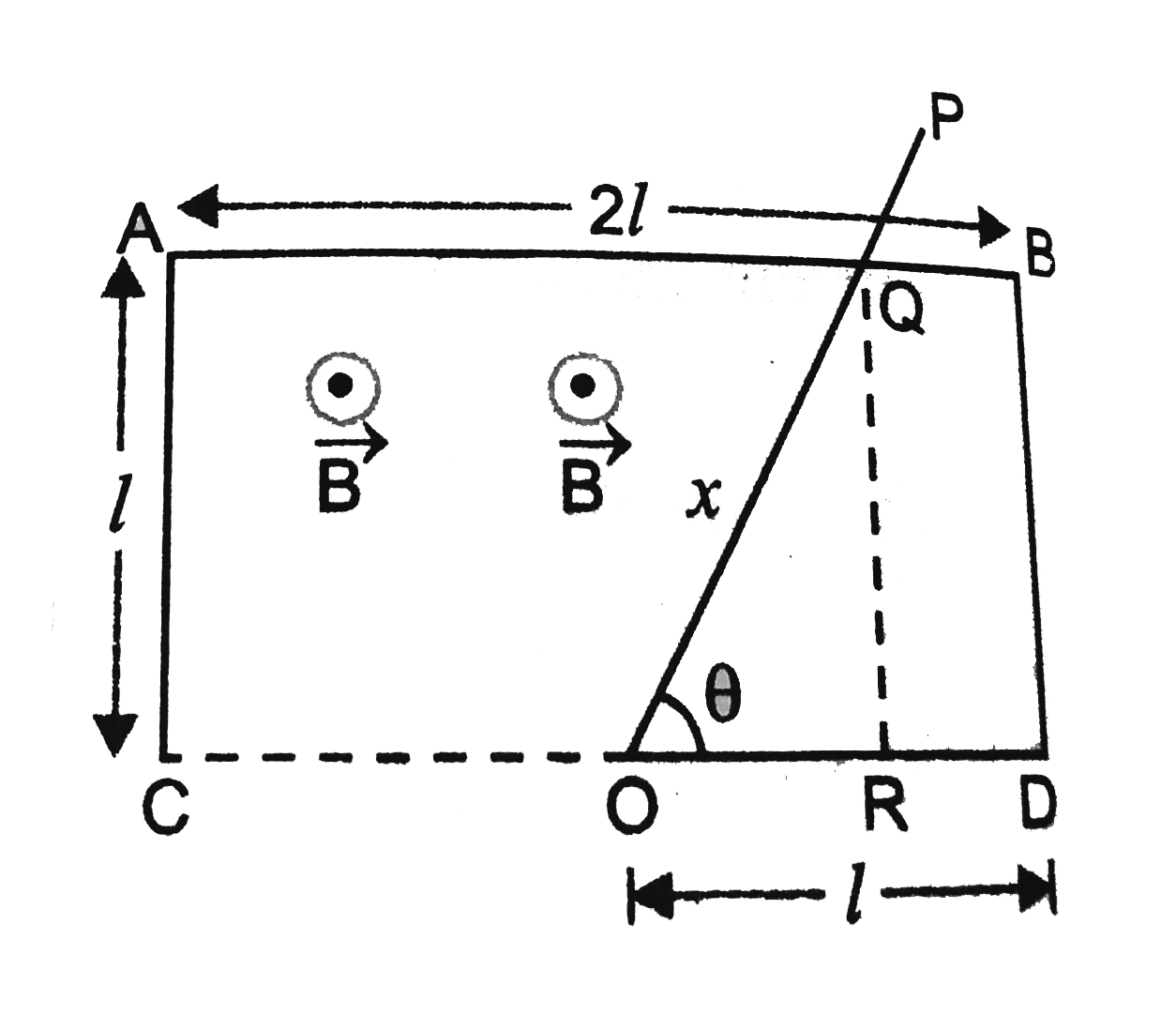
The set up is shon in Fig Between time
t = 0 `t = (T)/(8) = (pi)/(4 omega)`, the rod OP will make contach
with side BD. At any time t: `0 lt t lt (pi)/(4 omega)`, let the length
`:.` Magnetic flux through the area ODQ is
`phi = B xx area OQD = B xx (1)/(2) QD xx OD = B xx (1)/(2) l tan theta xx l`

`phi = (1)/(2) B l^(2) tan theta`, where `theta = omega t`
Magnetic of emf generated, `e = (d phi)/(dt) = (1)/(2) B l^(2) omega sec^(2) omega t`
If R is resistance of the rod in contact, then induced current `I = (e)/(R )`.
Now , `R = lambda x = (lambda l)/(cos omega t) :. I = (1)/(2) (B l^(2) omega sec^(2) omega t)/(lambda l //cos omega t) = (B l omega)/(2 lambda cos omega t)`
For `t = (T)/(8) = (pi)/(4 omega )` to `t = (3T)/(8) = (3 pi)/(8)`, the rod is contact with
the side AB, as shown in Fig. Let the length of the rod in contant, OQ = x.
Magnetic flux linked with area ODBQ
`phi = B xx `area of trapezium ODBQ `= B(l^(2) - (l^(2))/(2 tan theta))`, where `theta = omega t`

Magnitude of emf generated, `e = (d phi)/(dt) = (1)/(2) B l^(2) omega sec^(2) omega t = (1)/(2) B l^(2) omega (sec^(2) omega t)/(tan^(2) omega t)`
Induced current, `I = (e)/(R ) = (e)/(lambda x) = (e sin omega t)/(lambda l) = (1)/(2 lambda) xx (B l omega)/(sin omega t)`
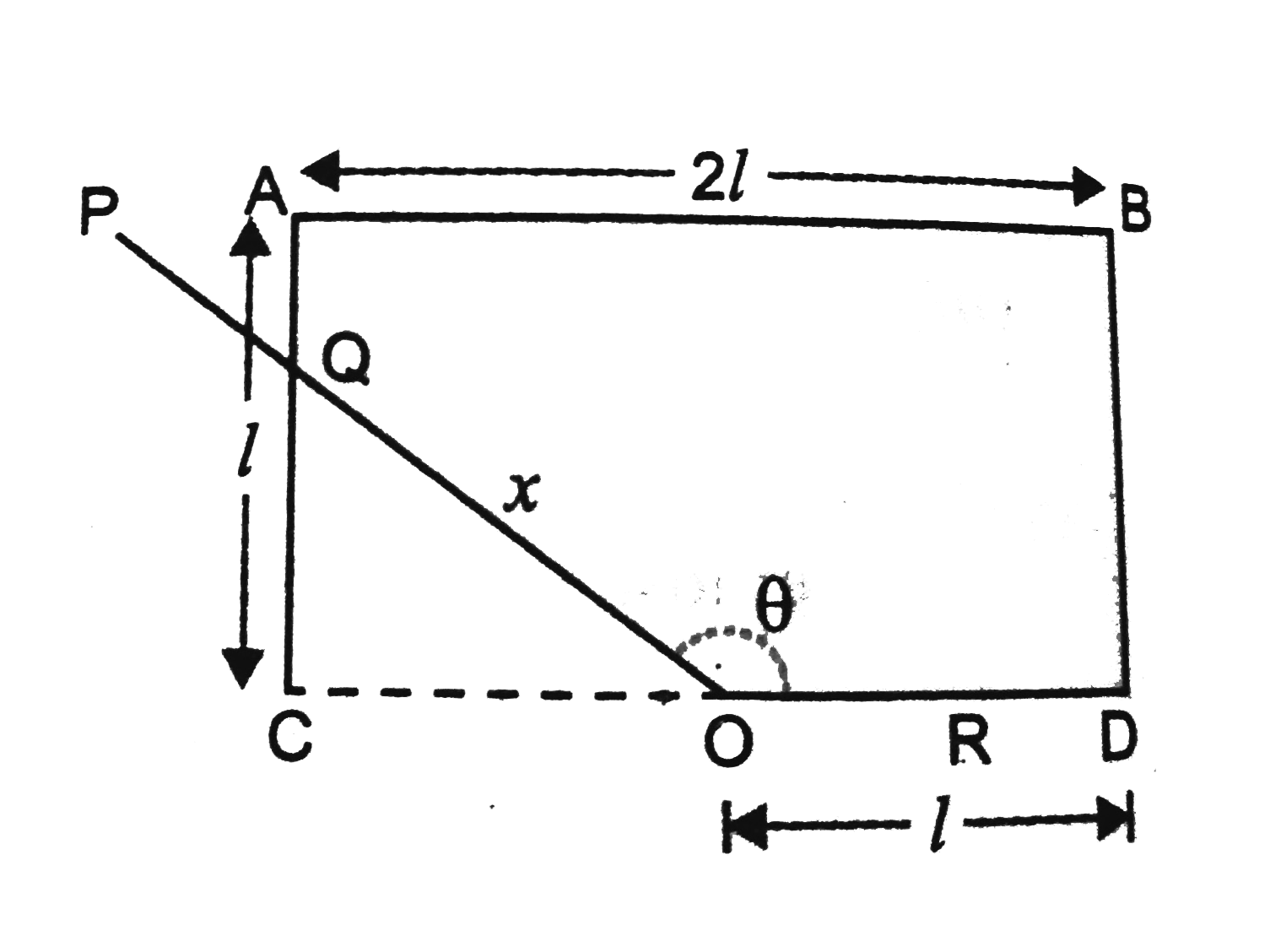
For `t = (3T)/(8) = (3 pi)/(4 omega)` to `t = (4 T)/( 8) = (pi)/(omega)`, the rod is in contact with
the side AC as shown in Fig.
Let the length of the rod in contact OQ = x.
Magnetic flux linked with area ODBAQ
`phi = B xx` [area of rectangular ABDC - area of `Delta OQC`]

`phi = B [2 l^(2) - (l^(2))/(2 tan omega t)]`
Magnitude of induced emf, `e = (d phi)/(dt) = (d)/(dt) B (2 l^(2) - (l^(2))/(2 tan omega t)) = (B omega l^(2) sec^(2) omega t)/(2 tan^(2) omega t)`
Induced current, `I = (e)/(R ) = (e)/(lambda x) = (e sin omega t)/(lambda l) = (B l omega)/(2 lambda sin omega t)`
Promotional Banner

Topper's Solved these Questions

  • ELECTROMAGNETIC INDUCTION & ALTERNATING CURRENT

    PRADEEP|Exercise Very Short Answer Qusetions|1 Videos
  • ELECTROMAGNETIC INDUCTION & ALTERNATING CURRENT

    PRADEEP|Exercise Value Based Questions|2 Videos
  • ELECTROMAGNETIC INDUCTION & ALTERNATING CURRENT

    PRADEEP|Exercise NCERT Question|4 Videos
  • DUAL NATURE OF RADIATION AND MATTER

    PRADEEP|Exercise Exercise|191 Videos
  • ELECTROMAGNETIC WAVES

    PRADEEP|Exercise II Focus multiple choice question|5 Videos

Similar Questions

Explore conceptually related problems

For an ideal conductor thermal resistance is .

The resistance of a conductor is

Resistance of conductor depends on

The resistance of a conductor depends on its

The resistance of a conductor increases with

A circular conductor of uniform resistance per unit length, is connected to a battery of 4 V. The total resistance of the conductor is 4omega . The net magnetic field at the centre of the conductor is