

Home
Class 12
PHYSICS
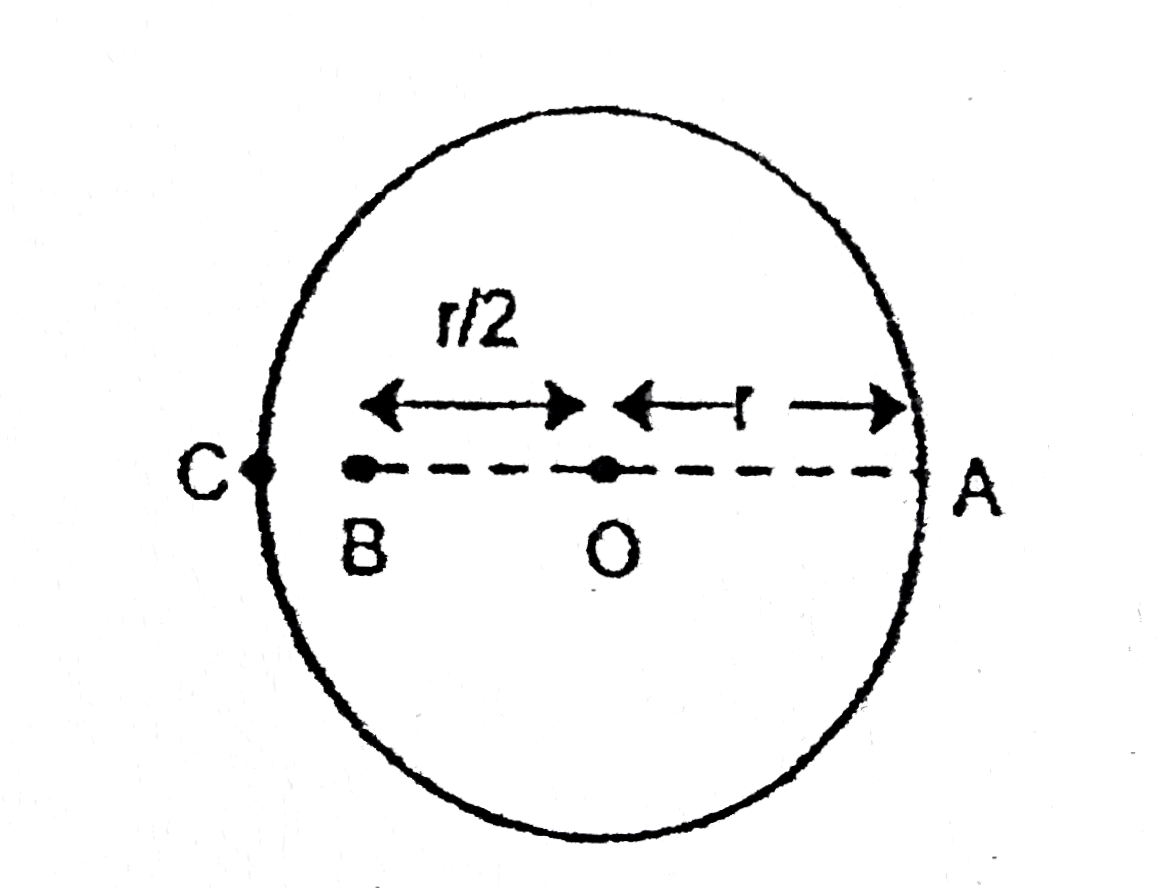
A particle is revolving in a circle of r...

A particle is revolving in a circle of radius `r` and centre at `'O'` with uniform angular velocity `omega`. Choose the correct option(s) :

Promotional Banner

Similar Questions

Explore conceptually related problems

A particle is moving along a circular path of radius 'r' with uniform angular velocity omega . Its angular acceleration is

A particle moving along a circule path of radius 'r' with uniform angular velocity omega . Its angular acceleration is

A particle of mass m is revolving along a circular path of radius r with uniform angular velocity omega . What will be the magnitude and direction of the angular momentum of that particle ?

A particle is moving in a circle of radius r and centre O with constantspeed. What isthe change in velocity in moving from A to B ?

A particle moving in a circular path of certain radius, with uniform angular velocity omega has an angular acceleration equal to :

A particle is moving in a circle of radius r with constant angular velocity omega . At any point (r, theta ) on its path , its position vector is vec(r ) = r cos theta hat(i) + r sin theta hat(j) . Show that the velocity of the particle has no component along the radius.

A particle of mass 'm' is attached to the rim of a uniform disc of mass 'm' and radius R. The disc is rolling wihtout slipping on a stationery horizontal surface as shown in the figure. At a particular instant, the particle is at the topmost position and centre of the disc has speed v_(0) amd its angular speed is omega . Choose the correct option (s).

A particle is moving in a circular orbit of radius r_(1) with an angular velocity omega_(1) . It jumps to another circular orbit of radius r_(2) and attains an angular velocity omega_(2) . IF r_(2) = 0.5 r_(1) and assuming that no external torque is applied to that system, then, the angular velocity omega_(2) is given by

A particle moves in a circle of radius r with constant angular velocity omega . What is the change in velocity when the particle describe an angle of 90^@ ?