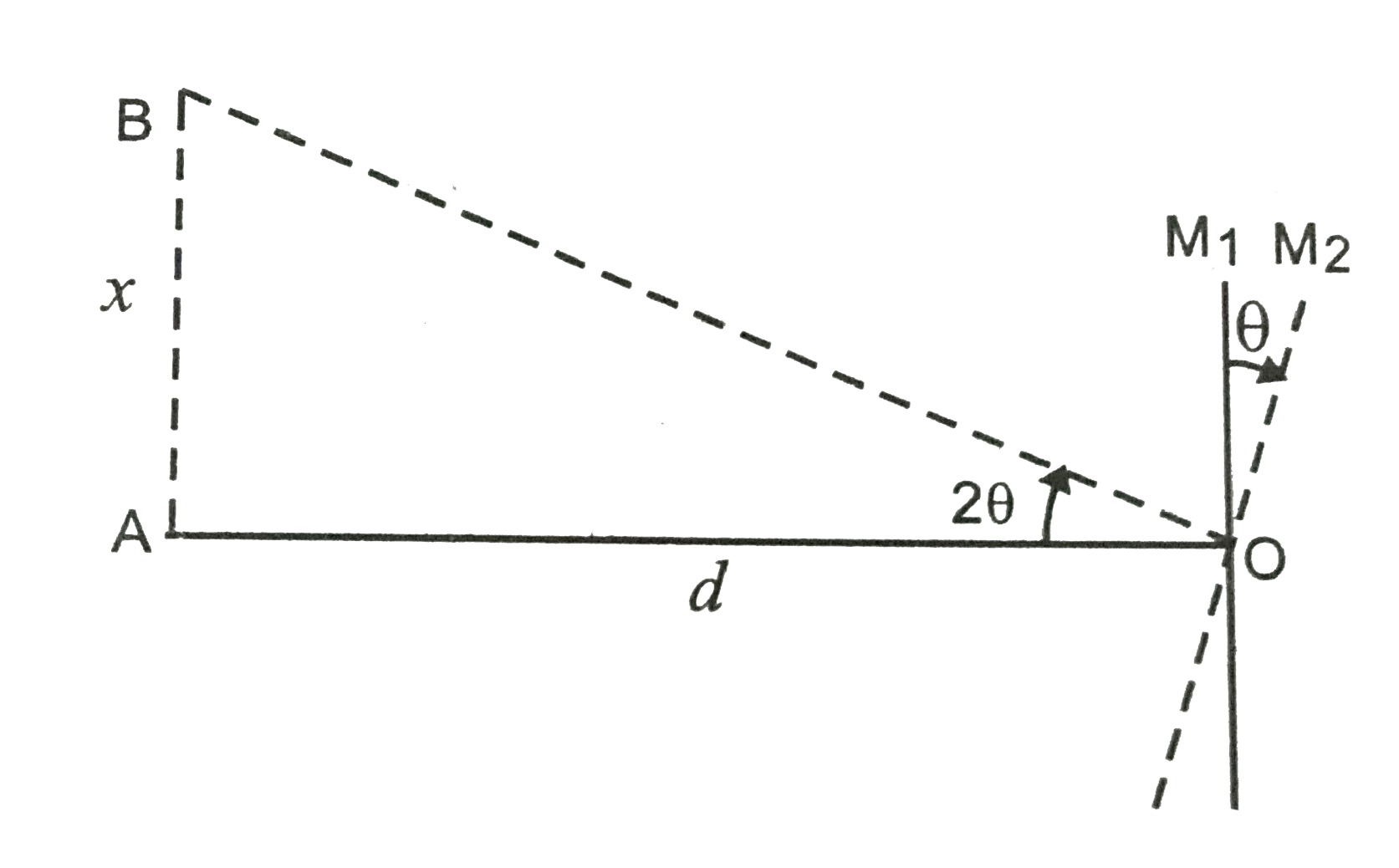
Light incident normally on a plane mirror attached to a galvanometer coil retraces backwards a shown in Fig. 6(a). 14. A current in the coil produces a deflection of `3.5^(@)` in the mirror. What is the displacement of the reflected spot of light on a screen placed `1.5 m` away ?
Text Solution
Verified by Experts
In Fig. when mirror is turned from position `M_(1)` to position `M_(2)` through `angletheta = 3.5^(@)`, `angle2theta = 7^(@) = angleAOB` `OA = d = 1.5 m` Displacement. `AB = x = ?` In `DeltaAOB = tan2theta = (x)/(d)` `x = d tan 2theta = 1.5 tan 7^(@) = 1.5 xx 0.1228 = 0.18 metre`.
Topper's Solved these Questions
OPTICS
PRADEEP|Exercise Very short answer question|5 Videos
OPTICS
PRADEEP|Exercise very short answer questions|1 Videos
A point source of light is placed in front of a plane mirror as shown in Figure. Determine the length of reflected path of light on the screen Sigma
A ray of light is incident at an angle of 35^@ on a plane mirror. What is the angle between the incident and the reflected rays ?
The radius of the coil of a Tangent galvanometer, which has 10 turns, is 0.1 m. The current required to produce a deflection of 60^(@) (B_(H)=4xx10^(-5)T) is
When a current of 1 Ampere is passed through a galvanometer coil, it is deflected through 20◦. But when it is shunted by a resistance of 12 Omega the same current produces a deflection of 5◦. The resistance of the galvanometer is
A point source has been placed as shown in the figure-. What is the length on the screen that will receive reflected light from the mirror ?
A current of 10^(-5)A produced a deflection of 10^(@) in a moving coil galvanometer . A current of 10^(-6)amp in the same galvanometer produces a deflection of 1^(@)
Two mirrors A and B are placed at right angles to each other as shown in Fig.16.4. A ray of light incident on mirror A at an angle of 250 falls on mirror B after reflection. The angle of reflection for the ray reflected from mirror B would be