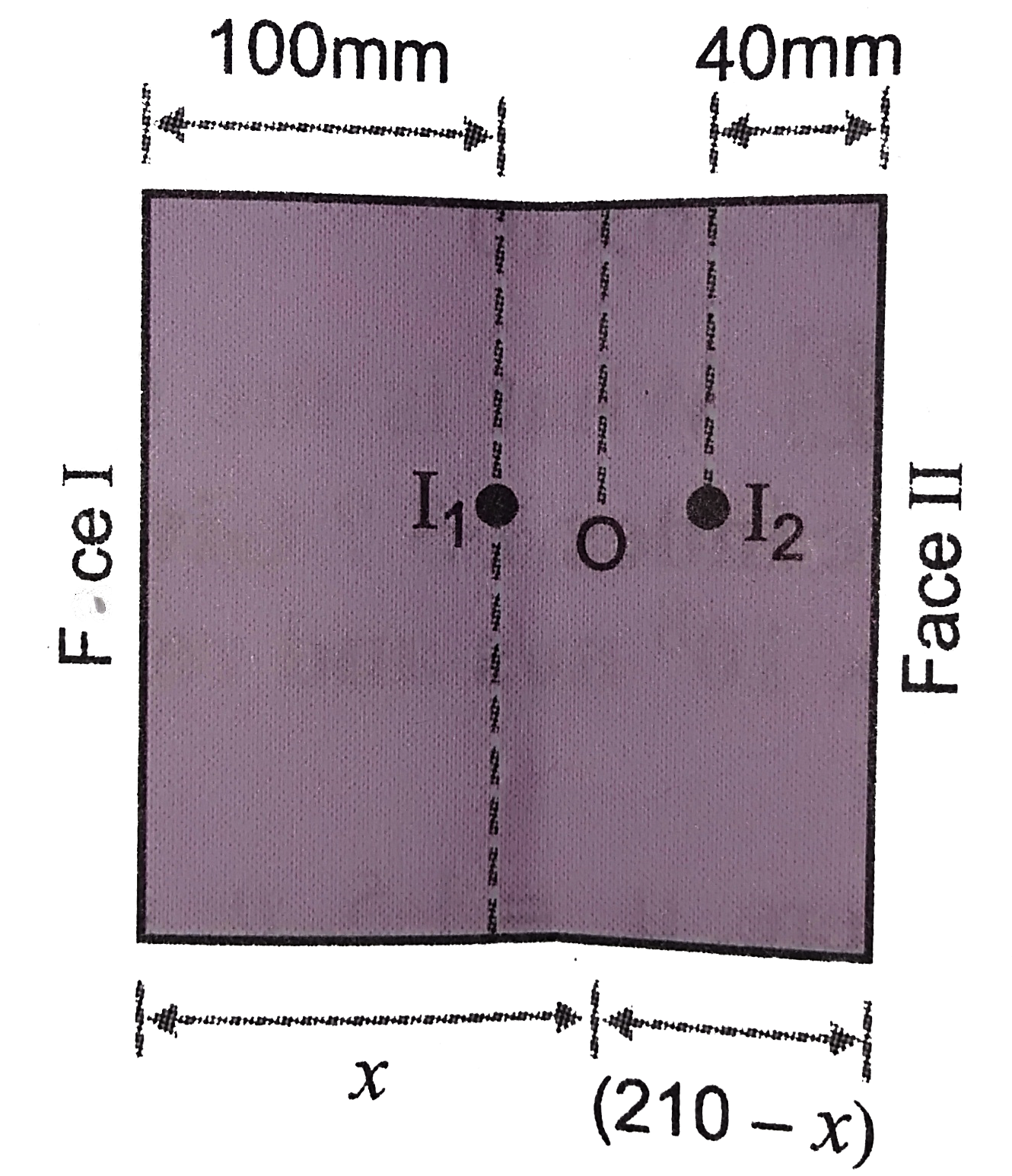
A transparent cube of side `210 mm` contains a small air bubble. Its apparent distance, when viewed from one face of the cube is `100 mm`, and when viewed through opposite face is `40 mm`. What is the actual distance of the bubble from the second face and what is the refractive index of the material of the cube ?
Text Solution
Verified by Experts
Let the bubble be at a distance `x` from face I. As `mu = ("real depth")/("apparent depth")`, therefore, for face I, `mu = (x)/(100)` and for face II, `mu = (210 - x)/(40)` `:. (x)/(100) = (210 - x)/(40) :. x = 150 mm` `:.` Actual distance of bubble from face II `= 210 - x = 210 - 150 = 60 mm` `mu = (x)/(100) = (150)/(100) = 1.5`
Topper's Solved these Questions
OPTICS
PRADEEP|Exercise Very short answer question|5 Videos
OPTICS
PRADEEP|Exercise very short answer questions|1 Videos
A transparent cube of 15 cm edge contains a small air bubble. Its apparent depth when viewed through one face is 6 cm and when viewed through the opposite face is 4 cm . Then the refractive index of the material of the cube is
A transparent cube contains a small air bubble. Its apparent distance is 2 cm when seen through other facel. If the refractive index of the material of the cube is 1.5, the real length of the edge of cube must be
An air bubble inside a glass slab (µ=1.5) appears 6 cm when viewed from one side and 4 cm when viewed from the opposite side. The thickness of the slab is
A rectangular box of dimension 15 xx 10xx7 cm is made out from a transparent material, An air bubble is observed from above at a distance of 3 cm when seen from above and at a distance of 0.5 cm when seen from opposite side. What is the refractive index of the material ? Also find the actual distance of the bubble from the upper face.
A charge q is placed at the centre of a cube of side l what is the electric flux passing through two opposite faces of the cube ?