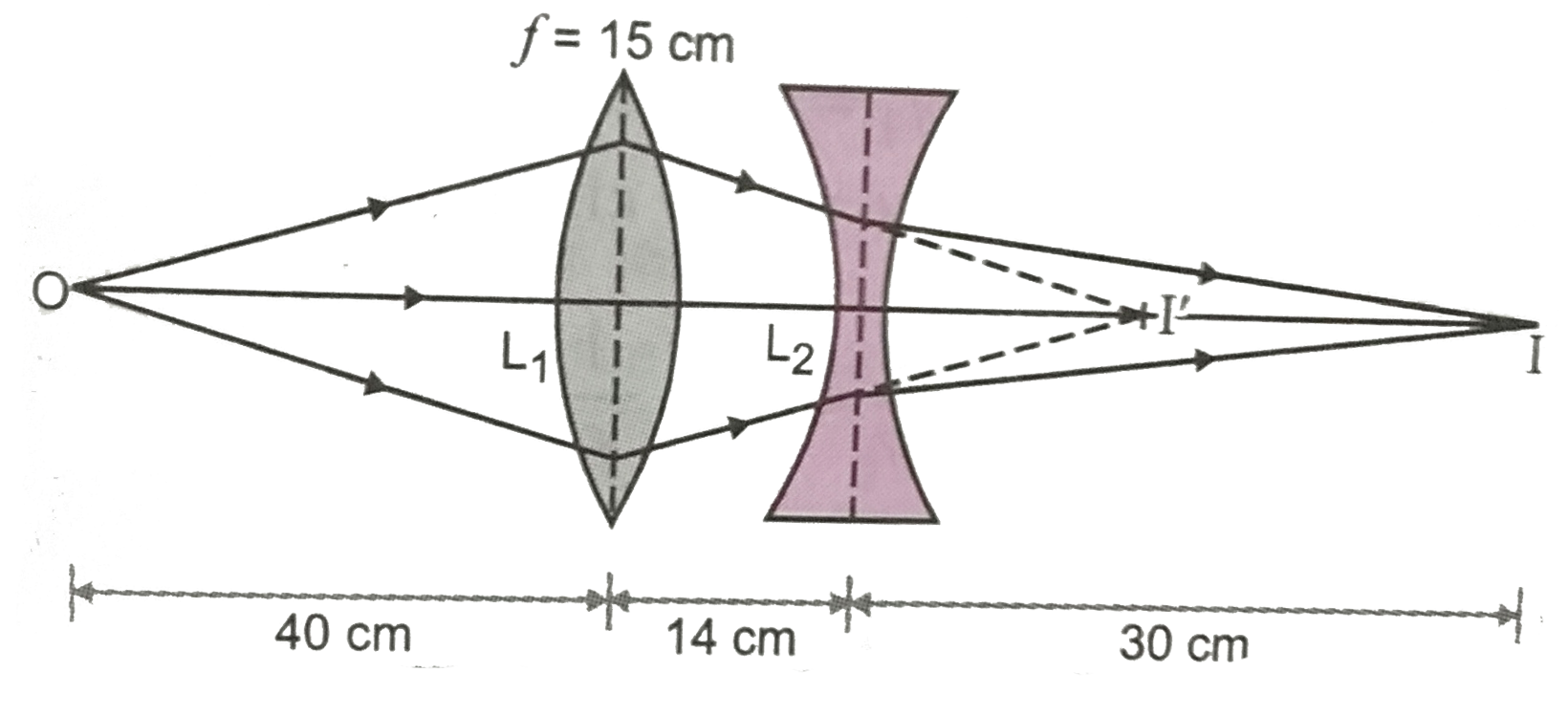
Use the following ray diagram, Fig. 6(b).56 to calculate focal length of lens `L_(2)`.
Text Solution
Verified by Experts
For lens `L_(1), f = 15 cm`, `u = -40cm`, `v = ?` `(1)/(v) = (!)/(f) + (1)/(u) = (1)/(15) - (1)/(40) = (5)/(120), v = 24 cm` The image would have been at `I'`, where `L_(1)I' = 24 cm`. `I'` serves as object for `L_(2)` `u = + (24 - 14) = 10 cm, v = 30 cm, f = ?` `(1)/(f') = (1)/(v) - (1)/(u) = (1)/(30) - (1)/(10) = (1)/(15) f = - 15 cm`
Topper's Solved these Questions
OPTICS
PRADEEP|Exercise Very short answer question|5 Videos
OPTICS
PRADEEP|Exercise very short answer questions|1 Videos
Use the following ray diagram, Fig. to calculate focal length of lens L_2 . .
From the ray diagram shown in Fig. calculte the focal length of concave lens. .
From the ray diagram shown below, calculate the focal length of the other convex lens.
Find the focal length of the lens shown in Fig.
The power of a combination of two lenses X and Y is 5 D. If the focal length of lens X be 15 cm: a) Calculate the focal length of lens Y. b) State the nature of lens Y.
In the following ray diagram the positions of an object O, image I and two lenses L_(1) and L_(2) and a mirror M are given. The focal length of L_(1) is 10 cm. Find the focal length of L_(2) .
Which of the following ray diagrams is correct for the ray of light incident on a lens shown in Fig. ? Choices are given in Fig.
An object placed 50 cm from a lens produces a virtual image at a distance of 10 cm in front of the lens. Draw a diagram to show the formation of image. Calculate focal length of the lens and magnification produced.
Draw ray diagrams showing the image formation by a convex lens when an object is placed (a) between optical centre and focus of the lens (b) between focus and twice the focal length of the lens ( c) at twice the focal length of the lens (d) at infinity , (e) at the focus of the lens
(a) Using the ray diagram for a system of two lenses of focal lengths f_(1) and f_(2) in contact with each other, show that the two lens system can be regarded as equivalent to a single lens of focal length f, where (1)/(f)=(1)/(f_(1))+(1)/(f_(2)) Also write the relation for the equivalent power of the lens combination. (b) Determine the position of the image formed by the lens combination given in the figure.