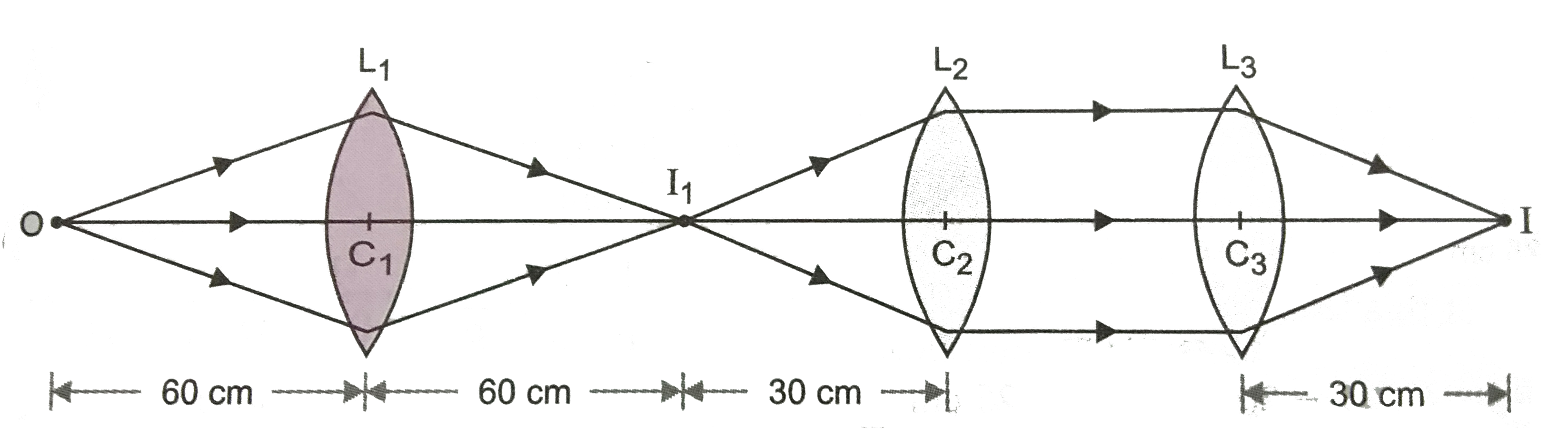
For lens `L_(1)` , `u = - 60cm, f = + 30cm`.
If `v_(1)` is distance of image `I_(1)` from `C_(1)`, then from
`(1)/(v_(1)) - (1)/(u) = (1)/(f_(1))`
`(1)/(v_(1)) = (1)/(f_(1)) + (1)/(u) = (1)/(30) - (1)/(60) = (1)/(60)`
`v_(1) = 60 cm = C_(1)I_(1)`.
As final image `I` is at focus of `L_(3)`, therefore, rays falling on `L_(3)` must be parallel to commen principal axis. For this to happen, `I_(1)` must be at the focus of `L_(2)`. Hence distance between `L_(1)L_(2)` is
`= C_(1)C_(2) = C_(1)I_(1) + I_(1)C_(2) = 60 cm + 30 cm = 90 cm`
and distance between `L_(2)` and `L_(3)` can have any reasonable value, as rays between `L_(2)` and `L_(3)` are parallel rays. The course of rays is shown in Fig.