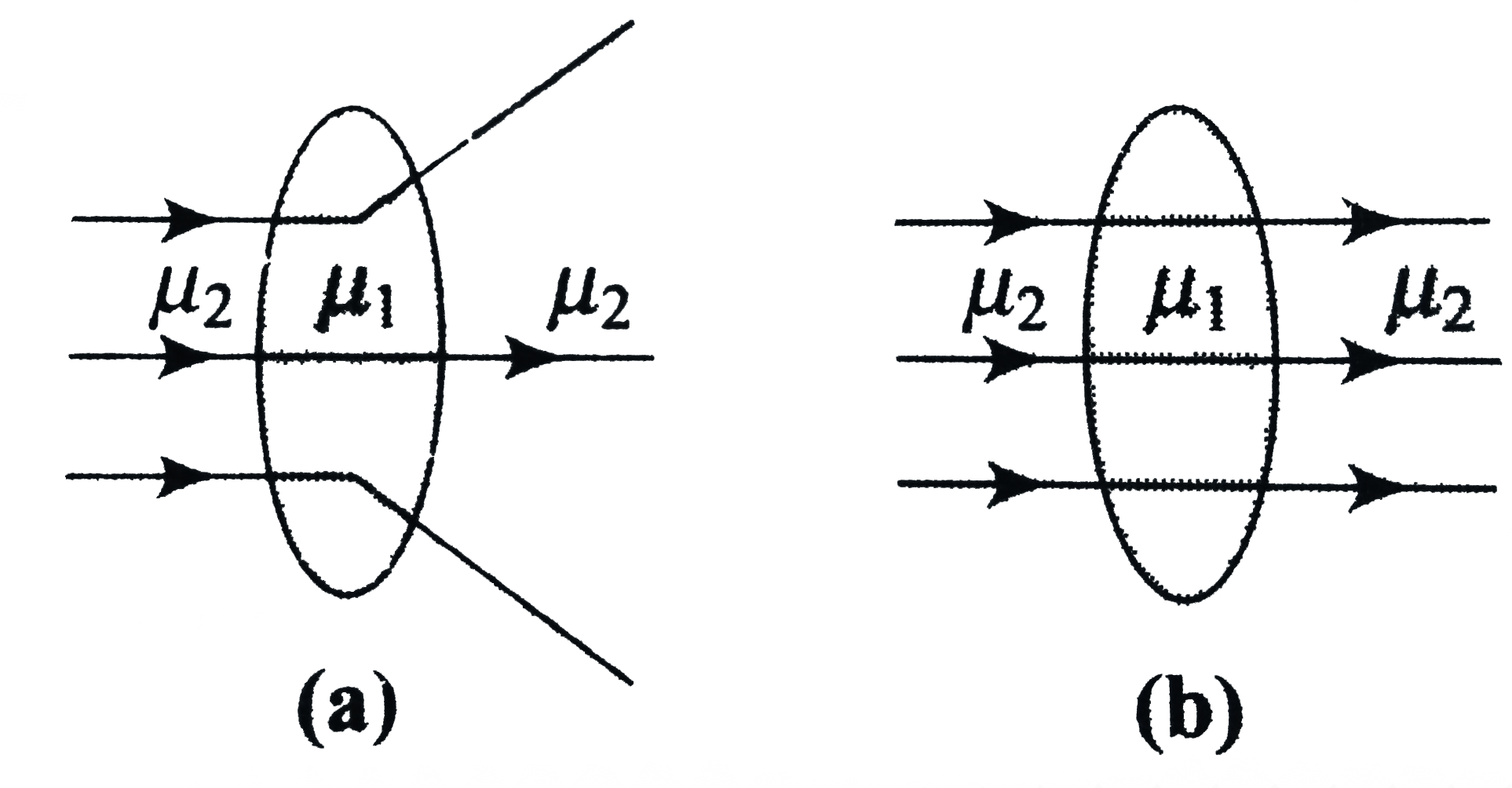
What is the relation between the refractive indices` mu,mu_(1) ` and `mu_(2)` if the behaviour of light rays is shown in Figure.
Text Solution
Verified by Experts
In Fig., the focal length `f` of the lens is given by `(1)/(f) = ((mu)/(mu_(1) - 1))((1)/(R_(1)) - (1)/(R_(2)))` As the rays pass through the lens without any deviation, therefore, `f = oo` `:. ((mu)/(mu_(1) -1))(1)/(R_(1) - (1)/(R_(2))) = (1)/(oo) = 0` For a double convex lens, `((1)/(R_(1)) - (1)/(R_(2))) is +` `:. (mu)/(mu_(1)) = 1 = 0 or (mu)/(mu_(1)) = 1 or mu = mu_(1)` In Fig.(b), `(1)/(f) = ((mu)/(mu_(2)) - 1)((1)/(R_(1)) - (1)/(R_(2)))` As the lens behave as a diverging lens , therefore `f` is negative As the factor `((1)/(R_(1)) - (1)/(R_(2)))` is positive, `:. ((mu)/(mu_(1)) - 1)` is negative i.e., `((mu)/(mu_(2)) - 1) lt 0 or (mu)/(mu_(2)) lt 1 or mu lt mu_(2)`
Topper's Solved these Questions
OPTICS
PRADEEP|Exercise Very short answer question|5 Videos
OPTICS
PRADEEP|Exercise very short answer questions|1 Videos
The relation between refractive indices u, mu_(1),mu_(2) . if the behaviour of light ray is as shown in figure
A monochromatic light is incident on the plane interface AB between two media of refractive indices mu_(1) and (mu_(2)gtmu_(1)) at an angle of incidence theta as shown in Fig. The angle theta is infinitesimally greater than the critical angle for the two media so that total internal reflection takes place. Now, if a transparent slab DEFG of uniform thickness and of refractive index mu_(3) is introduced on the interface (as shown in the figure), show that for any value of mu_(3) all light will ultimately be reflected back into medium II.
A ray of light passes through four transpar ent media with refractive indices mu_(1),mu_(2), mu_(3) and mu_(4) as shown in figure. The surfaces of all media are parallel. If the emergent ray is parallel to the incident ray, we must hav
A rectangular block is composed of three different glass prisms (with refractive indices mu_(1), mu_(2) and mu_(3) ) as shown in the figure below. A ray of light incident normal to the left face emerges normal to the right face. Then the refractive indices are related by
A ray of light passes through a plane boundary separating two media whose refractive indics are mu_(1) = 3//2 and mu_(2) = 4//3 . (i) If the ray travels from medium 1 to medium 2 at an angle of incidence of 30^(@) , what is the angle of refraction ? (ii) If the ray travels form medium 2 to medium 1 at the same angle of incidence, what is the angle of refraction ?
R is the radius of curvature for both the surfaces of lens shown in figure. Refractive index mu_(1), mu_(2) and mu_(3) are indicated in the figure. Light rays are incident from the side of refractive index mu_(1) as shown. If f is focal length of lens then find f//R for mu_(1) = 1, mu_(2)= 1.5, mu_(3)= 2 . |{:(0,1,2,3,4,5,6,7,8,9):}|
A ray of light passes through four transparent media with refractive indices mu_1 , mu_2 , mu_3 and mu_4 as shown in the figure. The surfaces of all media are parallel. If the emergent ray CD is parallel to the incident ray AB, we must have