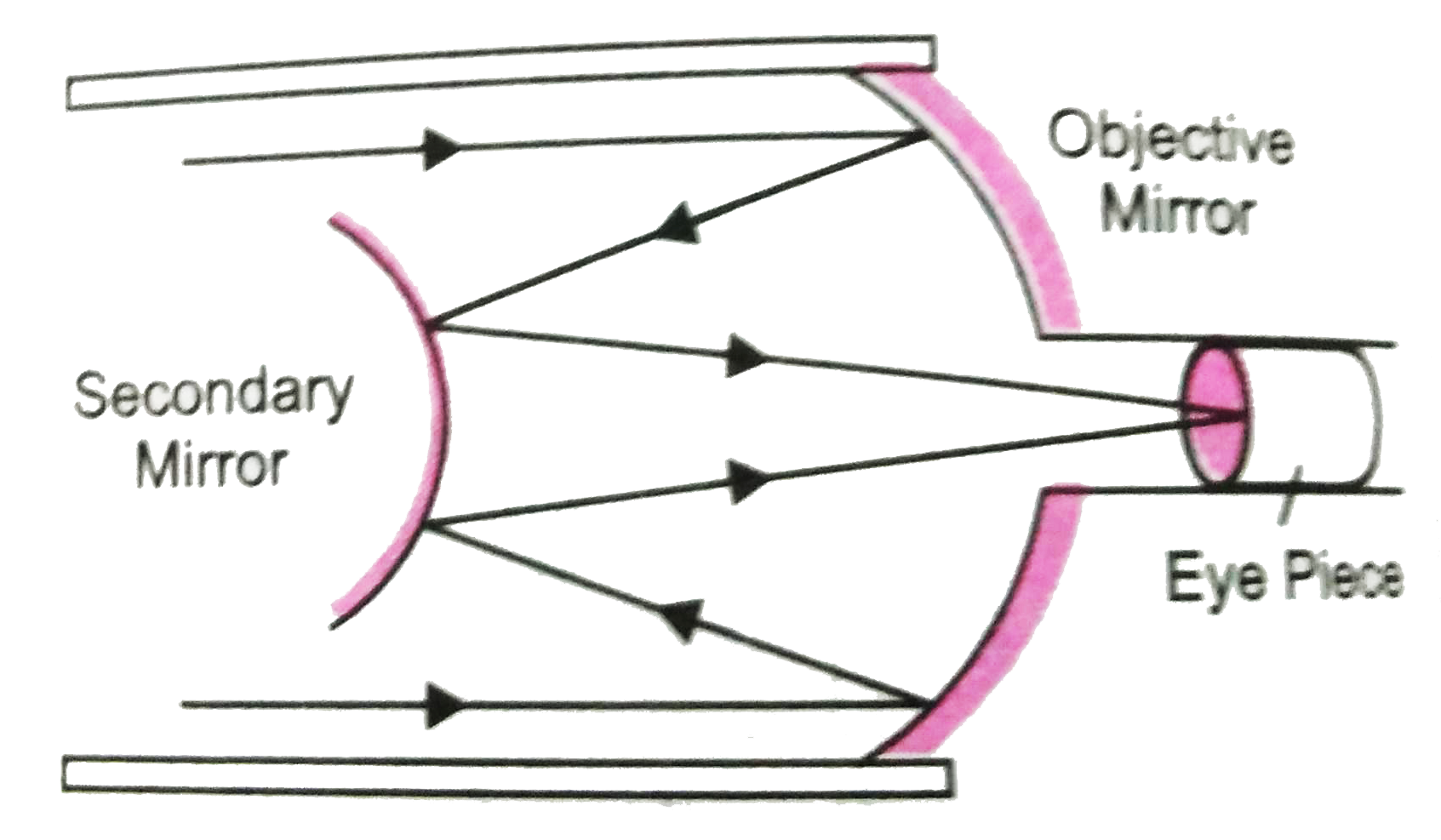
A Cassegrainian telescope uses two mirrors as shown in Fig. Such a telescope is built with the mirrors `20 mm` apart. If the radius of curvature of large mirror is `220 mm` and the small mirror is `40 mm`, where will the final image of an object at infinity be ?
Text Solution
Verified by Experts
Here, radius of curvature of objective mirror `R_(1) = 220 mm` ltbr. Radius of curvature of secondary mirror `R_(2) = 140 mm` , `f_(2) = (R_(2))/(2) = (140)/(2) = 70 mm` Distance between the two mirrors, `d = 20 mm`. When object is at infinity, parallel rays falling on objective mirror, on reflection, would collect at its focus at `f_(1) = (R_(1))/(2) = (220)/(2) = 110 mm` Instead, they fall on secondary mirror at `20 mm` from objective mirror. `:.` For secondary mirror, `u = f_(1) - d = 110 - 20 = 90 mm` From `(1)/(v) + (1)/(u) = (1)/(f_(2))` `(1)/(v) = (1)/(f_(2)) - (1)/(u) = (1)/(70) - (1)/(90) = (9 - 7)/(630) = (2)/(630)` `v = (630)/(2) = 315 mm = 31.5 cm` to the right of secondary mirror.
Topper's Solved these Questions
OPTICS
PRADEEP|Exercise Very short answer question|5 Videos
OPTICS
PRADEEP|Exercise very short answer questions|1 Videos
The radius of curvature of a concave mirror is 50 cm. Where should an object be held from the mirror so as to form its image at infinity?
A convex mirror forms a real image 5 times the size of the object placed at a distance of 20 cm from it. The radius of curvature of the mirror is
In a Cassegrainian telescope, ……………………. is a large concave mirror.
An object is 100 mm in front of a concave mirror which produces an upright image (erect image). The radius of curvature of the mirror is :
An object kept on the principle axis is moving in the sme directions as that of mirror as shown in the figure. Speed of object and mirror is 10(m)/(s) and (40)/(13)(m)/(s) . Radius of the curvature of the mirror is 20 cm. If the distance of object from the mirror at this instant is 5x cm, velocity of image at this instant is found to be zero. Find x.