Home
Class 12
PHYSICS
A circular disc of radius 'R' is placed ...

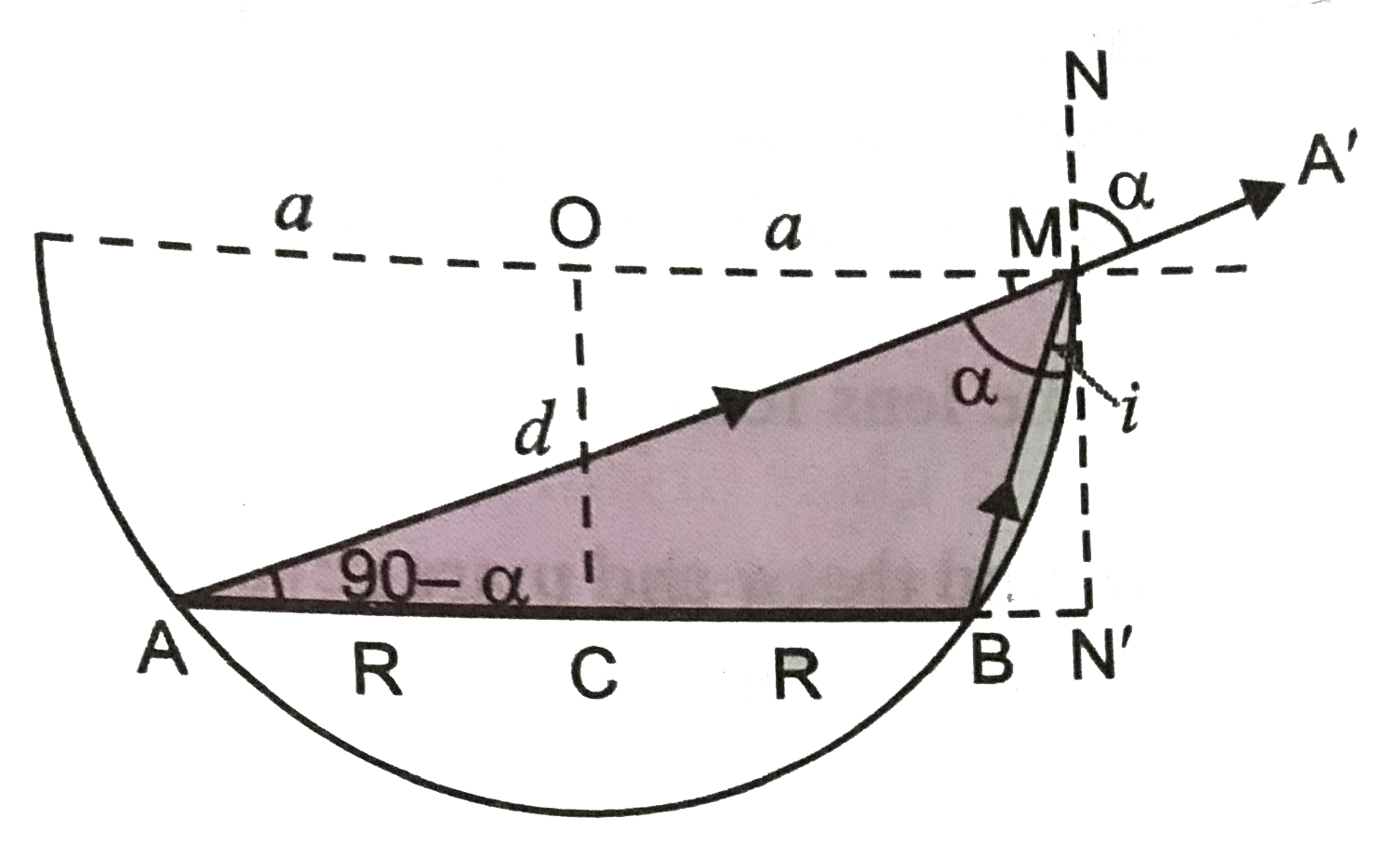
A circular disc of radius 'R' is placed co-axially and horizontally inside and opaque hemispherical bowl of radius 'a', Fig. The far edge of the disc is just visible when viewed from the edge of the bowl. The bowl is filled with transparent liquid of refractive index `mu` and the near edge of the dise becomes just visible. How far below the top of the bowl is the disc placed ?
.

Text Solution

Verified by Experts

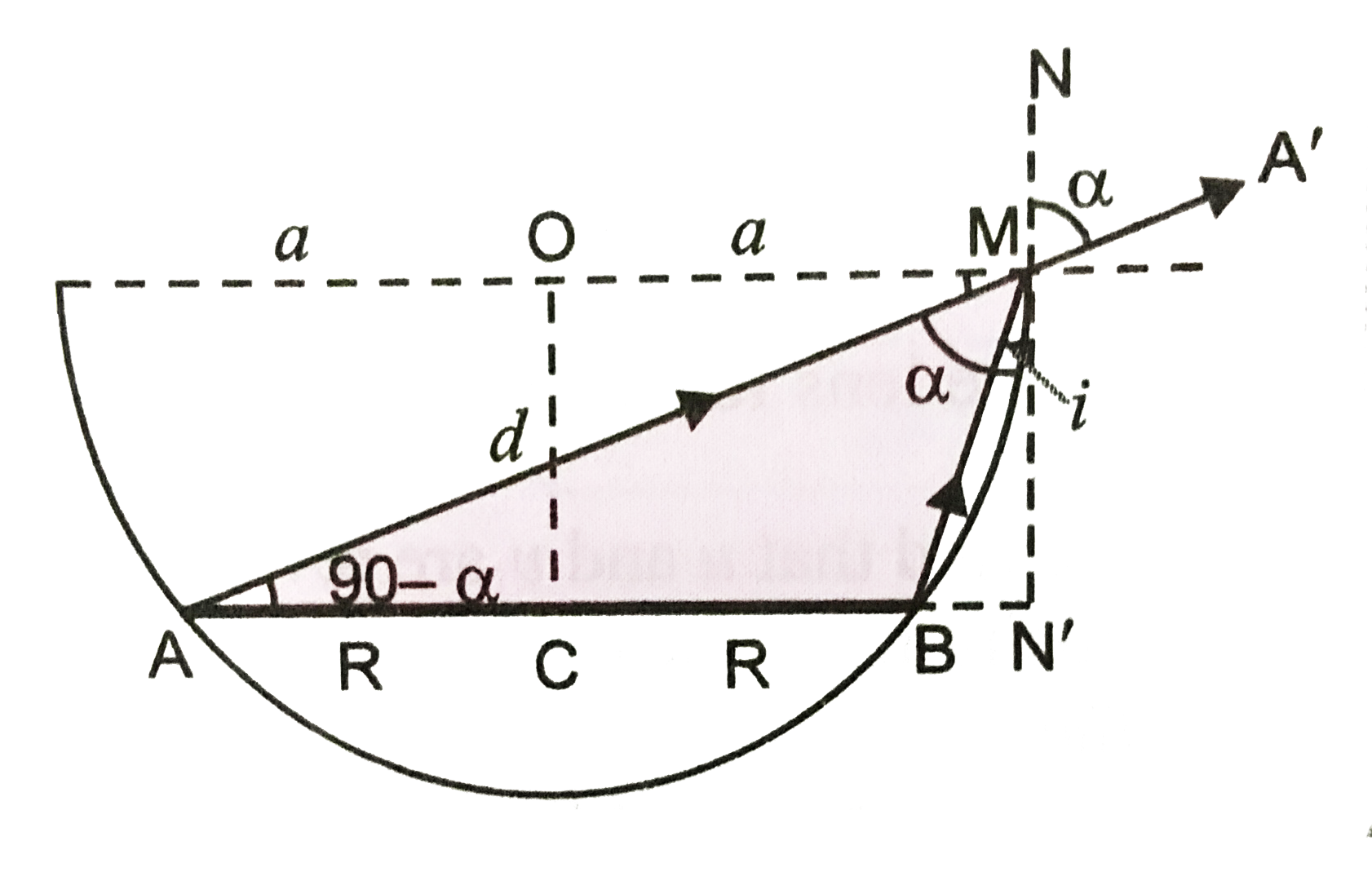
In Fig. we have shwon an opaque hemispherical bowl of raduis a with centre `O`.
A circular disc of radius `R` with centre `C` is placed co-axially and horizontally inside the bowl. We have to calculate `OC = d`.
AMA' is the direction of incident ray before liquid is filled in the bowl.
When liquid of refractive index `mu` is filled in the bowl, the near edge `B` of the disc just becomes visible. Here, `BM` is the incident ray, which is refracted along `MA'`.
`NN"` is normal to the horizontal surface of liquid in the bowl. `i` is the angle of incidence and `r = alpha` is the angle of refraction.
As refraction occurs at `M` in going from denser to rarer medium, therefore, according to Snell's law
`(1)/(mu) = (sin i)/(sin r) = (sin i)/( sin alpha)` ...(i)
Now, `sin i = (BN')/(BM) = (a - R)/(sqrt(d^(2) + (a - R)^(2))) and sin alpha = cos (90 - alpha) = (AN')/(AM) = (a + R)/(sqrt(d^(2) + (a + R)^(2)))`
Putting in (i), we get
`(1)/(mu) = (a - R)/(sqrt(d^(2) + (a - R)^(2))) xx sqrt(d^(2) + (a + R)^(2))/(a + R) or mu xx (a - R)sqrt(d^(2) + (a + R)^(2)) = (a + R) sqrt(d^(2) + (a - R)^(2))`
On simplifying, we get `d = (mu(a^(2) - R^(2)))/(sqrt(a + r)^(2) - mu (a - R)^(2))`
Promotional Banner

Topper's Solved these Questions

  • OPTICS

    PRADEEP|Exercise Very short answer question|5 Videos
  • OPTICS

    PRADEEP|Exercise very short answer questions|1 Videos
  • MAGNETIC EFFECT OF CURRENT AND MAGNETISM

    PRADEEP|Exercise Competition Focus (Multiple Choice Questions)|2 Videos

Similar Questions

Explore conceptually related problems

Find the total surface area of a hemispherical bowl of radius 5cm

A hemispherical bowl of radius r is placed in uniform electric field E . The electric flux passing through the bowl is

If R and r are the external and the internal radii of a hemispherical bowl, then what is the area of the ring, which forms the edge of the bowl (in sq. units)?

A hemispherical bowl is made of steel,0.25cm thick.The inner radius of the bowl is 5cm. Find the outer curved surface area of the bowl.

The radius of a hemispherical bowl is 6 cm. The capacity of the bowl is (Take pi = (22)/(7) )

A small mass of 10 g lies in a hemispherical bowl of radius 0.5 m at a height of 0.1 m from the bottom of the bowl. The mass will be in equilibrius if the bowl rotates at an