In the lens formula, `(1)/(f) = (1)/(v) - (1)/(u)`
We find that u and v reversible. Therefore, there are two positions of the object, for which there will an image on the screen.
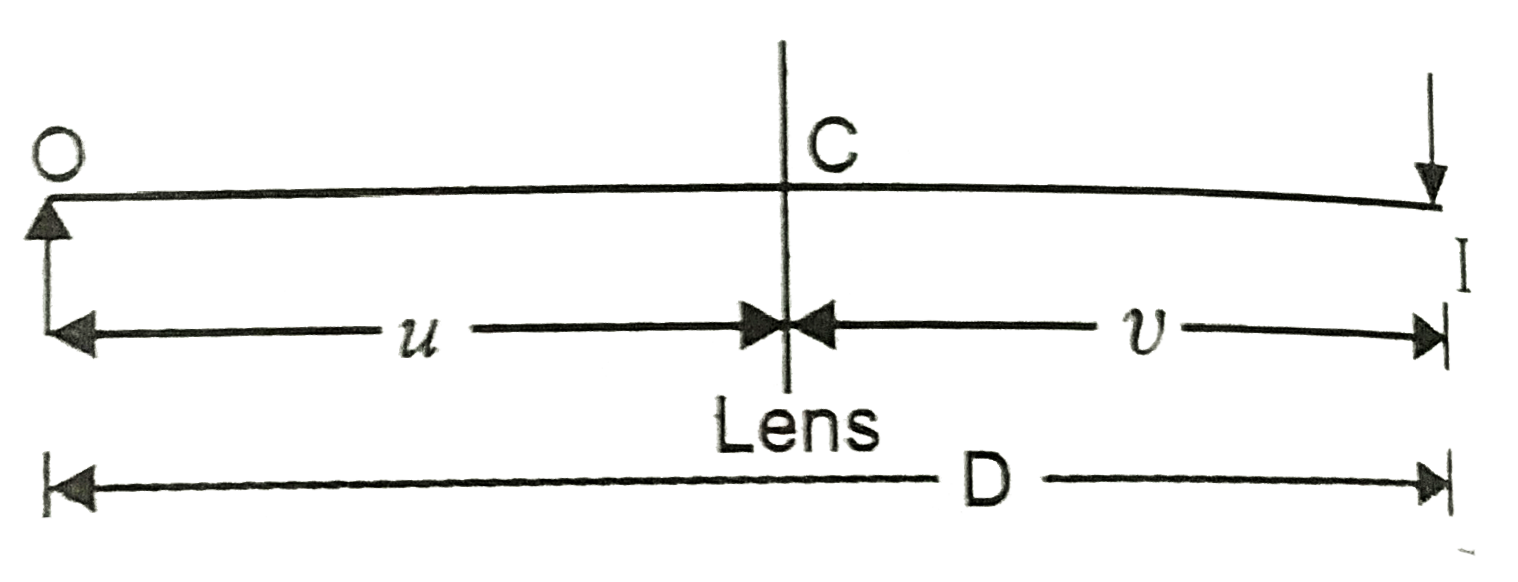
Let the first position be when lens is at `C`, Fig.
`:. -u + v = D =` distance between source (O) and screen I.
or `u = - (D - v)`
Put in (i)
`(1)/(v) + (1)/(D - v) = (1)/(f) or (D - v +v)/(v(D - v)) = (1)/(f) or D v - v^(2) = Df or v^(2) - Dv + Df = 0`.
`:. v = (D +- sqrt(D^(2) - 4 Df))/(2) = (D)/(2)+- (sqrt(D^(2) - 4 Df))/(2) and u = - (D - v) = [(D)/(2)+-(sqrt(D^(2) - 4 Df))/(2)]`
Thus if object distance is `u = (D)/(2) + (sqrt(D^(2) - 4 Df))/(2)`, then image distance is `v = (D)/(2) - (D)/(2) - (sqrt(D^(2) - 4 Df))/(2)`
Again, if object distance is `u = (D)/(2) - (sqrt(D^(2) - 4 Df))/(2)` , then image distance is `v = (D)/(2) + (sqrt(D^(2) - 4 Df))/(2)`
The distance between two position of the lens for these two object distance is
`d = (D)/(2) +(sqrt(D^(2) - 4 Df))/(2) - (D)/(2) + (sqrt(D^(2) - 4 Df))/(2) = sqrt)(D^(2) - 4 Df)`
If `u = (D)/(2) + (d)/(2)`, then `v = (D)/(2) - (d)/(2) :.` magnification, `m_(1) = (v)/(u) = (D - d)/(D + d)`
If `u = (D)/(2) - (d)/(2)`, then `v = (D)/(2) + (d)/(2) :.` magnification, `m_(2) = (v)/(u) = (D + d)/(D - d)`.