Home
Class 12
PHYSICS
The anode vollage of a photocell is kept...

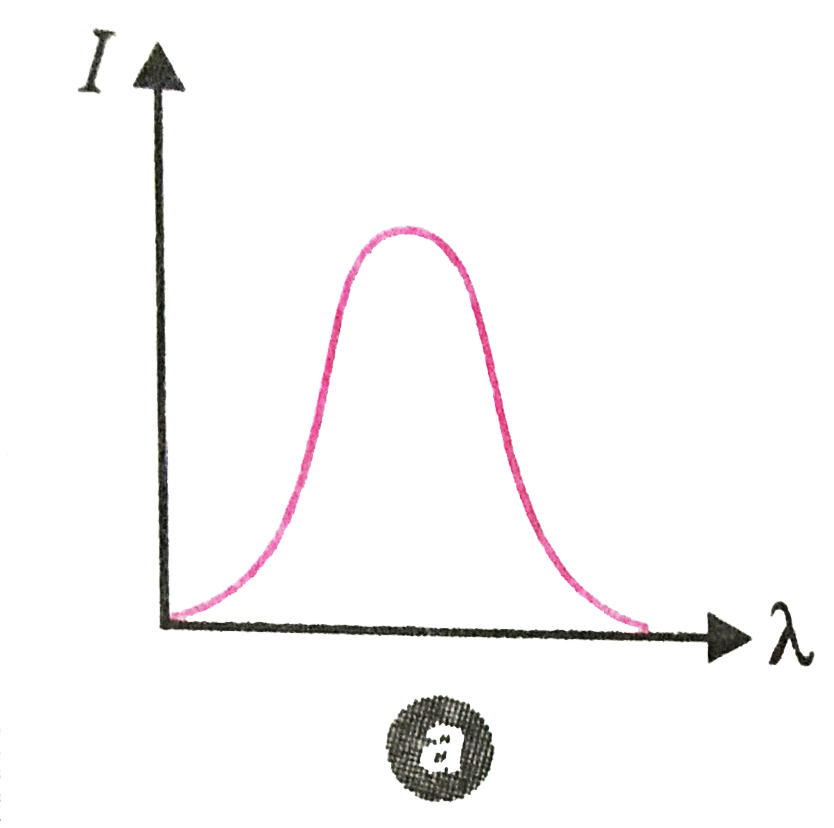
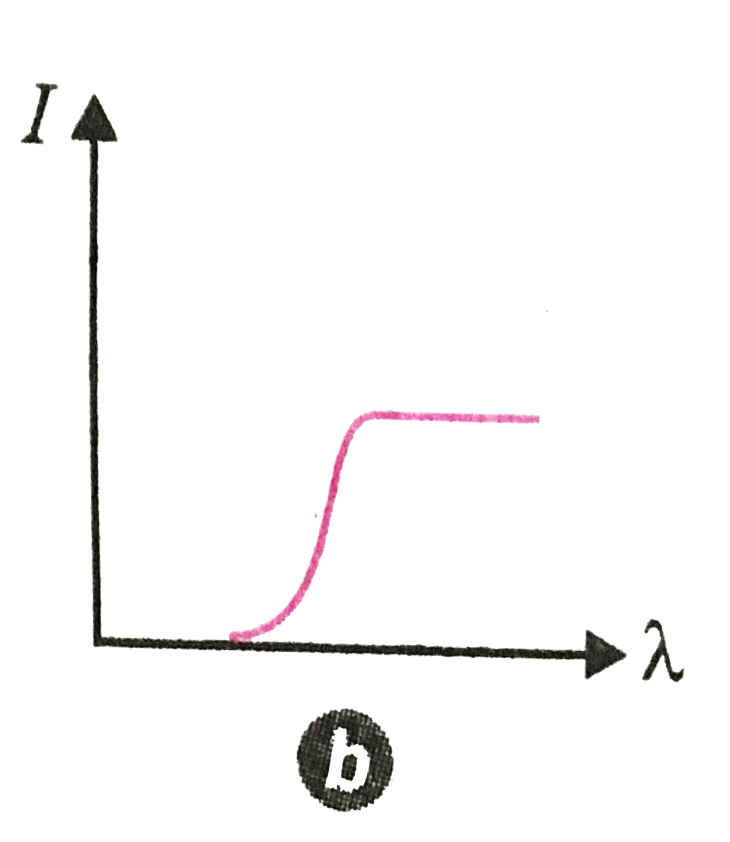
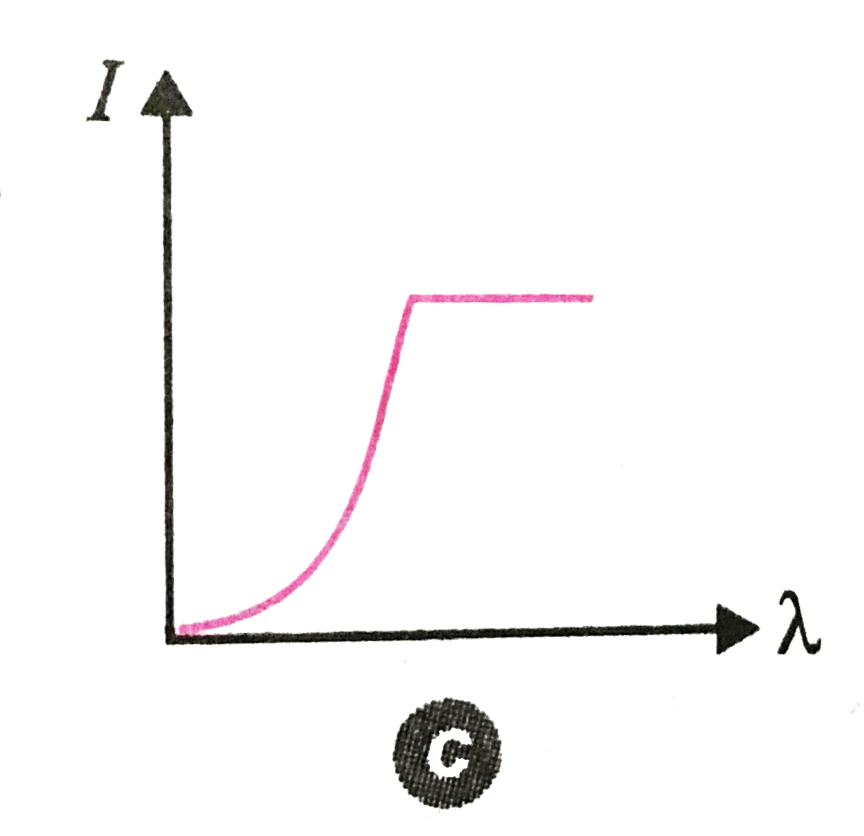
The anode vollage of a photocell is kept fixed . The wavelength `lambda `of the light falling on the cathode varies as follows

A

B

C

D

Text Solution

Verified by Experts

The correct Answer is:

d

As the wavelength `lambda` of the incident light falling on cathode is gradually increased, there will be a value of `lambda` above which the photoelectric emission will stop. I.e., the photoelectric emission will stop. i.e, the photoelectric current will become zero. As `lambda` is decreased, the energy of the incident photons increases `(E=hc//lambda)`. Due to it, more number of photons will be successful in ejecting the electrons from the surface of cathode. As a result of it, the photoelectric current increases, i.e., `I prop 1//lambda` Thus, option (d) is true.
Promotional Banner

Topper's Solved these Questions

  • DUAL NATURE OF RADIATION AND MATTER

    PRADEEP|Exercise Value based question|1 Videos
  • CURRENT ELECTRICITY

    PRADEEP|Exercise Problems for Practice (B)|2 Videos
  • ELECTROMAGNETIC INDUCTION & ALTERNATING CURRENT

    PRADEEP|Exercise Multiple Choice Questions|1 Videos

Similar Questions

Explore conceptually related problems

The anode voltage of photocellis kept fixed. The wavelength lambda of the light falling on the cathode is gradually changed. The plate current I of the photocell varies as follows:

The stopping potential in a photoelectric experiment is linearly related to the inverse of the wavelength (1/lambda) of the light falling on the cathode. The potential difference applied across an X-ray tube is linearly related to the inverse of the cutoff wavelength (1/lambda) of the X-ray emitted. Show that the slopes of the lines in the two cases are equal and find its value.

The cathode and anode in a photocell are respectively.

In the experimental setup for a photocell, the wavelength of the light incident on the cathod is initially 0.6 times the threshold wavelength for the material of the cathode. Certain change in the experimental setup are given in column A and their possibel effects are given in column B. {:("Column A","Column B"),((i)"The intensity of the incident light is doubled but the frequency remains unaltered",(a)"Photocurrent remains the same"),((ii)"Both the intensity and wavelength of the incident light are doubled",(b)"Photcurrent falls to zero"),((iii)"The intensity of the incident light is doubled and its wavelength is made half",(c)"Stopping potential increase"),((iv)"The intensity of the incident light ramains the same and the wavelength is made half",(d) "Photocurrent increases"):}

The maximum kinetic energy of photoelectron is doubled when the wavelength of light incident on the photosensitive changes from lambda_1 to lambda_2 . Deduce expression for the threshold wavelength and work function for metals in terms of lambda_1 and lambda_2

If lambda_(0) is the threshold wavelength for photoelectric emission. lambda wavelength of light falling on the surface on the surface of metal, and m mass of electron. Then de Broglie wavelength of emitted electron is :-

If one angle of a triangle is kept fixed then the measure of the remaining two angles vary inversely with each other

A vacuum photocell consists of a central cathode and an anode. The internal surface is silver of work function 4.5 eV. The contact potential difference between the electrodes equals to 0.6 V. The photocell is illuminated by light of wavelength 2.3xx10^-7 m. a. What retrading potential difference should be applied between electrodes of the photocell for the photocurrent to drop to zero? b. If a retarding potential of 1V is applied between electrodes at what limiting wavelength lamda of light incident on the cathode will on the cathode will the photoelectric effect begin?

PRADEEP-DUAL NATURE OF RADIATION AND MATTER-Exercise
  1. A and B are two metals with threshold frequencies 1.8xx10^(14)Hz and 2...

    Text Solution

    |

  2. The fig. shows the variation of photon current with anode potential fo...

    Text Solution

    |

  3. The anode vollage of a photocell is kept fixed . The wavelength lambda...

    Text Solution

    |

  4. In a photoemissive cell, with exciting wavelength lambda, the faster e...

    Text Solution

    |

  5. The collector plate in an experiment on photoelectric effect is kept v...

    Text Solution

    |

  6. When a certain metallic surface is illuminated with monochromatic ligh...

    Text Solution

    |

  7. The kinetic energy of an electron is E when the incident wavelength is...

    Text Solution

    |

  8. When light of wavelength 400nm is incident on the cathode of photocell...

    Text Solution

    |

  9. A photosenstive metallic surface has work function hv(0). If photons o...

    Text Solution

    |

  10. Maximum velocity of photoelectrons emitted by a metal surface is 1.2xx...

    Text Solution

    |

  11. If the frequency of light in a photoelectric experiment is doubled the...

    Text Solution

    |

  12. The velocity of the most energetic electrons emitted from a metallic s...

    Text Solution

    |

  13. Light of wavelength lambda strikes a photo - sensitive surface and ele...

    Text Solution

    |

  14. Two identical metal plates show photoelectric effect by a light of wav...

    Text Solution

    |

  15. A metal is illumimated by light of two different wavelength 248nm and ...

    Text Solution

    |

  16. Monochromatic light of frequency f(1) incident on a photocell and the ...

    Text Solution

    |

  17. A metal plate is exposed to light with wavelength lambda. It is observ...

    Text Solution

    |

  18. Photoelectric emission is observed from a metallic surface for frequen...

    Text Solution

    |

  19. The threshold frequency for certain metal is v0. When light of frequen...

    Text Solution

    |

  20. Silver has a work function of 4.7 eV. When ultraviolet light of wavele...

    Text Solution

    |
