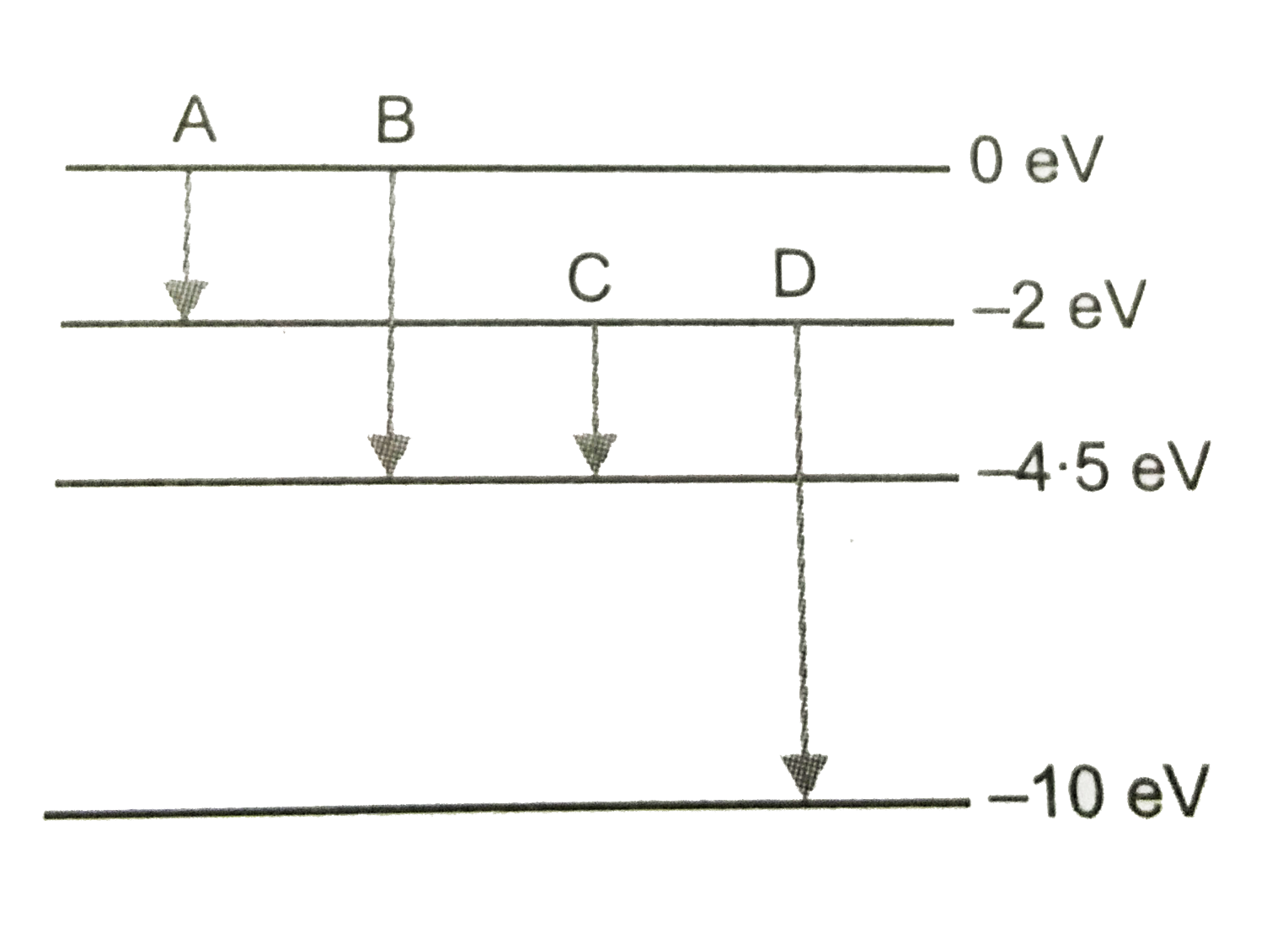
The energy levels of an atom are shown in fig. Which transition corresponds to emission of radiation of (i) maximum wavelength (ii) minimum wavelength?
Text Solution
Verified by Experts
As energy emitted, `E=(hc)/lambda prop1/lambda` ` :.` for maximum wavelength , E should be minimum. Transition A for which energy diff. E is minimum corresponds to emission of radiation of max. wavelength. Similarly, transition D for which energy diff. E is maximum, corresponds to emission of radiation of minimum wavelength.
Topper's Solved these Questions
ATOMS AND NUCLEI
PRADEEP|Exercise (II) very short answer 16|1 Videos
ATOMS AND NUCLEI
PRADEEP|Exercise (I) Short Answer questions 1|1 Videos
COMMUNICATION SYSTEMS
PRADEEP|Exercise MODEL TEST PAPER-2|9 Videos
Similar Questions
Explore conceptually related problems
The energy levels of a hypothetical aton are shown below. Which of the shown transitions will result in the emmission of a photon of wavelength 275 nm? Which of these transitions correspond to emission of radiation of (i) maximum and (ii) minimum wavelength?
The energy levels of an atom are as shown in figure . Which one of those transition will result in the emission of a photon of wavelength 275 nm ?
The energy level diagram of an element is given here. Which transition corresponds to the emission of a spectral line of wavelength 102.7nm?
Fig. shows energy level diagram of hydrogen atom. Find out the transition which results in the emission of a photon of wavelength 496 nm. Which transition corresponds to emission of radiation of maximum wavelength? Justify your answer.
The energy levels of an atom of element X are shown in Fig. 20.2. Which one of the level transitions will result in the emission of photons of wavelength 620 nm ? Support your answer with mathematical calculations.
PRADEEP-ATOMS AND NUCLEI-Assertion- Reason type question 12