Home
Class 12
PHYSICS
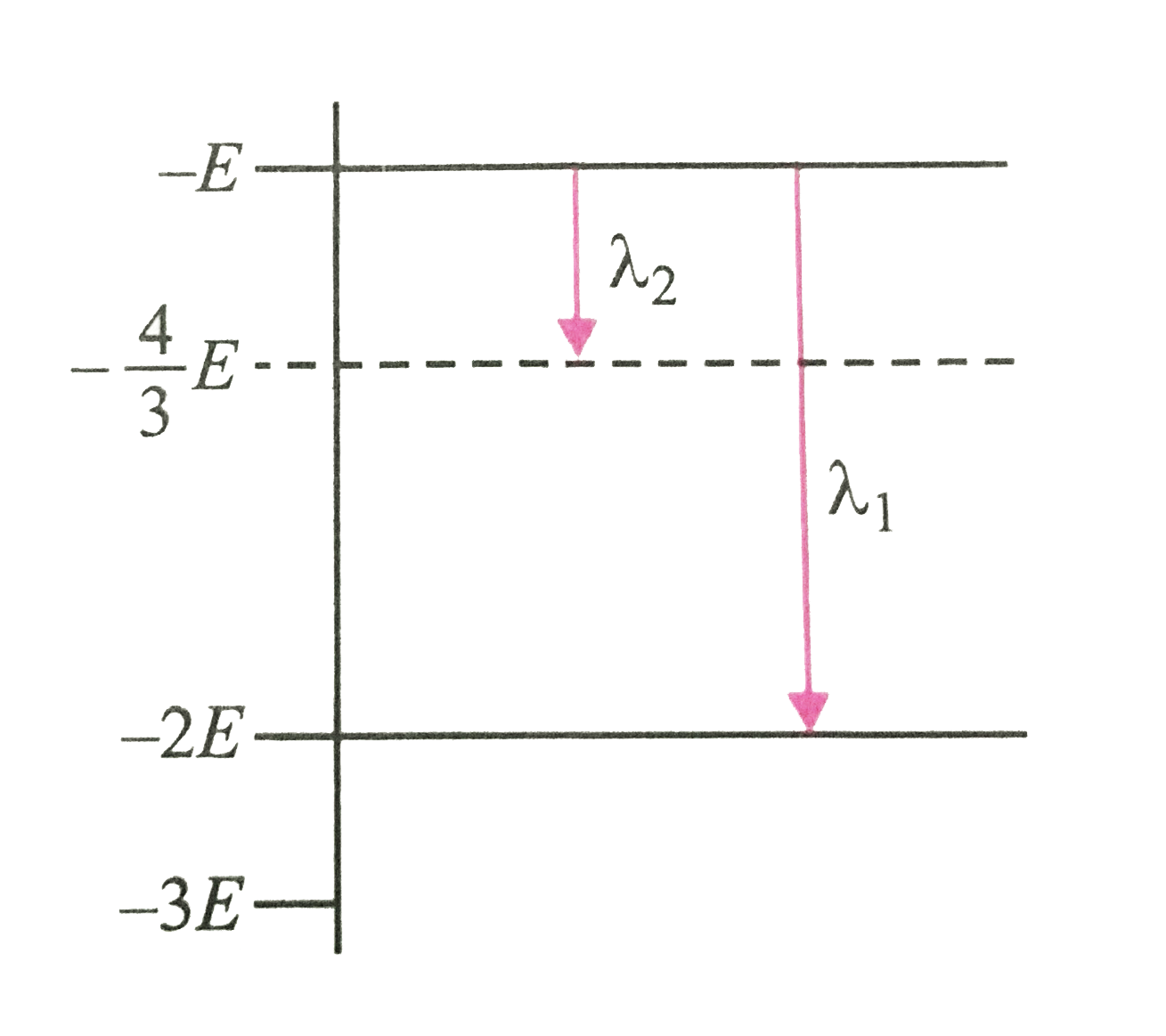
Some energy levels of a molecule are sh...

Some energy levels of a molecule are shown in the fig. The ratio of the wavelengths `r=lambda_(1)//lambda_(2)`, is given by

A

`r=3/4`

B

`r=1/3`

C

`r=4/3`

D

`r=2/3`

Text Solution

Verified by Experts

The correct Answer is:
B

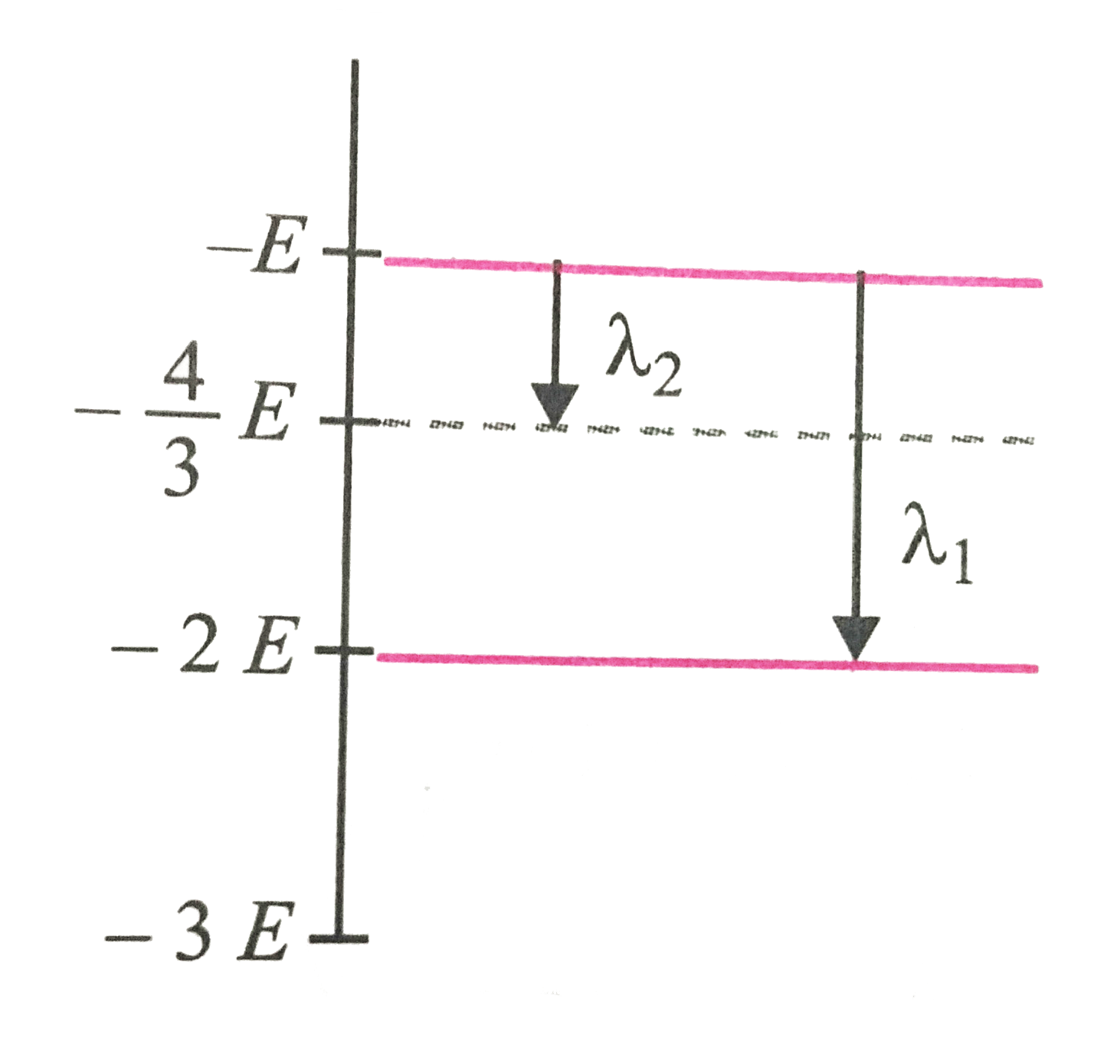
As is clear form fig.
`(hc)/(lambda_(1))=-E-(-2E)=E.......(i)`
and `(hc)/(lambda_(2))=-E-(-4/3 E)=E/3.......(ii)`

Dividing (ii) by (i), we get
`(lambda_(1))/(lambda_(2))=(E//3)/E=1/3`
Promotional Banner

Topper's Solved these Questions

  • ATOMS AND NUCLEI

    PRADEEP|Exercise Fill in the blank 2|1 Videos
  • ATOMS AND NUCLEI

    PRADEEP|Exercise Multiple choice questions 1|1 Videos
  • ATOMS AND NUCLEI

    PRADEEP|Exercise curiocity quetions 3|1 Videos
  • COMMUNICATION SYSTEMS

    PRADEEP|Exercise MODEL TEST PAPER-2|9 Videos

Similar Questions

Explore conceptually related problems

Some energy levels of a molecule are shown in the figure. The ratio of the wavelengths r = lambda_1//lambda_2 is given by -

Some energy levels of a molecule are shown in the figure. The ratio of the wavelength r=lamda_(1)lamda_(2) ,is given by:

If lambda_(1), lambda_(2), lambda_(3) are the wavelengths of the waves giving resonance in the fundamental, first and second overtone modes respecively in a open organ pipe, then the ratio of the wavelengths lambda_(1) : lambda_(2) : lambda_(3) , is :

The energy of a photon of wavelength lambda is given by

If lambda_1, lambda_2 and lambda_3 are the wavelength of the waves giving resonance to the fundamental, first and second overtone modes respectively in a string fixed at both ends. The ratio of the wavelengths lambda_1:lambda_2:lambda_3 is

The following diagram indicates the energy levels of a certain atom when the system moves from 4E level to E . A photon of wavelength lambda_(1) is emitted. The wavelength of photon produced during its transition from (7)/(3)E level to E is lambda_(2) . the ratio (lambda_(1))/(lambda_(2)) will be

PRADEEP-ATOMS AND NUCLEI-Exercise
  1. The wavelength of the first spectral line in the Balmer series of hydr...

    Text Solution

    |

  2. The wavelength of the first line of Lyman series for hydrogen atom is ...

    Text Solution

    |

  3. Some energy levels of a molecule are shown in the fig. The ratio of t...

    Text Solution

    |

  4. Out of the following which one is not a possible energy for a photon t...

    Text Solution

    |

  5. A diatomic molecule is made of two masses m(1) and m(2) which are sepa...

    Text Solution

    |

  6. Electron in hydrogen atom first jumps from third excited state to seco...

    Text Solution

    |

  7. An electrons of a stationary hydrogen aton passes form the fifth enegr...

    Text Solution

    |

  8. The transition form the state n = 3 to n = 1 in a hydrogen-like atom r...

    Text Solution

    |

  9. In a hydrogen like atom electron make transition from an energy level ...

    Text Solution

    |

  10. Hydrogen atom in ground state is excited by a monochromatic radiation ...

    Text Solution

    |

  11. Hydrogen ((1)H^(1)) Deuterium ((1)H^(2)) singly omised helium ((1)He...

    Text Solution

    |

  12. Balmer gives an equation for wavelength of visible radition of H^(-) s...

    Text Solution

    |

  13. The kinetic energy of the electron in an orbit of radius r in hydrogen...

    Text Solution

    |

  14. Consider 3rd orbit of He^(+) (Helium) using nonrelativistic approach t...

    Text Solution

    |

  15. The ratio of wavelength of the lest line of Balmer series and the last...

    Text Solution

    |

  16. The radiation corresponding to 3 rarr 2 transition of hydrogen atom f...

    Text Solution

    |

  17. if lambda(Cu) is the wavelength of Kalpha, X-ray line fo copper (atomi...

    Text Solution

    |

  18. An electron is an excited state of Li^(2 + )ion has angular momentum 3...

    Text Solution

    |

  19. Given the value of Rydberg constant is 10^(7)m^(-1), the waves number ...

    Text Solution

    |

  20. A fission reaction is given by (92)^(236) U rarr(54)^(140) Xe + (38)^(...

    Text Solution

    |

