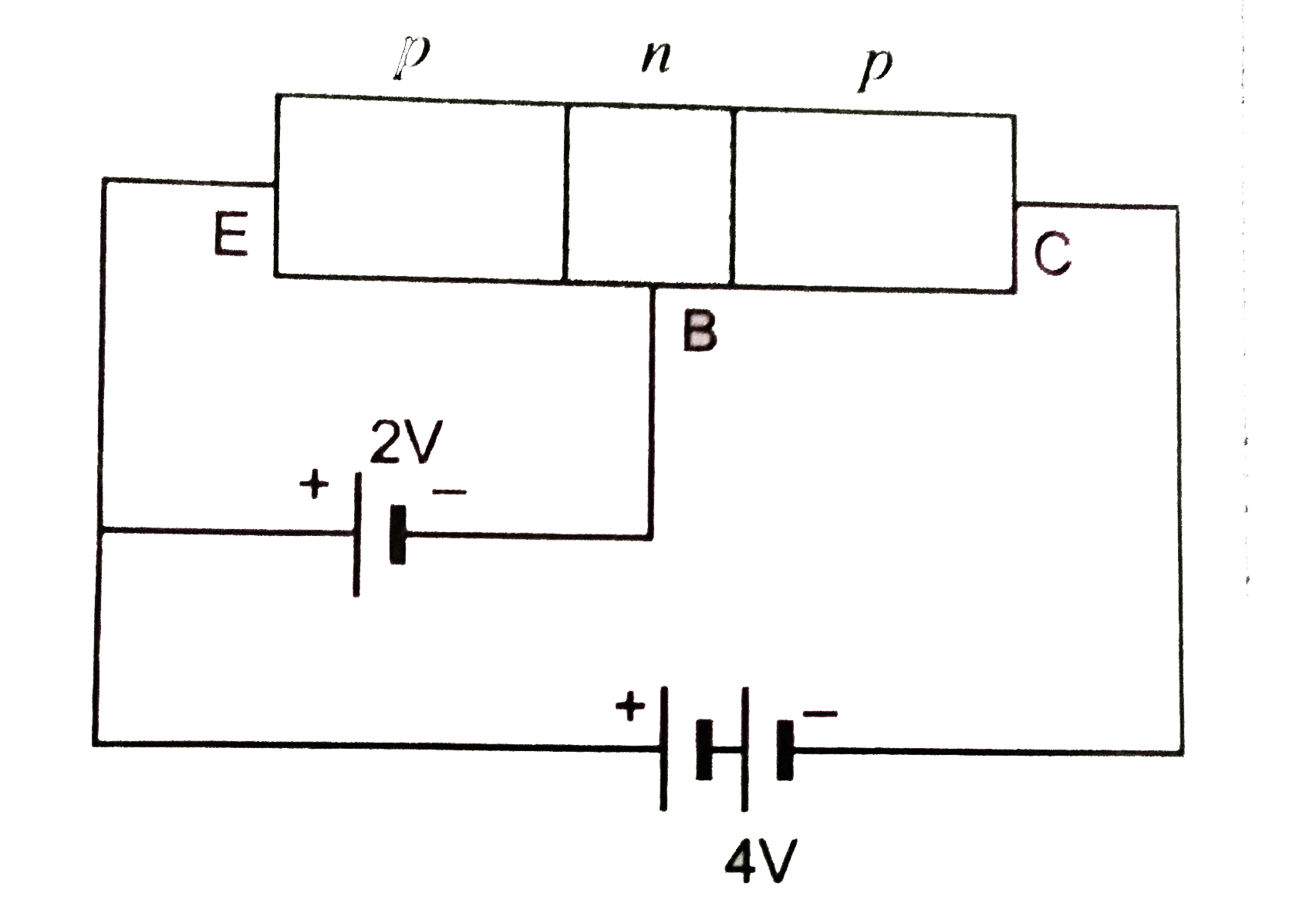
In the p-n-p transistor circuit shown in Fig. What is the potential difference between base and collector? What is the nature of biasing between emitter base junction and collector-base junction?
Text Solution
Verified by Experts
For the collector-base circuit, the two batteries connected in circuit oppose their voltage. Therefore, the potential difference across base-collector voltage `=4-2=2V`, where base is at higher potential and collector is at lower potential. As emitter is connected to positive terminal of 2V battery and base to negative terminal of 2V battery, hence emitter-base junction is forward biased. As discussed above, the collector-base junction is reverse biased.
Topper's Solved these Questions
ELECTRONIC DEVICES
PRADEEP|Exercise SAMPLE PROBLEM|2 Videos
ELECTRONIC DEVICES
PRADEEP|Exercise CONCEPTUAL PROBLEMS|1 Videos
ELECTROMAGNETIC WAVES
PRADEEP|Exercise II Focus multiple choice question|5 Videos
ELECTROSTATICS
PRADEEP|Exercise ASSERTION-REASON TYPE QUESTIONS|2 Videos
Similar Questions
Explore conceptually related problems
In a transistor with normal bias, the emitter base junction
How is the emitter base junction in the transistor biasing ?
Emitter base and collector base junction in n-p-n transistor are
With respect to the potential of emitter, base and collector, a NPN transistor conducts when
in common emitter amplifier, the emitter base junction is
In a transistor, the emitter , base and collector are respectively
In a p-n-p transistor circuit, the collector current is 10mA , If 95% of the electrons emitted reach the collector , what is base current ?
In a junction transistor the emitter, base and collector are made of.
What will happen if emitter be reversebiased and collector be forward biased in a transistor?
At the base emitter junction of a transistor one finds