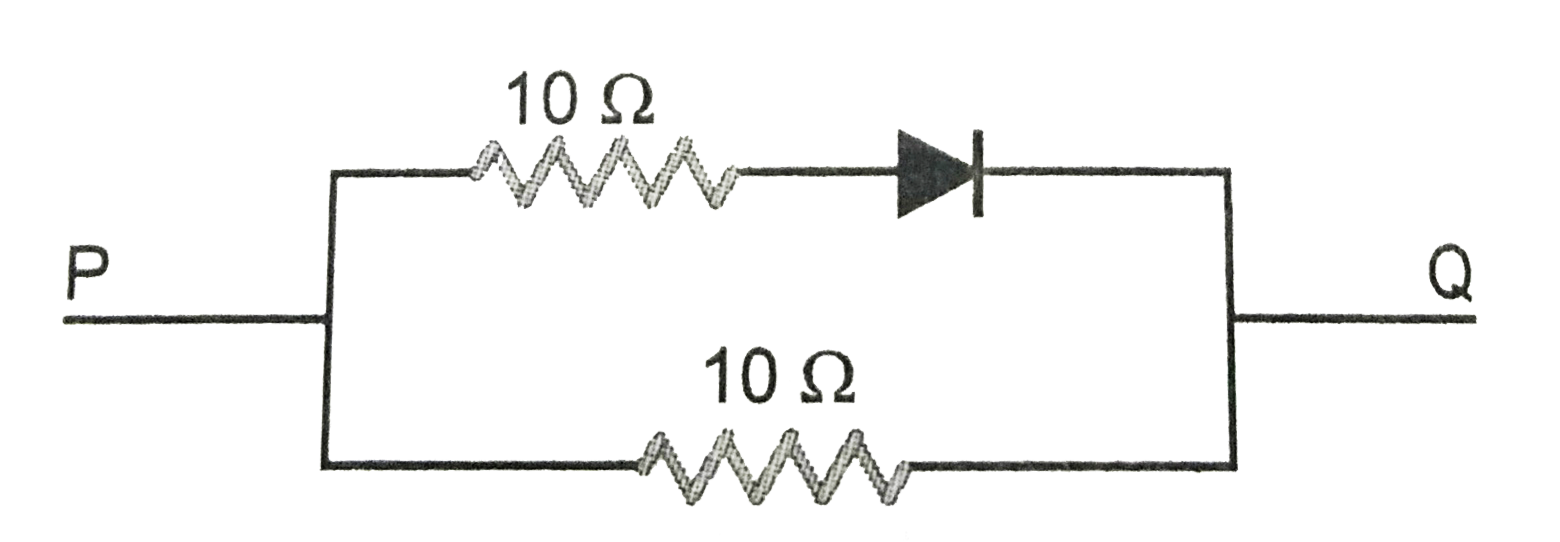
Find the equivalent resistance of the network shown in Fig.1 between the point p and Q, when the p-n junction diode used ideal one.
Text Solution
Verified by Experts
(i) When potential of P is higher than that of Q, the junction diode in circuit is forward biased. Its resistance becomes zero. Now we shall have two resistance in parallel each of `10 Omega` between points P and Q. Their effective resistance between P and Q is `R=(10xx10)/(10+10)=5Omega` (ii) When potential of P is lower than that of Q, the p-n junction in circuit is reverse biased. Its resistance becomes infinite. No current flows in the arm of p-n junction diode. The current will flow through 10Omega resistance connected in parallel arm to p-n junction diode. Therefor the resistance of circuit is 10Omega
Topper's Solved these Questions
ELECTRONIC DEVICES
PRADEEP|Exercise SAMPLE PROBLEM|2 Videos
ELECTRONIC DEVICES
PRADEEP|Exercise CONCEPTUAL PROBLEMS|1 Videos
ELECTROMAGNETIC WAVES
PRADEEP|Exercise II Focus multiple choice question|5 Videos
ELECTROSTATICS
PRADEEP|Exercise ASSERTION-REASON TYPE QUESTIONS|2 Videos
Similar Questions
Explore conceptually related problems
Find the equivalent resistance of the network shown in figure between the points a and b .
Find the equivalent resistance of the networks shown in figure between the points A and B
Find the equivalent resistance of the networks shown in figure between the points a and b.
Find the equivalent resistance of the networks shown in figure. between the points A and B.
Find the equivalent resistance of the networks shown in figure between the points A and B.
Find the equivalent resistances of the network shown in figurebetween the points a and b.