

Home
Class 11
PHYSICS
A uniform circular disc of mass 1.5 kg ...

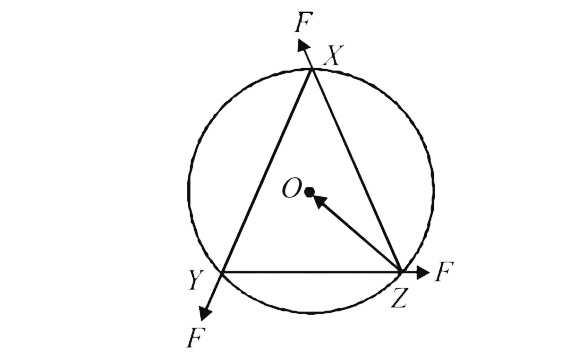
A uniform circular disc of mass 1.5 kg and raius 0.5 m is initially ar rest on a horiozntal frictonless surface. Three forces of equal matgnitude F = 0.5 N are applied simultaneously along the three sides of an equilateral triangle XYZ with its vertices on the perimeter of the disc (see figure). One second after applying the forces the angular speed of the disc in `rad s^(-1)` is

Promotional Banner

Similar Questions

Explore conceptually related problems

A thin circular disc of mass 12 kg and radius 0.5 m rotates with an angular velocity of 100 rad/s. The rotational kinetic energy of the disc is

A uniform solid disc of mass 1 kg and radius 1m is kept on a rough horizontal surface. Two forces of magnitude 2N and 4N have been applied on the disc as shown in the figure. Linear acceleration of the center of mass of the disc is if there is no slipping is

A uniform solid disc of mass 1 kg and radius 1m is kept on a rough horizontal surface. Two forces of magnitude 2N and 4N have been applied on the disc as shown in the figure. Linear acceleration of the center of mass of the disc is if there is no slipping is

A uniform solid disc of mass 1 kg and radius 1m is kept on a rough horizontal surface. Two forces of magnitude 2N and 4N have been applied on the disc as shown in the figure. Linear acceleration of the center of mass of the disc is if there is no slipping is

A uniform disc of mass of 0.50 kg and radius 0.20 m lies on one side initially at rest on a frictionless horizontal surface. A constant force of 3 N is then applied tangentially at its perimeter using a light weight cord wrapped aroutid its edge. What is the (i) angular acceleration (ii) angular velocity and angular displacement after 2s ?

Three equal masses of 1 kg each are placed at the vertices of an equilateral triangle of side 1 m, then the gravitational force on one of the masses due to other masses is (approx.)

Three equal masses of 1 kg each are placed at the vertices of an equilateral triangle of side 1 m, then the gravitational force on one of the masses due to other masses is (approx.)