

Home
Class 11
PHYSICS
A particle 'P' is moving on a circular u...

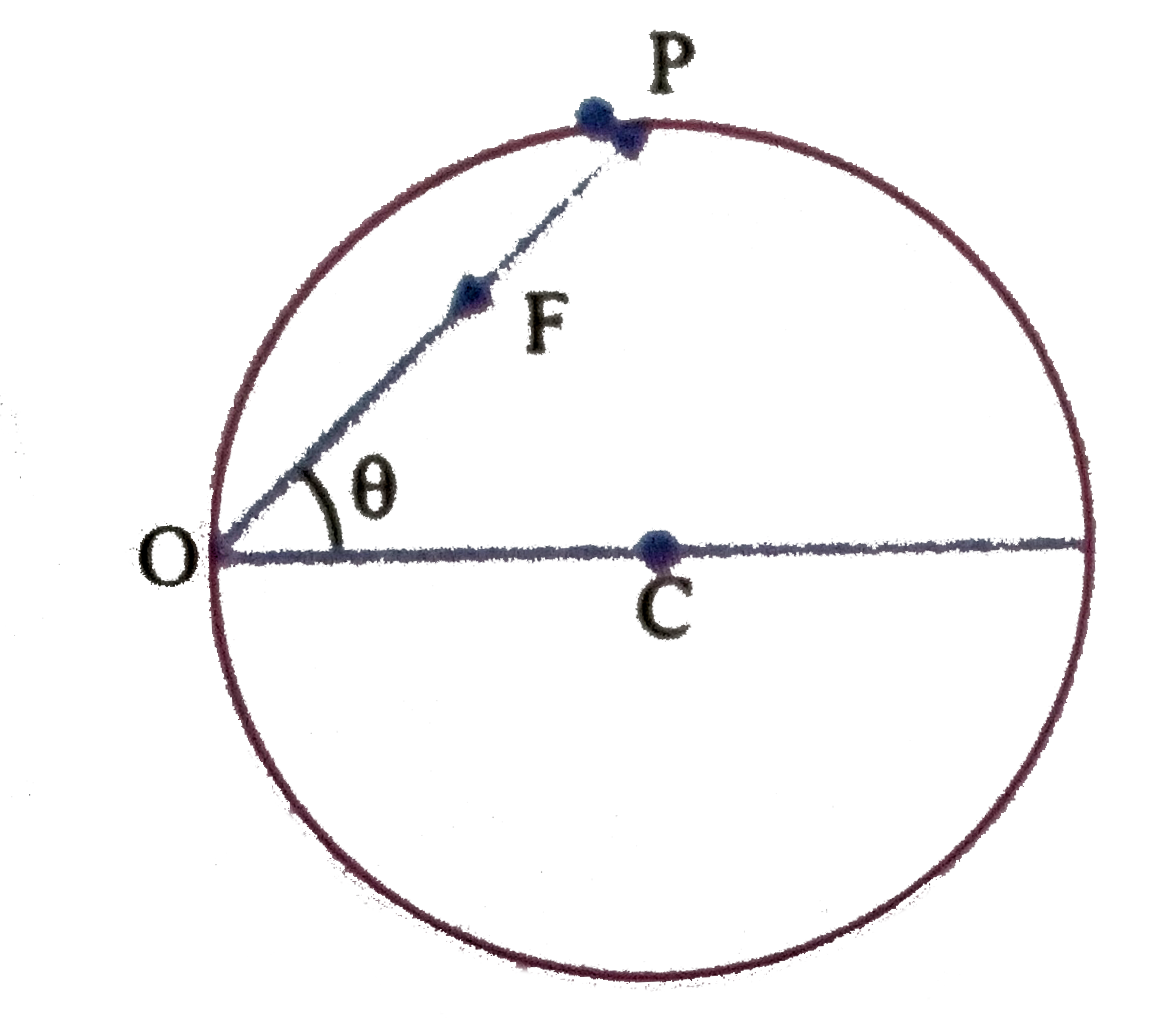
A particle `'P'` is moving on a circular under the action of only one force action always toward the fixed point `'O'` on the circumference. Find the ratio of `(d^(2)theta)/(dt^(2))` & `(("d"theta)/(dt))^(2)`

Promotional Banner

Similar Questions

Explore conceptually related problems

A particle 'P' is moving on a circular path under the action of only one force action always toward the fixed point 'O' on the circumference. Find the ratio of (d^(2)theta)/(dt^(2)) & (("d"theta)/(dt))^(2)

A particle P is moving on a circle under the action of only one force acting always fixed point O on the circumference . Find ratio of (d^(2)phi)/(dt^(2)) and ((d phi)/dt)

A particle is moving in a circular path of radius a under the action of an attractive potential U = -k/(2r^(2)) .Its energy is

A particle is moving in a circular path of radius a under the action of an attractive potential U=-(k)/(2r^(2)) . Its total energy is :

A particle is moving in a circular path of radius a under the action of an attractive potential U=-(k)/(2r^(2)) . Its total energy is :

A particle is moving in a circular path of radius a under the action of an attractive potential U=-(k)/(2r^(2)) . Its total energy is :

A particle is moving in a circular path of radius a under the action of an attraction potential U = - (k)/(2r^(2)) . Its total energy is

A particle is moving in a circular path of radius 1 m. under the action of a centripetal force, the speed sqrt2pi ms^(-1) of the particle is constant. Find the average of the velocity ("in" ms^(-1)) between A and B.

A particle is moving in a circular path of radius 1 m. under the action of a centripetal force, the speed sqrt2pi ms^(-1) of the particle is constant. Find the average of the velocity ("in" ms^(-1)) between A and B.