

Home
Class 11
PHYSICS
A uniform disc of mass M and radius R is...


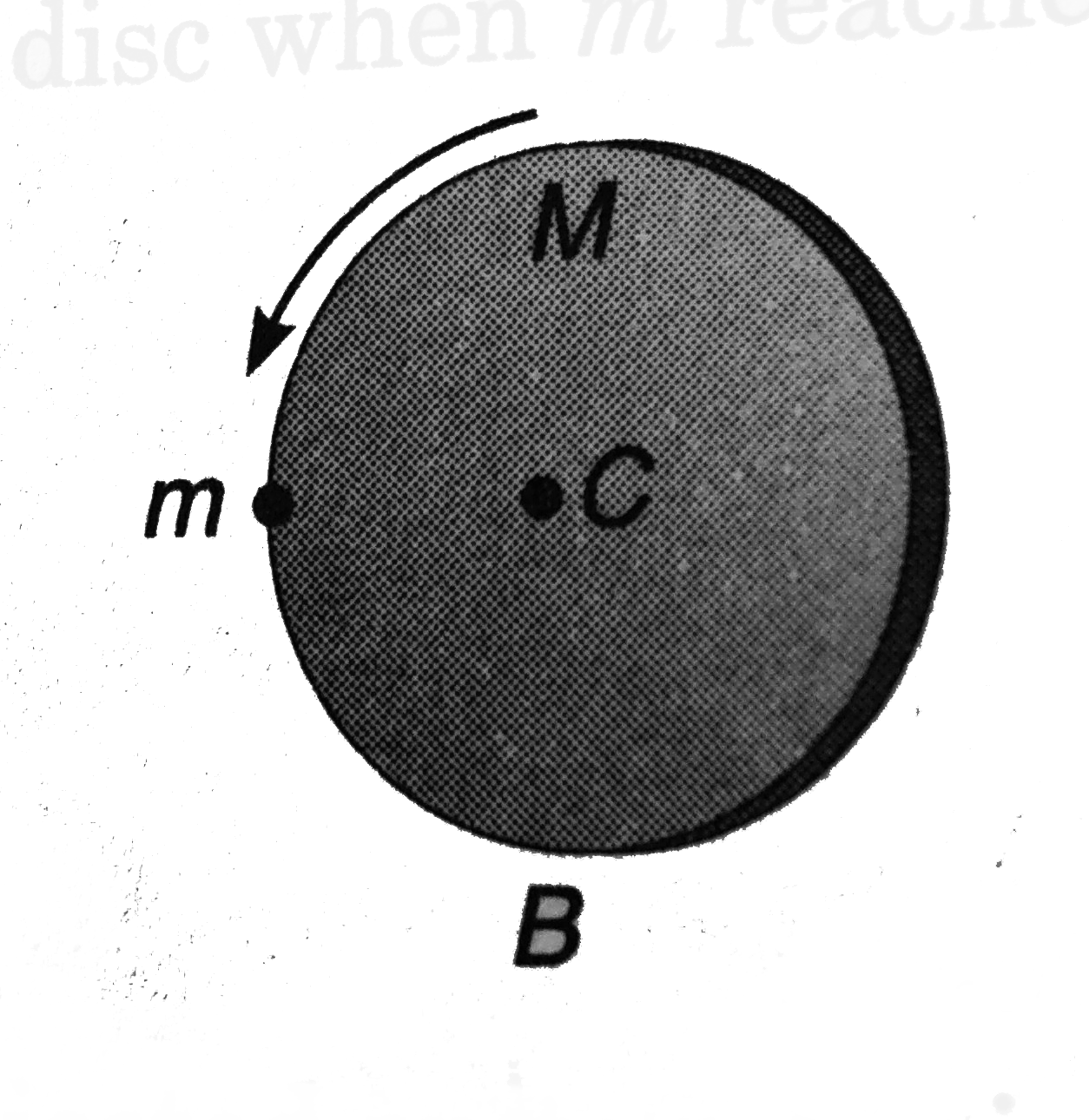
A uniform disc of mass `M` and radius R is pivoted about the horizontal axis through its centre `C` A point mass m is glued to the disc at its rim, as shown in figure. If the system is released from rest, find the angular velocity of the disc when `m` reaches the bottom point B.

Promotional Banner

Similar Questions

Explore conceptually related problems

A solid unifrom disk of mass m and radius R is pivoted about a horizontal axis through its centre and a small body of mass m is attached to the rim of the disk. If the disk is released from rest with the small body, initially at the same level as the centre, the angular velocity when the small body reaches the lowest point of the disk is.

A uniform disc of mass M and radius R is rotating about a horizontal axis passing through its centre with angular velocity omega . A piece of mass m breaks from the disc and flies off vertically upwards. The angular speed of the disc will be

A uniform disc of mass M and radius R is hinged at its centre C. A force F is applied on the disc as shown. At this instant, the angular acceleration of the disc is

A uniform disc of mass M and radius R is hinged at its centre C . A force F is applied on the disc as shown . At this instant , angular acceleration of the disc is

A uniform disc of mass M and radius R is hinged at its centre C . A force F is applied on the disc as shown . At this instant , angular acceleration of the disc is

A uniform disc of mass m and radius R is pivoted at point P and is free rotate in vertical plane. The centre C of disc is initially in horizontal position with P as shown in figure. If it is released from this position, then its angular acceleration when the line PC is inclined to the horizontal at an angle theta is

A uniform disc of mas M and radius R is smoothly pivoted at O . A light iextensible string wrapped over the disc hangs a particle of mass m . If the system is released from rest, assuming that the string does not slide on the disc, find the angular speed of the disc as the function of time using impulse momentum equation.