Home
Class 12
PHYSICS
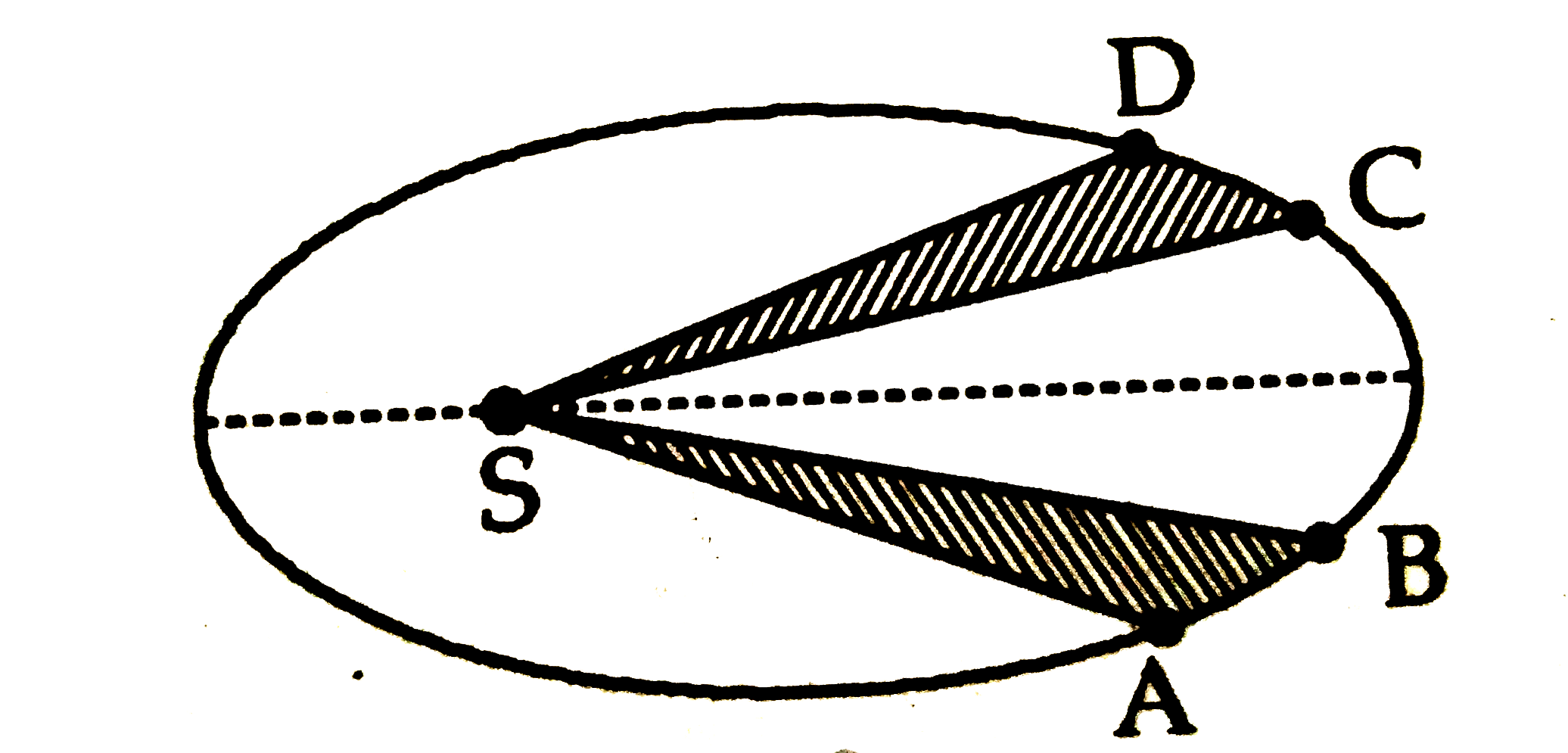
The figure shows the motion of a planet ...

The figure shows the motion of a planet around the sun in an elliptical orbit with the sun at one focus. The shaded area SAB is twice that of SCD. If `t_(1) and t_(2)` are the times taken by the planet to move from A to B and C to D respectively, then

A

`t_(1)=t_(2)`

B

`t_(2)=2t_(1)`

C

`t_(1)=2t_(2)`

D

none

Text Solution

Verified by Experts

The correct Answer is:

c

`(t_(1))/(t_(2))=(A_(1))/(A_(2))=(2A_(2))/(A_(2))=2`
`t_(1)=2t_(2)`.
Promotional Banner

Topper's Solved these Questions

  • ELECTROSTATICS

    NIKITA PUBLICATION|Exercise Multiple Choice Questions|458 Videos
  • INTERFERENCE AND DIFFRACTION

    NIKITA PUBLICATION|Exercise MULTPLE CHOICE QUESTIONS|333 Videos

Similar Questions

Explore conceptually related problems

Figure shows the motion of a planet around the Sun S in an elliptical orbit with the Sun at the focus. The shaded areas A and B are also shown in the figure which can be assumed to be equal. If t_(1) and t_(2) represent the time taken for the planet to move from a to b and c to d , respectively then

The motion of a planet around sun in an elliptical orbit is shown in the following figure. Sun is situated at one focus. The shaded areas are equal. If the planet takes time t_1 and l_2 in moving from A to B and from C to D respectively, then

Figure shows the elipticla path of a planet about the sun. The two shaded parts have equal area. If t_1 and t_2 be the tim taken by the planet to go from a to b and from c to d respectively

For a planet moving around the sun in an elliptical orbit, which of the following quantities remain constant ?

The figure shows elliptical orbit of a planet m about the sun S. the shaded area SCD is twice the shaded area SAB. If t_(1) be the time for the planet to move from C to D and t_(2) is the time to move from A to B, then:

The figure shows elliptical orbit of a plant P about the sun S. The shaded area CSD is twice tha shaded area ASB. If t_(1) is the time taken by the planet to move from C to D and t_(2) is the time to move from A to B, determine the ratio t_(1)//t_(2)

A plantet is moving round the sun in an elliptical orbit as shows. As the planet moves from a to B

NIKITA PUBLICATION-GRAVITATION-Multiple Choice Questions
  1. A planet is revolving in an elliptical orbit about the sun. Its closes...

    Text Solution

    |

  2. If a and b are the nearest and farthest distances of a planet from the...

    Text Solution

    |

  3. The figure shows the motion of a planet around the sun in an elliptica...

    Text Solution

    |

  4. A planet is revolving around a very massive star in a circular orbit o...

    Text Solution

    |

  5. The ratio of the distance of two planets from the sun is 1:2. Then rat...

    Text Solution

    |

  6. The period of revolution of a planet around the sun is 8 times that of...

    Text Solution

    |

  7. The period of revolution of a planet around the sun in a circular orbi...

    Text Solution

    |

  8. A planet is revolving around a very massive star in a circular orbit o...

    Text Solution

    |

  9. The gravitational potential of a body on the surface of the earth is p...

    Text Solution

    |

  10. In a gravitational field, at a point where the gravitational potential...

    Text Solution

    |

  11. In some region, the gravitational field is zero. The gravitational pot...

    Text Solution

    |

  12. At some point the gravitational potential and also the gravitational f...

    Text Solution

    |

  13. Intensity of gravitational field inside the hollow spherical shell is

    Text Solution

    |

  14. Gravitational potential difference between surface of a planet and a p...

    Text Solution

    |

  15. An object of mass 2 kg is moved from infinity to a point P. Initially ...

    Text Solution

    |

  16. There are two bodies of masses 100 kg and 10000 kg separated by a dist...

    Text Solution

    |

  17. Three equal point masses of each mass m are located, respectively at t...

    Text Solution

    |

  18. From the figure, the gravitational potential at '0' due to three point...

    Text Solution

    |

  19. Two point masses 100 kg and 25 kg are situated at two points 2 m apart...

    Text Solution

    |

  20. Two small and heavy spheres, each of mass M, are placed a distance r a...

    Text Solution

    |
