Home
Class 12
PHYSICS
In Young's experiment, monochromatic lig...

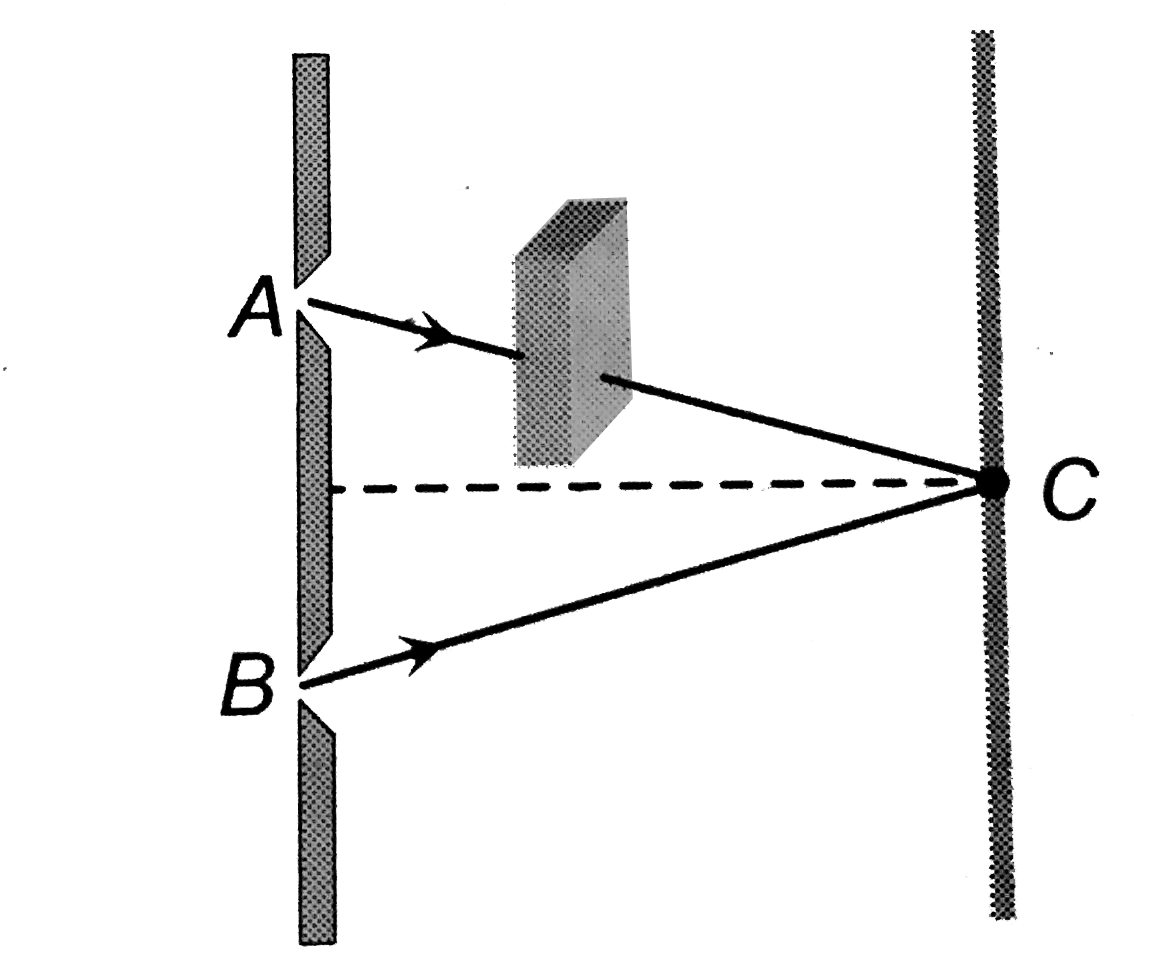
In Young's experiment, monochromatic light is used to illuminate the two slits A and B. Interference fringes are observed on a screen placed in front of the slits. Now if a thin glass plate is placed normally in the path of the beam coming from the slit

A

fringes will disappear

B

the fringe width will dicreases

C

the fringe width will increases

D

there will be no changed in the fringe width

Text Solution

Verified by Experts

The correct Answer is:

D

By introduction of slab in the path of one interfering beam, the entire, interference pattern is shifted in the direction of slab, but fringe width remains unchanged
Promotional Banner

Topper's Solved these Questions

  • GRAVITATION

    NIKITA PUBLICATION|Exercise Multiple Choice Questions|409 Videos
  • KINETIC THEORY OF GASES & RADIATION

    NIKITA PUBLICATION|Exercise MCQs (Question Given in MHT-CET)|79 Videos

Similar Questions

Explore conceptually related problems

In Young’s experiment, monochromatic light through a single slit S is used to illuminate the two slits S_1 and S_2 . Interference fringes are obtained on a screen. The fringe width is found to be w. Now a thin sheet of mica (thickness t and refractive index mu ) is placed near and in front of one of the two slits. Now the fringe width is found to be w’, then :

A two slit Young's interference experiment it done with monochromatic light of wavelength 6000 A . The slits are 2 mm apart. The fringes are observed on a screen placed 10 cm away from the slits. Now a transparent plate of thickness 0.5 mm is placed in front of one of the slits and it if found that the interference pattern shifts by 5 mm . The refractive index of the transparent plate is :

A Young's double slit experiment uses a monochromatic source. The shape of the interference fringes formed on a screen is

In Young's double slit experiment, if the two slits are illuminated with separate sources, no interference pattern is observed because

In Young's double slit experiment , red light of wavelength 620 nm is used and the two slits are 0.3 mm apart . Interference fringes are observed on a screen 1.3 mm apart . Calculate (i) the distance of slits from the screen and (ii) the fringe width if this distance is doubled .

In a Young's double-slit experiment, green light is incident on the two slits. The interference pattern is observed on a screen. Which one of the following changes would cause the observed fringes to be more closely spaced?

In Young's double slit experiment the slits are 0.5 mm apart and interference is observed on a screen placed at a distance of 100 cm from the slits. It is found that the 9^(th) bright fringe is at a distance of 8.835 mm from the second dark fringe from the centre of the fringe pattern. Find the wavelength of light used.

In Young's double slit experiment, the two slits are at a distance 'd' apart. Interference pattern is observed on a screen at a distance D front the slit, if at a point on the screen, directly opposite to the slits, the first dark fringe is observed, then wave length of the wave will be

In a young's double slit experiment, green light is incident on the two slits. The interference pattern is observed on a screen. Which of the following changes would cause the observed fringes to be more closely spaced?

NIKITA PUBLICATION-INTERFERENCE AND DIFFRACTION-MULTPLE CHOICE QUESTIONS
  1. In Young's experiment with one source and two slits, one of the slits ...

    Text Solution

    |

  2. In Young's interference expriment with one source and two slits, one s...

    Text Solution

    |

  3. In Young's experiment, monochromatic light is used to illuminate the t...

    Text Solution

    |

  4. In double slits experiment, for light of which colour the fringe width...

    Text Solution

    |

  5. Thomas Young demonstrated interference of light in

    Text Solution

    |

  6. In Youg's double slite arrangment the central fringe is

    Text Solution

    |

  7. In Young's double slite experiment, the separation between the two sli...

    Text Solution

    |

  8. The optical path difference between the two light waves arriving at a ...

    Text Solution

    |

  9. The distance of n^(th) bright fringe from the centre of the interferen...

    Text Solution

    |

  10. The distance of n^(th) minima from the centre of interference pattern ...

    Text Solution

    |

  11. The optical path difference at a point on the screen which is equidist...

    Text Solution

    |

  12. The distance between any two successive bright bands is

    Text Solution

    |

  13. The distance between any two successive dark bands is given by

    Text Solution

    |

  14. In interference of light, bandwidthis

    Text Solution

    |

  15. The bandwidth of fringes is independent of

    Text Solution

    |

  16. In interference of light, beta is fringe width. The distance of n^(th)...

    Text Solution

    |

  17. In interference of light beta is band width. The distance of n^(th) m...

    Text Solution

    |

  18. Two waves of equal amplitude and frequency interfere each other. The r...

    Text Solution

    |

  19. In the Young's experiment, the distance between slit and screen is dou...

    Text Solution

    |

  20. In interference with two choherent beam of light, the frige widht is

    Text Solution

    |
