Home
Class 12
PHYSICS
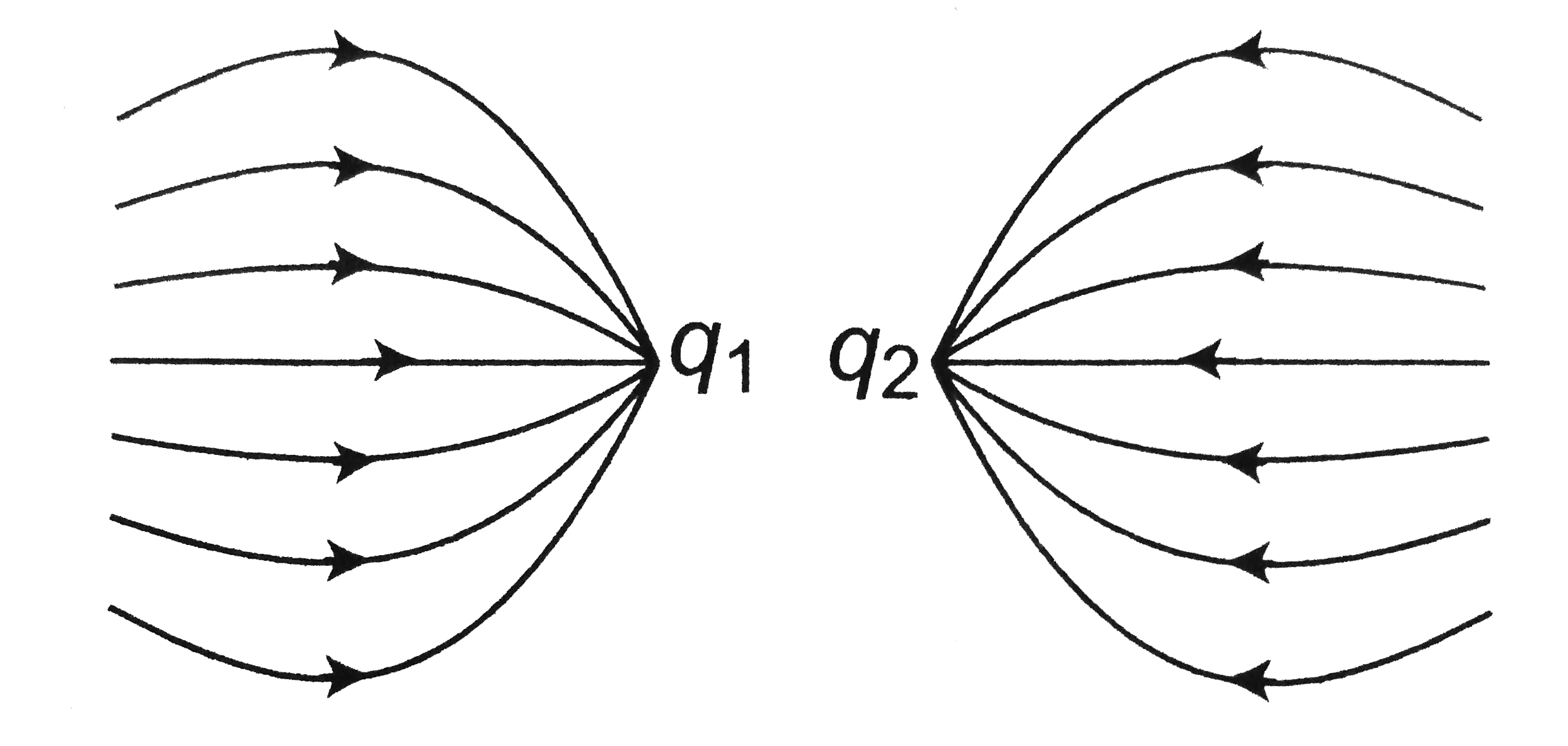
The given figure gives electric line of ...

The given figure gives electric line of force due to two charges `q_(1)` and `q_(2)`. What are the signs of the two charges ?

A

Both are positive

B

Both are negative

C

`q_(1)` is positive but `q_(2)` is negative

D

`q_(1)` is negative but `q_(2)` is positive

Text Solution

Verified by Experts

The correct Answer is:

B
Promotional Banner

Topper's Solved these Questions

  • ELECTRONS AND PHOTONS

    NIKITA PUBLICATION|Exercise MCQs|162 Videos
  • GRAVITATION

    NIKITA PUBLICATION|Exercise Multiple Choice Questions|409 Videos

Similar Questions

Explore conceptually related problems

In the adjoining figure, the electric field lines for charges q_1 and q_2 are shown. Identify the sign of the charges.

The electric lines of force of two point charges are shown in fig. What is the value of the ratio q_(1)//q_(2) ?

Figure shows some of the electric field lines due to three point charges q_, q_2 and q_3 of equal magnitude. What are the signs of each of the three charges?

A few electric field lines for a system of two charges Q_(1) and Q_(2) fixed at two different points on the X-axis are shown in Fig. (i) what is the nature of charges ? (ii) which one of the two is bigger ? (iii) What is the ratio of magnitude of two charges ? (iv) Where can the electric field due to two charges be zero ?

The lines of force of the electric field due to two charges q and Q are sketched in the figure. State if

Fig.1 shows the variation of electric potential V with 1//r , where r is the distance from the two charges Q_(1) and Q_(2) . Determine (i) signs of two charges Q_(1) and Q_(2) (ii) Which of the two charges has a larger magnitude ? Justify.

A few electric field lines for a system of two charges Q_(1) and Q_(2) fixed at two different points on the x -axis are shown in the figure. These lines suggest that (i) |Q_(1) | gt |Q_(2)| (ii) |Q_(1)| lt |Q_(2)| (iii) At a finite distance to the left of Q_(1) the electric field is zero (iv) At a finite distance to the right of Q_(2) the electric field is zero

Looking at the various electric lines of forces between charges Q_(1) and Q_(2) , find the value of (Q_(1))/(Q_(2))

Draw E-r and V-r graphs due to two point charges + q and -2q kept at some along the line joining these two charges.

NIKITA PUBLICATION-ELECTROSTATICS-Multiple Choice Questions
  1. If electric field is uniform, then the electric lines of forces are :

    Text Solution

    |

  2. The figure shows the electric lines of force emerging from a charged b...

    Text Solution

    |

  3. The given figure gives electric line of force due to two charges q(1) ...

    Text Solution

    |

  4. Which of the following figures cannot possibly represent electrostatic...

    Text Solution

    |

  5. The number of electric lines of force passing normally through unit ar...

    Text Solution

    |

  6. The dot product of E and normal area ds, calculated over the closed su...

    Text Solution

    |

  7. Electric flux in an electric field vecE through area vector vec(ds) is...

    Text Solution

    |

  8. A cylinder of radius R and length L is placed in a uniform electric fi...

    Text Solution

    |

  9. The number of electric lines of force passing normally through unit ar...

    Text Solution

    |

  10. If the dielectric constant of a medium increases then the number of el...

    Text Solution

    |

  11. Lines of force cut equipotential surface

    Text Solution

    |

  12. A charged particle is projected perpendicular to the direction of unif...

    Text Solution

    |

  13. One electron volt is equal to

    Text Solution

    |

  14. One giga electron volt (1 Gev) is equal to

    Text Solution

    |

  15. Mathematically, the electric flux (phi) through small area ds placed i...

    Text Solution

    |

  16. An arbitrary surface encloses a dipole. What is the electric flux thro...

    Text Solution

    |

  17. A plane area of 100cm^(2) is placed in uniform electric field of 100N/...

    Text Solution

    |

  18. A point charge of 10^(-7)C is situated at the centre of a cube of side...

    Text Solution

    |

  19. The product of small area element and normal component of electric int...

    Text Solution

    |

  20. The total electric flux phi through the entire area of a closed surfac...

    Text Solution

    |
