Home
Class 12
PHYSICS
Variation of current and voltage in a co...

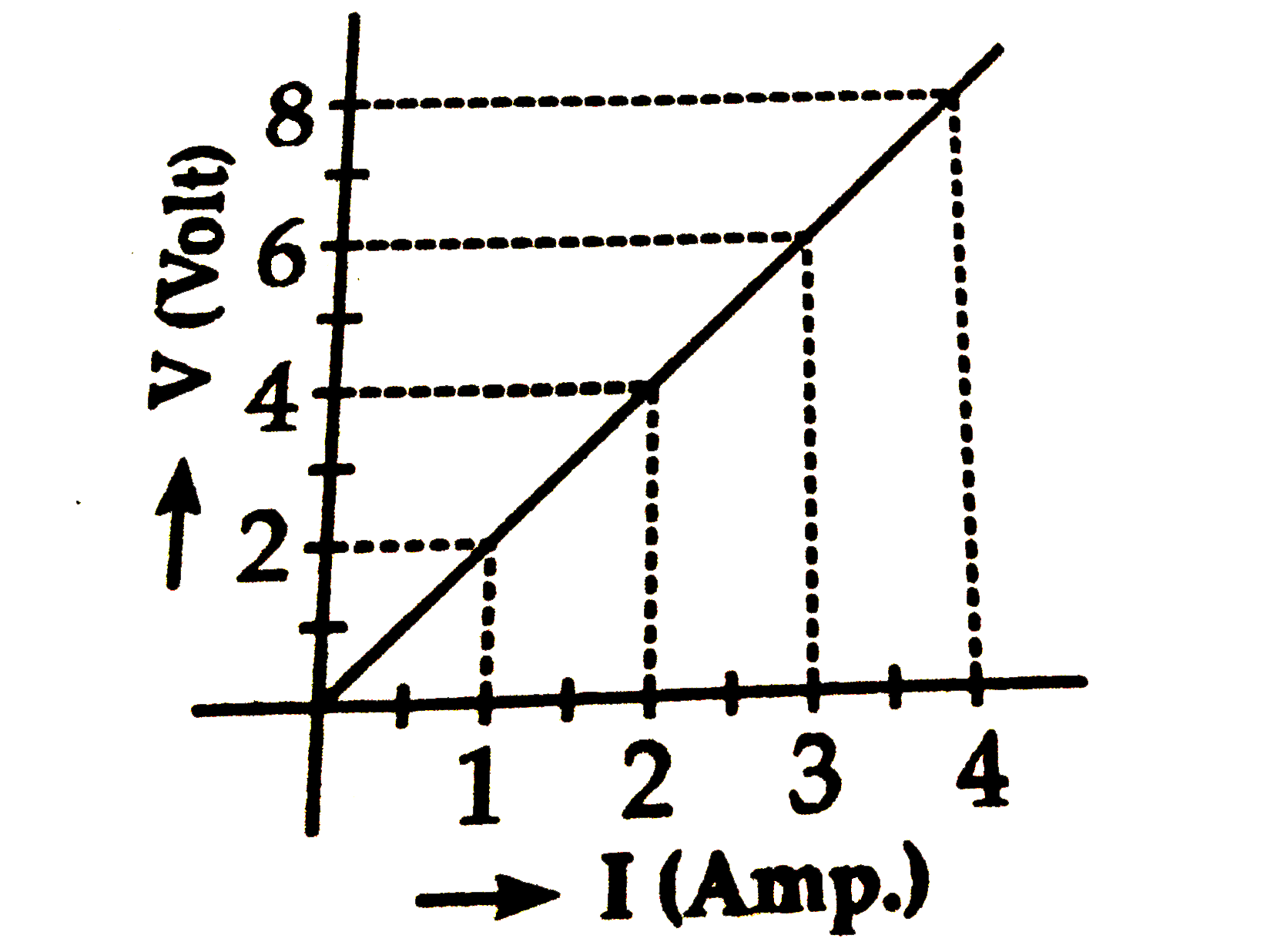
Variation of current and voltage in a conductor is shown in the adjoining figure. The resistance of the conductor is

A

`4Omega`

B

`2Omega`

C

`1Omega`

D

`0.5Omega`

Text Solution

Verified by Experts

The correct Answer is:

B

From graph,
Resistance = Slope of graph
`=2/1 = 2 Omega`
Promotional Banner

Topper's Solved these Questions

  • CURRENT ELECTRICITY

    NIKITA PUBLICATION|Exercise Multiple Choice Questions|314 Videos
  • COMMUNICATION SYSTEMS

    NIKITA PUBLICATION|Exercise Multiple Choice Questions (Examples for Practice)|8 Videos
  • ELASTICITY

    NIKITA PUBLICATION|Exercise MCQ|314 Videos

Similar Questions

Explore conceptually related problems

The resistance of a conductor is

Variation of current and voltage in a conductor has been shown in the diagram below. The resistance of the conductor is.

Relation between current in a conductor and time is shown in fig. If the resistance of the conductor is R, then the total heat disspipated across resistance R is

The variation of current (I) and voltage (V) is as shown in figure A . The variation of power P with current I is best shown by which of the following graph

The current-voltage graph of a device is shown in figure. The resistance is negative in region.

In the network of resistors shown in the adjoining figure, the equivalent resistance between A and B is

Relation between current in a conductor and time is shown in fig. Total charge flowing through the conductor is

For a given metallic conductor , the variation of current through the conductor with potential difference applied across the conductor is shown in the given graph. If temperature of the conductor is increased , then slope tan theta

Variation of resistance of the conductor with temperature is shown . Temperature coefficient of the conductor is

For a given voltage and time ,the heat produced in a conductor is ……. To the resistance of the conductor

NIKITA PUBLICATION-CURRENT ELECTRICITY-Multiple Choice Questions
  1. In an electric circuit, potential difference across a lamp is 20 V and...

    Text Solution

    |

  2. A cell of e.m.f. 2 V and internal resistance 2Omega and an external re...

    Text Solution

    |

  3. Variation of current and voltage in a conductor is shown in the adjoin...

    Text Solution

    |

  4. Which of the following I-V graph represents ohmic conductors?

    Text Solution

    |

  5. The external diameter of a 5 metre long hollow tube is 10 cm and the t...

    Text Solution

    |

  6. Statement-1 : The temperature coefficient of resistance is positive fo...

    Text Solution

    |

  7. Which of the following has negative temperature coefficient of resista...

    Text Solution

    |

  8. At a temperature of 0^(@)K, the germanium behaves as

    Text Solution

    |

  9. When the temperature of a metallic conductor is increased, its resista...

    Text Solution

    |

  10. Thermistors are usually, perpared from

    Text Solution

    |

  11. Thermistor is

    Text Solution

    |

  12. If temperature is increases, then relaxation time of electrons in meta...

    Text Solution

    |

  13. Thermistors are usually, perpared from

    Text Solution

    |

  14. A typical thermistor can easily measure a change in temperature of the...

    Text Solution

    |

  15. The algebraic sum of currents at junction points in any electric circ...

    Text Solution

    |

  16. The mathematical equation of Kirchhoff's current law is

    Text Solution

    |

  17. Sigma IR=Sigma E is the mathematical equaiton of

    Text Solution

    |

  18. Kirchhoff's current law is the law of conservation of

    Text Solution

    |

  19. Kirchhoff's second law is based on law of conservation of

    Text Solution

    |

  20. Kirchhoff's second law is based on law of conservation of

    Text Solution

    |
