

Home
Class 11
PHYSICS
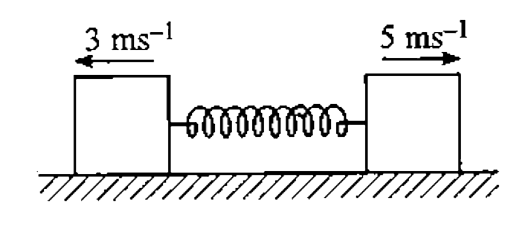
Two identical blocks each of mass 1kg ar...

Two identical blocks each of mass 1kg are joined together with a compressed spring. When the system is released from rest the two blocks appear to be moving with unequal speeds in the opposite direction as shown in figure. Choose the correct statement (s):

Promotional Banner

Similar Questions

Explore conceptually related problems

Two identical blocks each of mass 1kg are joined together with a compressed spring. When the system is released the two blocks appear to be moving with unequal speeds in the opposite directions as shown in fig. Choose the correct statement -

Two identical blocks each of mass 1kg are joined together with a compressed spring. When the system is released the two blocks appear to be moving with unequal speeds in the opposite directions as shown in fig. Choose the correct statement -

Two blocks A and B are joined together with a compressed spring. When the system is released, the two bloks appear to be moving with unequal speeds in the opposite directions as shown in figure. Select incorrect statements(s) :

Two blocks A and B are joined together with a compressed spring. When the system is released, the two bloks appear to be moving with unequal speeds in the opposite directions as shown in figure. Select incorrect statements(s) :

Two blocks A and B are joined together with a compressed spring. When the system is released, the two bloks appear to be moving with unequal speeds in the opposite directions as shown in figure. Select incorrect statements(s) :

Two identical blocks A and B of mass m joined together with a massless spring as shown in figure are placed on a smooth surface. If the block A moves with an acceleration a_0 , then the acceleration of the block B is

Two identical blocks A and B of mass m joined together with a massless spring as shown in figure are placed on a smooth surface. If the block A moves with an acceleration a_0 , then the acceleration of the block B is

Two unequal masses are ties together with a cord with a compressed spring in between. When the cord is burnt with a match releasing the spring, the two masses fly apart with equal

Two unequal masses are ties together with a cord with a compressed spring in between. When the cord is burnt with a match releasing the spring, the two masses fly apart with equal

Two blocks each of mass m are joined together using an ideal spring of force constant K and natural length l_(0) . The blocks are touching each other when the system is released from rest on a rough horizontal surface. Both the blocks come to rest simultaneously when the extension in the spring is (l_(0))/4 . The coefficient of friction between each block and the surface (assuming it to be same between any of the blocks and the surface) is :