Home
Class 12
MATHS
Each question in this section contains s...

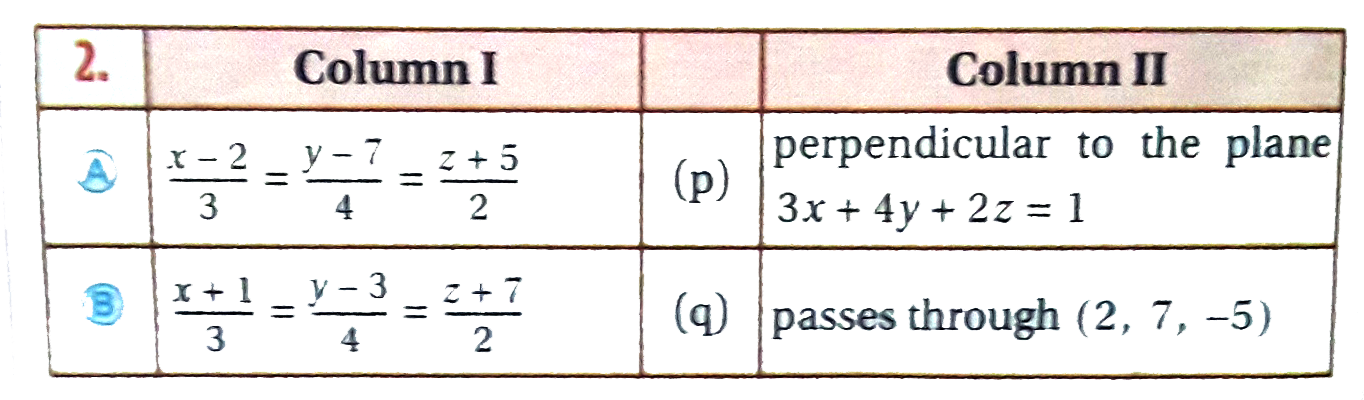
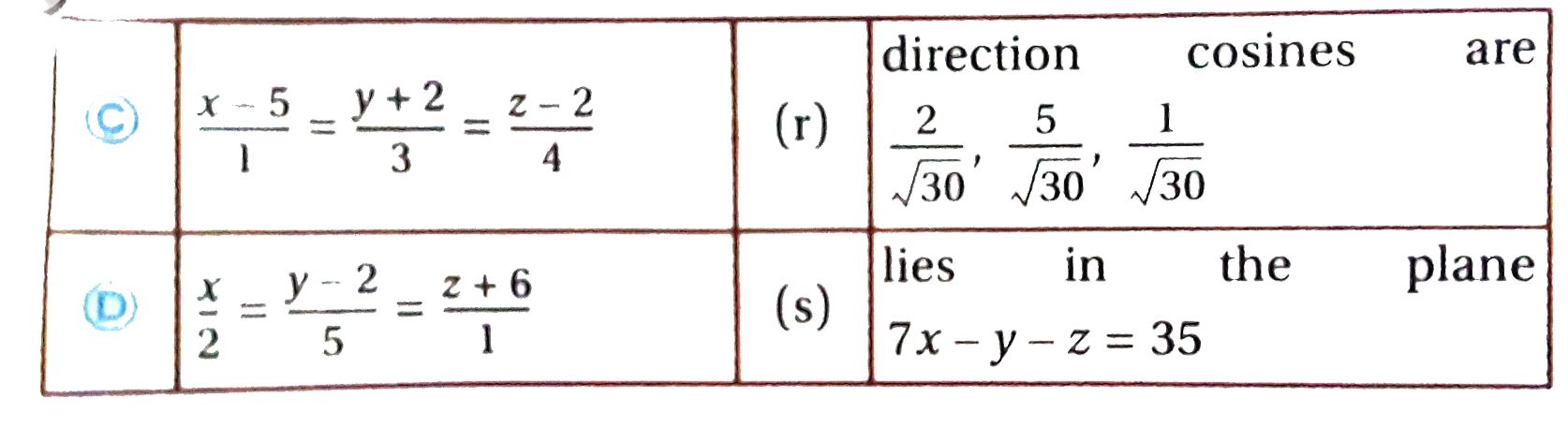
Each question in this section contains statements given in two columns which have to be matched. Statements in Column I are labetted as A,B, C, and D where as statements in Column II are labelled (p), (q), (r) and (s).

Text Solution

Verified by Experts

The correct Answer is:

A `to` (q) , B `to` (p),(q) , C `to` (s) D `to` (q),(r)
Promotional Banner

Topper's Solved these Questions

  • STRAIGHT LINE IN THREE DIMENSINAL SPACE

    CHHAYA PUBLICATION|Exercise Exercise 4A|81 Videos
  • SIGNIFICANCE OF DERIVATIVE AS RATE OF CHANGE

    CHHAYA PUBLICATION|Exercise SAMPLE QUESTIONS FOR COMPETITVE EXAMINATION|20 Videos
  • TANGENT AND NORMAL

    CHHAYA PUBLICATION|Exercise ASSERTION-REASON TYPE|2 Videos

Similar Questions

Explore conceptually related problems

Each question contains statements given in two columns which have to be matched. Statements a,b,c,d in column I have to be matched with statements p,q,r,s in column II. If the correct matches are a-p, q-s, b-q, r c-p, q and d-s, then the correctly bubbled 4x4 matrix should be as follows: Figure Column I, Column II: Differential equation order 1, p.of all parabolas whose axis is the x-axis order 2, q.of family of curves y=a(x+a)^2, where a is an arbitrary constant degree 1, r. (1+3(dy)/(dx))^(2/3)=(4d^3y)/(dx^3) degree 3, s. of family of curve y^2=2c(x+sqrt(c)), where c >0

Each question contains statements given in two columns which have to be matched. Statements (a,b,c,d) in column I have to be matched with statements (p,q,r,s) in column II. If the correct match are a-p, s, b-r c-p, q. and d-s, then the correctly bubbled 4x4 matrix should be as follows: figure Column I, a) If int(2^x)/(sqrt(1-4^x))dx=ksin^(-1)(f(x))+C , then k is greater than, b) If int((sqrt(x))^5)/((sqrt(x))^7+x^6)dx=aln(x^k)/(x^k+1)+c , then a k is less than, c) If int(x^4+1)/(x(x^2+1)^2)dx=kln|x|+m/(1+x^2)+n , where n is the constant of integration, then m k is greater than, d) If int(dx)/(5+4cosx)=ktan^(-1)(mt a n x/2)+C , then k//m is greater than, COLUMN II p) 0 q) 1 r) 3 s)4

Each equation contains statements given in two columns which have to be matched. Statements (a,b,c,d) in column I have to be matched with Statements (p, q, r, s) in column II. If the correct match are avecp ,avecs ,bvecq ,bvecr , cvecp , cvecq , and dvecs , then the correctly bubbled 4x4 matrix should be as follows: Figure Consider the lines represented by equation (x^2+x y-x)(x-y)=0, forming a triangle. Then match the following: Column I|Column II a. Orthocenter of triangle |p. (1/6,1/2) b.Circumcenter|q. (1(2+2sqrt(2)),1/2) c.Centroid|r. (0,1/2) d.Incenter|s. (1/2,1/2)

match the defects given in column I with the statements in given Column II.

match the types of defect given in column I with the statement given in column II.

This question has Statement I and Statement II, Of the four choices given after the Statement, choose the one that best describes the two Statements (1) Statement - I is true, Statement - II is true, Statement - II is a correct explanation of Statement - I (2) Statement - I is true - II is true, Statement - II is not a correct explanation of Statement - I (3) Statement - I is true, Statement - II is false Statement - I is false Statement - II is true Statement - I : 1 equivalent of H_2SO_4 contains 1 equivalent of H, S and O each Statement - II : A species contains same number of equivalents of its components

Each of the following question contain two statements- Statemnet I and statement II. Each of the questions has following four choice A,B,C and D only one of which is correct. Statement - I P(A) = 0.25, P(B) = 0.50 and P(AcapB) = 0.14 , then the probability that neither A nor B occurs is 0.39. Statement - II: P(bar(AcupB)) = bar(A)cup bar(B)

This question has statement I and statement II of the four choices given after the statements choose the one that best describes the two statements Statement -I:The first ionization enthalpy of Be I sgreater than that of B Statement-II:2 p orbital is lower in energy than 2s orbital

CHHAYA PUBLICATION-STRAIGHT LINE IN THREE DIMENSINAL SPACE -Sample Questions for Competitive Examination
  1. The symmetrical from of the lines x+y+z-1=0 and 4x+y-2z+2=0 are -

    Text Solution

    |

  2. The equation of line passing through the point vec(a) parallel to the ...

    Text Solution

    |

  3. The lines vec(r)=hat(i)+hat(j)-hat(k)+lamda(3hat(i)-hat(j)) and vec(r)...

    Text Solution

    |

  4. Consider the lines (x-5)/(3)=(y-7)/(-16)=(z-3)/(7) and (x-9)/(3)=(y-13...

    Text Solution

    |

  5. The distance of the point A(veca) from the line vec(r)=vec(b)+tvec(c)...

    Text Solution

    |

  6. If the length of the perpendicular drawn from (1,2,3) to the line (x-6...

    Text Solution

    |

  7. If the shortest distance between the lines (x-1)/(1)=(y-1)/(1)=(z-1)/(...

    Text Solution

    |

  8. The line (x-2)/(3)=(y+1)/(2)=(z-1)/(-1) intersects the curve xy xy=c^(...

    Text Solution

    |

  9. A line passing through the point (1,1,1) from a tiangle of area sqrt(6...

    Text Solution

    |

  10. The direction cosines of two lines satisfy the relations lamda(l+m)=n ...

    Text Solution

    |

  11. Each question in this section contains statements given in two columns...

    Text Solution

    |

  12. vec(a)=6hat(i)+7hat(j)+7hat(k),vec(b)=3hat(i)+2hat(j)-2hat(k),P(1,2,3)...

    Text Solution

    |

  13. vec(a)=6hat(i)+7hat(j)+7hat(k),vec(b)=3hat(i)+2hat(j)-2hat(k),P(1,2,3)...

    Text Solution

    |

  14. vec(a)=6hat(i)+7hat(j)+7hat(k),vec(b)=3hat(i)+2hat(j)-2hat(k),P(1,2,3)...

    Text Solution

    |

  15. L(1):(x+1)/(-3)=(y-3)/(2)=(z+2)/(1),L(2):(x)/(1)=(y-7)/(-3)=(z+7)/(2) ...

    Text Solution

    |

  16. L(1):(x+1)/(-3)=(y-3)/(2)=(z+2)/(1),L(2):(x)/(1)=(y-7)/(-3)=(z+7)/(2) ...

    Text Solution

    |

  17. L(1):(x+1)/(-3)=(y-3)/(2)=(z+2)/(1),L(2):(x)/(1)=(y-7)/(-3)=(z+7)/(2) ...

    Text Solution

    |

  18. Statement - I: The point A (1,0,7) is the mirror image of the point B(...

    Text Solution

    |

  19. Statement - I : The lines vec(r)=hat(i)+hat(j)-hat(k)+S(3hat(i)-hat(j)...

    Text Solution

    |
