

Home
Class 11
MATHS
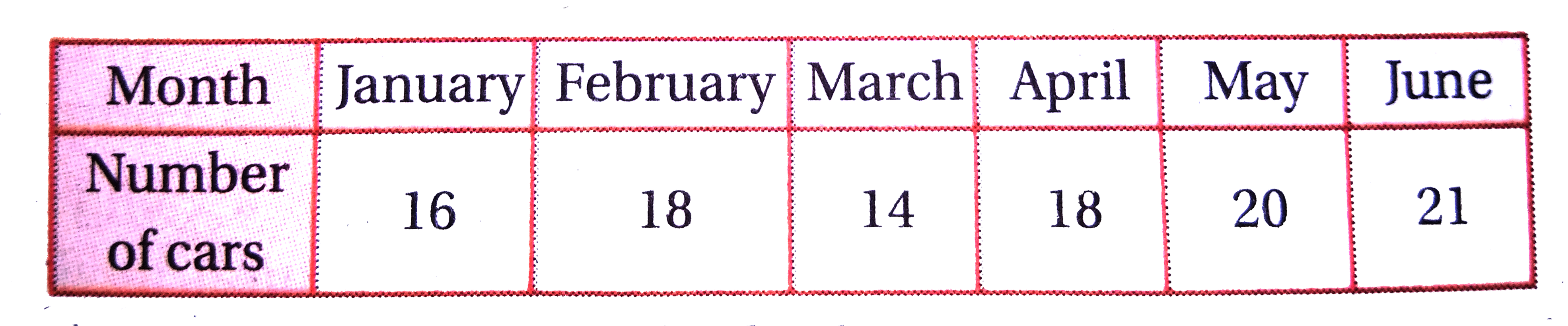
A car manufacting company produces the f...

A car manufacting company produces the following number of a cars in the first six months of the year 2005. Represent the data by a chart.

Promotional Banner

Topper's Solved these Questions

  • DIAGRAMMATIC REPRESENTATION OF DATA

    CHHAYA PUBLICATION|Exercise EXERCISE (Very short Answer Type Question)|7 Videos
  • DIAGRAMMATIC REPRESENTATION OF DATA

    CHHAYA PUBLICATION|Exercise EXERCISE (Very short Answer Type Question)|7 Videos
  • HYPERBOLA

    CHHAYA PUBLICATION|Exercise SAMPLE QUESTIONS FOR COMPETITIVE EXAMS|12 Videos

Similar Questions

Explore conceptually related problems

The velocity of a car travelling on a straight road is 36kmh^(-1) at an instant of time. Now travelling with uniform acceleration for 10s, the velocity becomes exactly double. If the wheel radius of the car is 25cm, then which of the following numbers is the closest to the number of revolutions that the wheel makes during this 10s?

In a hexaonal system system of cycstals, a frequently encountered arrangement of atoms is described as a hexagonal prism. Here, the top and bottom of the cell are refular hexagons, and three atoms are sandwiched in between them. A space-cilling model of this structure, called hexagonal close-paked is constituted of a sphere on a flat surface surrounded in the same plane by six identical spheres as closely as possible. Three spherres are then placed overt the first layer so that they toych each other and represent the second layer so that they toych each other and present the second layer. Each one of the three spheres touches three spheres of the bottom layer. Finally, the second layer is convered with a third layer identical to the bottom layer in relative position. Assume the radius of every sphere to be r . The number of atom in this hcp unit cell is

The present value of a car is Rs. 360000. If the value of the car decreases at the rate of 10% in the first year and in the next every year the rate of decrease is 20% per year. Then find the value of car after 3 years.

Represent the following data by a pie chart on proposed outlay during a Five-year plan of a Government:

A manufacturer of TV sets produced 600 sets in the third year and 700 sets in the seventh year. Assuming that the production increases uniformly by a fixed number every year, find: (i) the production in the 1st yea (ii) the production in the 10th year (iii) the total production in first 7 years Solution :

In which of the following situations, does the list of numbers involved is in the form of a GP? (i) Salary of Sharmila, when her salary is 5,00,000 for the first year and expected to receive yearly increase of 10%. ii) Number of bricks needed to make each step, if the stair case has total 30 steps, provided that bottom step needs 100 bricks and each successive step needs 2 brick less than the previous step. iii) Perimeter of the each triangle, when the mid points of sides of an equilateral triangle whose side is 24 cm are joined to form another triangle, whose mid points in turn are joined to form still another triangle and the process continues indefinitely.

The value of a new car sis rs. 360000. If the value of the car decreases by 10% per annum in the first 2 years and then by 20% for each year, then what will be the value of the car after 3 years?

Write the following sets in the roster form. (i) B is the set of all months in a year having 30 days. (ii) P is the set of all prime numbers smaller than 10. (iii) X is the set of colours of the rainbow.

An insurance company selected 2000 drivers at random (i.e., without any preference of one driver over another) in a particular city to find a relationship between age and accidents. The data obtained is given in the following table: Find the probabilities of the following events for a driver chosen at random from the city: (i) The driver being in the age group 18-29 years and having exactly 3 accidents in one year. (ii) The driver being in the age group of 30-50 years and having one or more accidents in a year. (iii) Having no accidents in the year.

A student noted the number of cars passing thorugh a spot on a road for 100 periods, each of 3 minutes, and summarised this in the table given below. Find the mode of the data.