A
B
C
D
Text Solution
Verified by Experts
The correct Answer is:
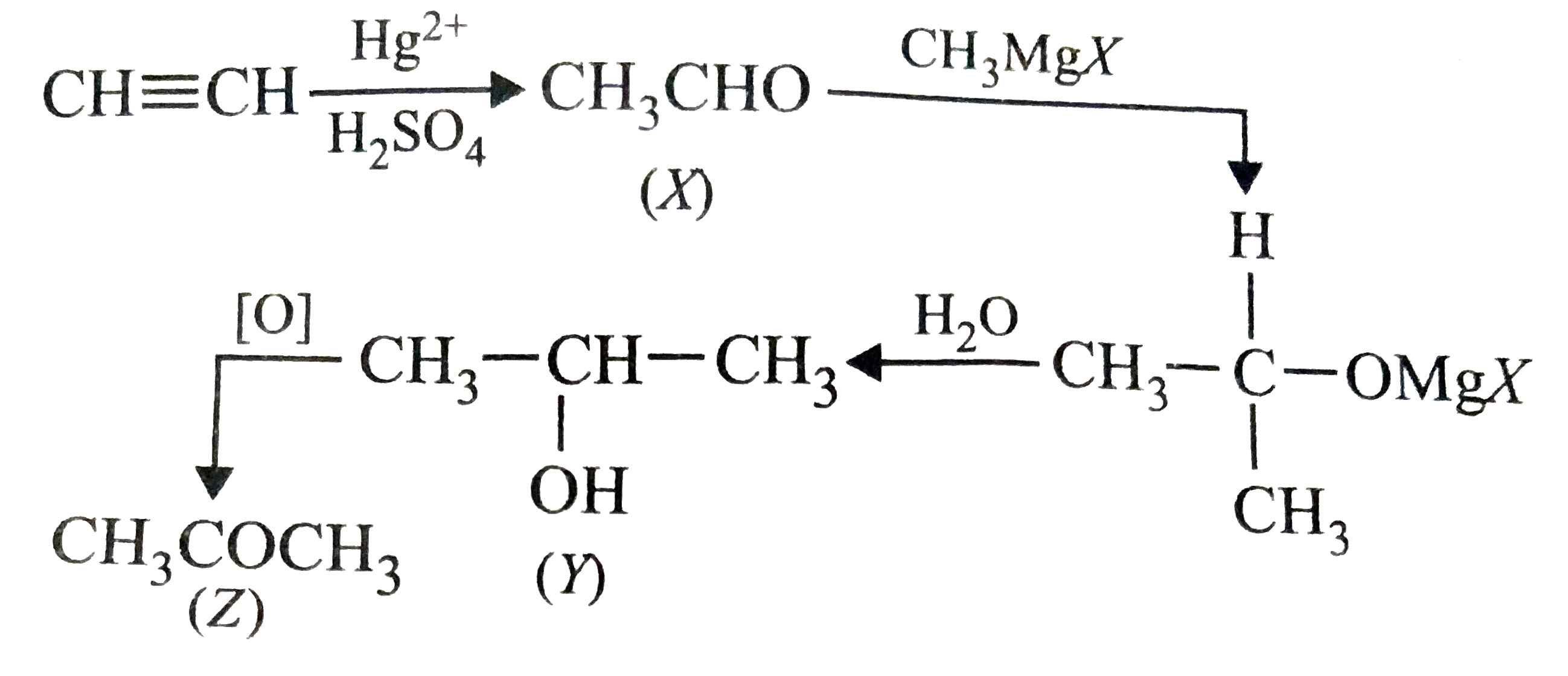



Topper's Solved these Questions
ALDEHYDES, KETONES AND CARBOXYLIC ACIDS
NCERT FINGERTIPS|Exercise MCQs( CHEMICAL REACTIONS )|2 VideosALDEHYDES, KETONES AND CARBOXYLIC ACIDS
NCERT FINGERTIPS|Exercise MCQs(CHEMICAL REACTIONS )|11 VideosALDEHYDES, KETONES AND CARBOXYLIC ACIDS
NCERT FINGERTIPS|Exercise Physical Properties|4 VideosALCOHOLS,PHENOLS AND ETHERS
NCERT FINGERTIPS|Exercise Assertion And Reason|14 VideosAMINES
NCERT FINGERTIPS|Exercise NCERT EXEMPLER PROBLEMS|1 Videos
Similar Questions
Explore conceptually related problems
NCERT FINGERTIPS-ALDEHYDES, KETONES AND CARBOXYLIC ACIDS-Chemical Reactions
- The best oxidising agent for oxidation of CH(3)-CH=CH-CHO" to "CH(3)...
Text Solution
|
- Which of the following statements is not correct ?
Text Solution
|
- In the following sequence of reaction, the final product (Z) is CH-...
Text Solution
|
- Which of the following reagents are not correctly matched with the rea...
Text Solution
|
- Identify (X), (Y) and (Z) in the given reaction. CH(3)COCH(3) overse...
Text Solution
|
- Identify (X), (Y) and (Z) retgents in the given sequence of reaction. ...
Text Solution
|
- Which of the following does not answer iodoform test ?
Text Solution
|
- A compound 'A' having the molecular formula C(5)H(12)O, on oxidation ...
Text Solution
|
- Write a test to differentiate between pentan-2-one and pentan-3-one.
Text Solution
|
- An organic compound of molecular formula C(3)H(6)O did not give a silv...
Text Solution
|
- Which is the correct method of synthesising acetamide from acetone?
Text Solution
|
- Compound (X) with molecular formula C(3)H(8)O is treated with acidifie...
Text Solution
|
- Few simple chemical tests are given below to differentiate between the...
Text Solution
|
- Which of the following will not give aldol condensation ?
Text Solution
|
- The claisen schmidt condensation product of benzaldehyde and acetone i...
Text Solution
|
- Study the following sequence of reaction and identify the product (Y)....
Text Solution
|
- Identify (X), (Y) and (Z) in the given reaction. X +Y overset(Z) to ...
Text Solution
|
- Propanal on treatment with dilute sodium hydroxide gives
Text Solution
|
- Aldehydes that do not undergo aldol condensation are (1) propanal (...
Text Solution
|
- The order of reactivity of CH(3)CHO, CH(3)COC(2)H(5) and CH(3)COCH(3) ...
Text Solution
|