Home
Class 10
MATHS
In the above fig. square ABCD is a trape...


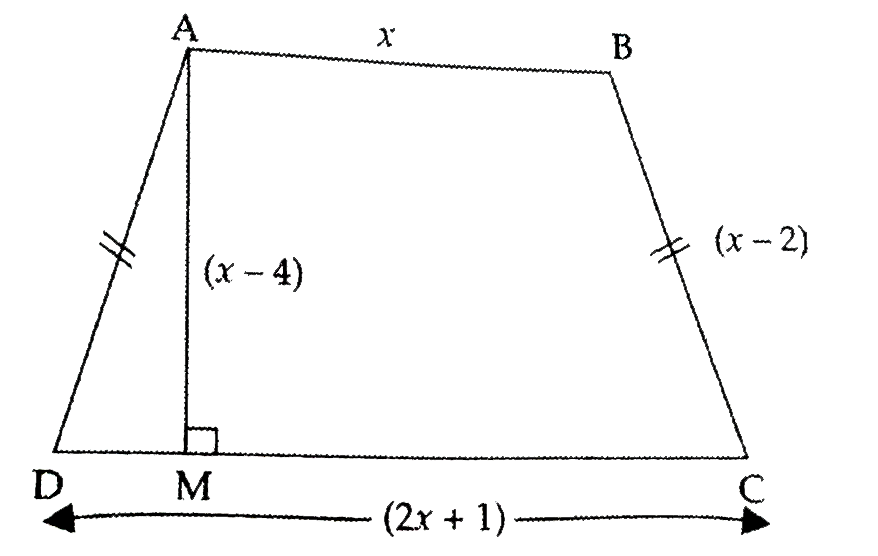
In the above fig. `square` ABCD is a trapezium AB ` |\|`CD and its area is 33 `cm^(2)`. From the information given in the figure, find the lengths of all sides of the `square` ABCD. Fill in the empty boxes to get the solution.

Text Solution

Verified by Experts

The correct Answer is:

AB=7 cm, CD=15 cm, AD=BC=5cm
Promotional Banner

Topper's Solved these Questions

  • QUADRATIC EQUATIONS

    CHETAN PUBLICATION|Exercise PROBLEM SET 2|50 Videos
  • QUADRATIC EQUATIONS

    CHETAN PUBLICATION|Exercise PROBLEMS FOR PRACTICE|21 Videos
  • QUADRATIC EQUATIONS

    CHETAN PUBLICATION|Exercise PRACTICE SET 2.5|15 Videos
  • PYTHAGORAS THEOREM

    CHETAN PUBLICATION|Exercise ASSIGNMENT -5|1 Videos
  • SIMILARITY

    CHETAN PUBLICATION|Exercise ASSIGNMENT-1|12 Videos

Similar Questions

Explore conceptually related problems

Diagonals of a trapezium ABCD with AB || DC, intersect each other at the point ‘O’. If AB = 2CD, find the ratio of areas of triangles AOB and COD.

Four long, straight wires, each carrying a current of 5.0 A, are placed in a plane as shown in figure . The points of intersection form a square of side 5.0 cm. (a) Find the magnetic field at the centre P of the square. (b) Q_1, Q_2, Q_3 and Q_4 are points situated on the diagonals of the square and at a distance from P that is equal to the length of the diagonal of the square. Find the magnetic fields at these points.

A chess board contains 64 equal squares and the area of each square is 6.25cm^(2) . A border round the board is 2cm wide find its side.

ABCD is quadrilateral such that all of its sides touch a circle . If AB = 6cm, BC = 6.5 cm and CD = 7cm , then find the length of AD .

Four charges are arranged at the comers of a square ABCD of side d, as shown in Fig. a. Find the work required to put together this arrangement b. A charge q_(0) is brought to the centre E of the square, the four charges being held fixed at its corners. How much extra work is needed to do this?n

Figure shows a part of an electric circuit. ABCD is a rectangular loop made of uniform wire. The length AD= BC = 1 cm. The sides AB and DC are long as compared to the other two sides. Find the magnetic force per unit length acting on the wire DC due to the wire AB if the ammeter reads 10A.

ltimg src="https://d10lpgp6xz60nq.cloudfront.net/physics_images/CEN_ALG_DPP_4_2_E01_233_Q01.png" width="80%"gt Let ABCD is a unit square and each side of the square is divided in the ratio alpha : (1-alpha) (0 lt alpha lt 1) . These points are connected to obtain another square. The sides of new square are divided in the ratio alpha : (1-alpha) and points are joined to obtain another square. The process is continued idefinitely. Let a_(n) denote the length of side and A_(n) the area of the n^(th) square The value of alpha for which side of n^(th) square equal to the diagonal of (n+1)^(th) square is

The position vectors of the vertices A, B and C of a tetrahedron ABCD are hat i + hat j + hat k , hat k , hat i and hat 3i ,respectively. The altitude from vertex D to the opposite face ABC meets the median line through Aof triangle ABC at a point E. If the length of the side AD is 4 and the volume of the tetrahedron is2/2/3, find the position vectors of the point E for all its possible positfons

A light wire AB of length 10 cm can slide on a vertical frame as shown in figure. There is a film of soap solution trapped between the frame and the wire. Find the load W that should be suspended from the wire to keep it in equilibrium. Neglect friction. Surface tension of soat solution =25 dyne cm^-1 . Take g=10 ms^-2
