

Home
Class 10
MATHS
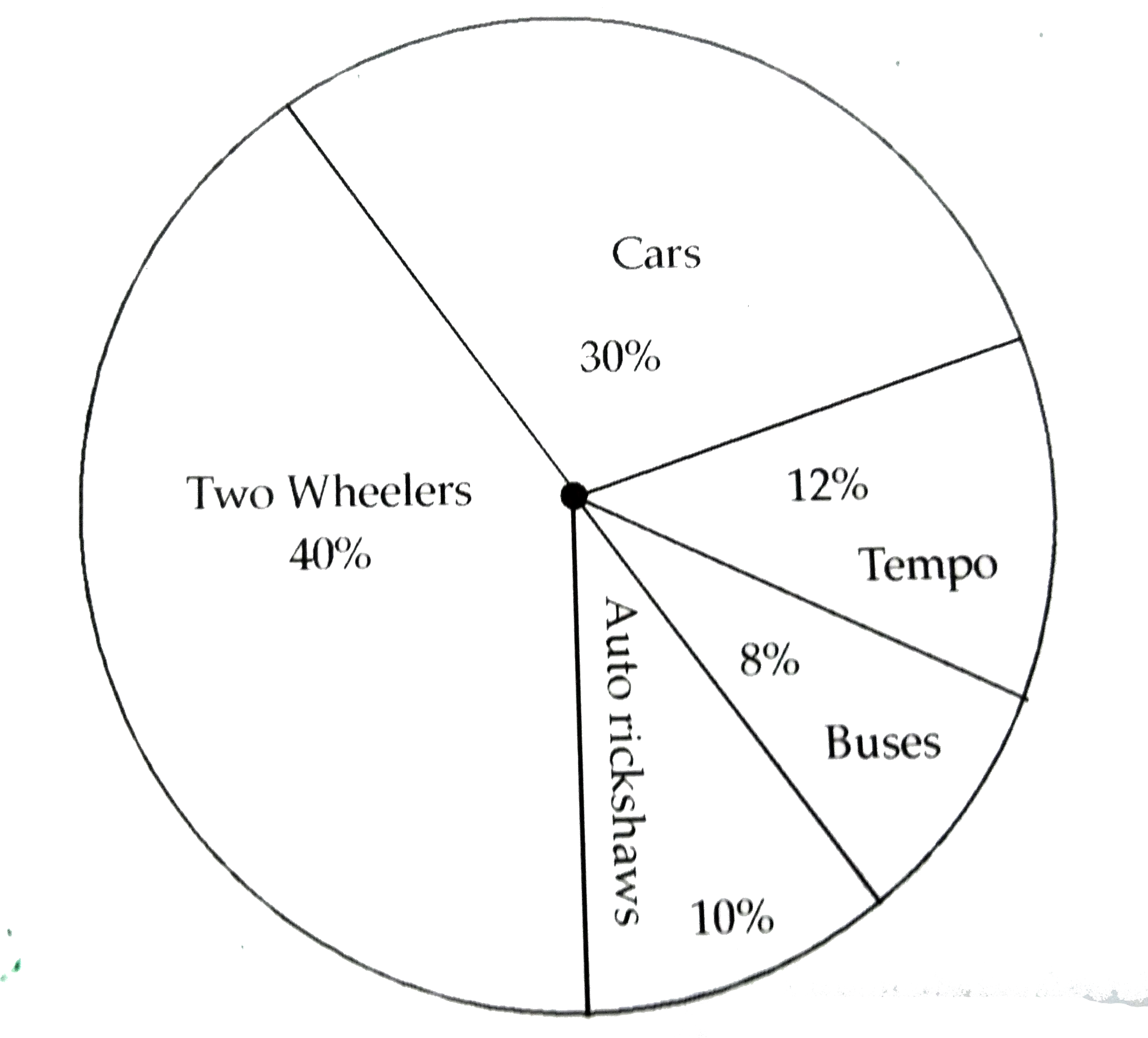
Observe the below pie diagram. It shows ...

Observe the below pie diagram. It shows the percentages of number of vehicles passing a signal in a town between 8 am and 10 am

(i) Find the central angle for each type of vehicle.

Promotional Banner

Topper's Solved these Questions

  • STATISTICS

    CHETAN PUBLICATION|Exercise PRACTICE SET -6.1|6 Videos
  • STATISTICS

    CHETAN PUBLICATION|Exercise PRACTICE SET -6.2|4 Videos
  • STANDARD IX SYLLABUS

    CHETAN PUBLICATION|Exercise PROBLEMS FOR PRACTICE|20 Videos
  • TRIGONOMETRY

    CHETAN PUBLICATION|Exercise ASSIGNMENT - 6|11 Videos

Similar Questions

Explore conceptually related problems

Observe the below pie diagram. It shows the percentages of number of vehicles passing a signal in a town between 8 am and 10 am (ii) If the number of two -wheelers is 1200 , find the number of all vehicles .

If eleven A.M. ‘s are inserted between 28 and 10, then find the number of integral A.M. ‘s.

The adjoining pie-diagram shows the percentage distribution of the expenditure incurred in publishing a book. Study the diagram and answer the questions: (a) If for certain quantity of books, the publisher has to pay Rs.30,600 as printing, then what will be the amount of Royalty to be paid for these books? (b) What is the central angle of the sector corresponding to the expenditure incurred on Royalty?

If the A.M. between two numbers exceeds their G.M. by 2 and the GM. Exceeds their H.M. by 8/5, find the numbers.

(i) A mobile phone has a passcode of 6 digits. What is the maximum number of attempts one makes to retrieve the passed. (ii) Given four flags of different colours, how many different signals can be generated if each signal requires the use three flags, One below the other?

(i) Count the total number of ways of answering 6 objective type questions , each question having 4 choices. (ii) In how many ways 10 pigeons can be placed in 3 different pigeon holes ? (iii) Find the number of ways of distributing 12 distance prizes to 10 students ?

Figure shows two block A and B , each having a mass of 320 g connected by a light string passing over a smooth light pulley. The horizontal surface on which the block A can slide is smooth. The block A is attached to spring constant 40 N//m whose other end is fixed to a support 40 cm above the horizontal surface. Initially, the spring is vertical and unstretched when the system is released to move. Find the velocity of the block A at the instant it breaks off the surface below it. Take g = 10 m//s^(2) .