Home
Class 12
PHYSICS
Consider the charge q, q and -q placed a...

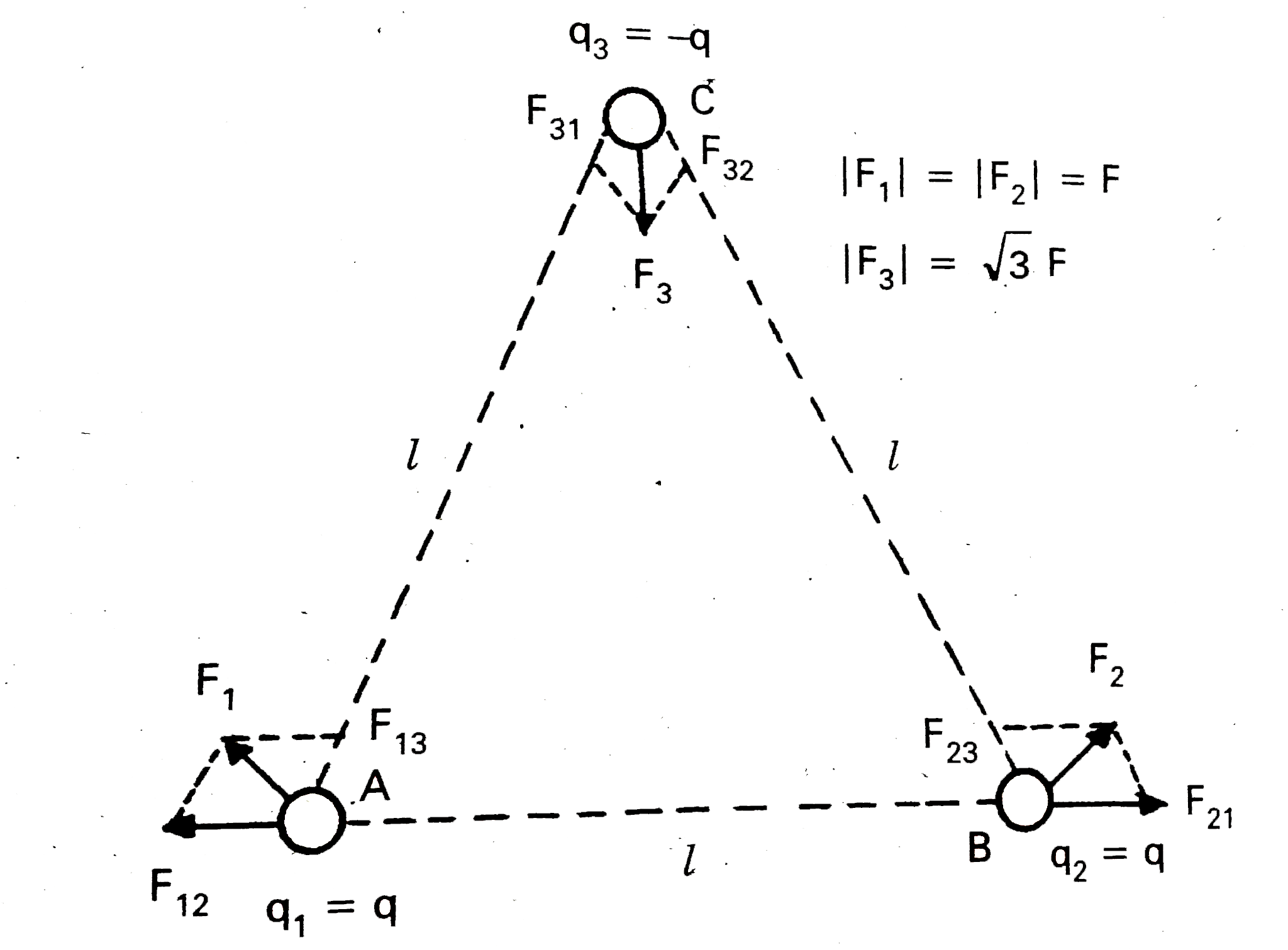
Consider the charge q, q and -q placed at the vertices of an equilateral triangle, as shown in fig. What is the force on each charge?

Text Solution

Verified by Experts

The forces acting on charge q at A due to charges q at B and -q at C are `F_(12)` along BA and `F_(13)` along AC respectively, as shown in Fig. By the parallelogram law, the total force `F_(1)` on the charge q at A is given by
`F_(1)=F hat(r)_(1)` where `hat(r)_(1)` is a unit vector along BC.
The force of attraction or repulsion for each pair of chrages has the same magnitude
`F=q^(2)/(4pi epsi_(0) l^(2))`
The total force `F_(2)` on charge q at B is thus `F_(2)=F hat(r)_(2)`, where `hat(r)_(2)` is a unit vector along AC.
similarly the total force on charge -q at C is `F_(3)=sqrt(3) F hat(n)`, where `hat(n)` is the vector along the direction bisecting the `angleBCA`.
It is interesting to see that the sum of the forces on the three charges is zero, i.e.,
`F_(1)+F_(2)+F_(3)=0`
The result is not at all surprising. It follows straight from the fact that Coulomb's law is consistent with Newton's third law. The proof is left to you as an exercise.
Promotional Banner

Topper's Solved these Questions

  • ELECTRIC CHARGES AND FIELDS

    VIKRAM PUBLICATION ( ANDHRA PUBLICATION)|Exercise VERY SHORT ANSWER QUESTIONS|13 Videos
  • ELECTRIC CHARGES AND FIELDS

    VIKRAM PUBLICATION ( ANDHRA PUBLICATION)|Exercise SHORT ANSWER QUESTIONS|6 Videos
  • DUAL NATURE OF RADIATION AND MATTER

    VIKRAM PUBLICATION ( ANDHRA PUBLICATION)|Exercise DAM SURE (VSAQ)|2 Videos
  • ELECTROMAGNETIC INDUCTION

    VIKRAM PUBLICATION ( ANDHRA PUBLICATION)|Exercise Additional EXERCISES|15 Videos

Similar Questions

Explore conceptually related problems

Consider three charges q_(1), q_(2), q_(3) each equal to q at the vertices of an equilateral triangle of side l. What is the force on a charge Q (with the same sign as q) placed at the centroid of the triangle, as shown in Fig. ?

Three positive charges of equal value q are placed at vertices of an equilateral triangle. The resulting lines of force should be sketched as in

Consider two charges +q and -q placed at B and C of an equilateral triangle ABC. For this system, the total charge is zero. But the electric field (intensity) at A which is equidistant from B and C is not zero. Why?
