

Home
Class 11
PHYSICS
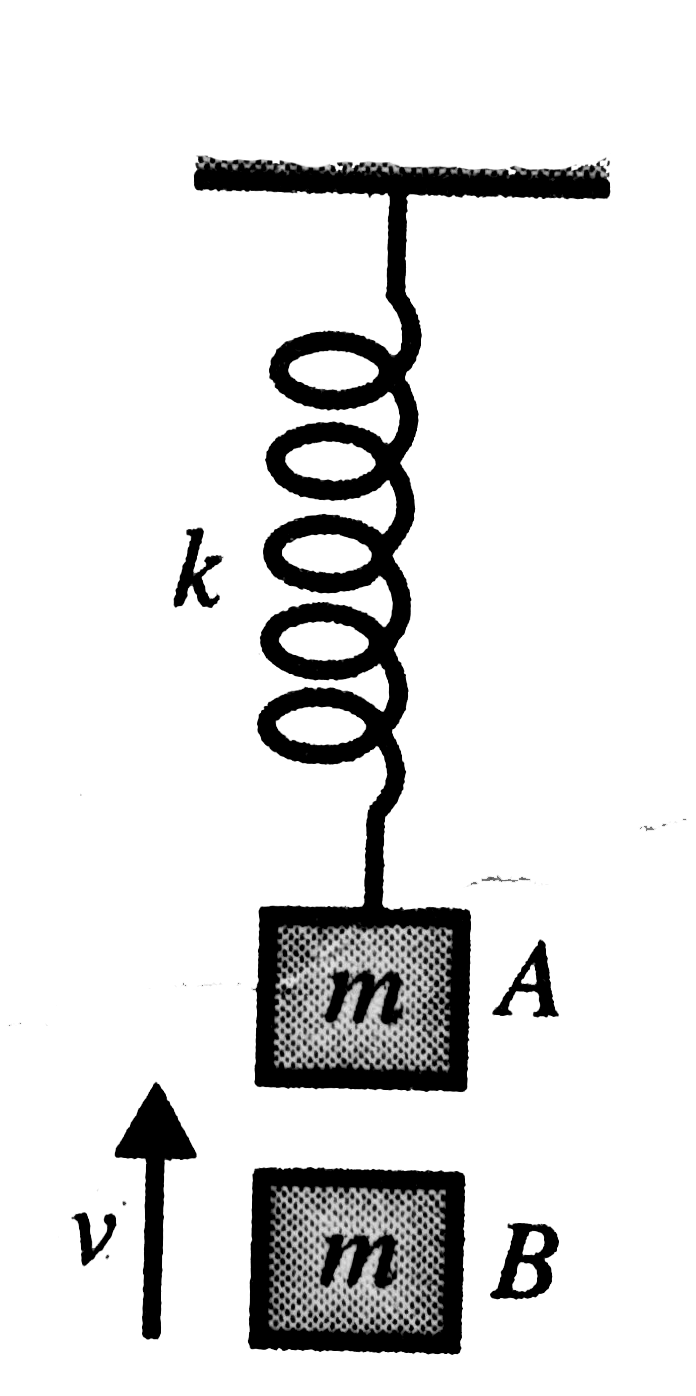
Block A is hanging from a vertical sprin...

Block `A` is hanging from a vertical spring and is at rest. Block `B` strikes the block `A` with velocity `v` and sticks to it. Then the value of `v` for which the spring just attains natural length is

Promotional Banner

Similar Questions

Explore conceptually related problems

Block A is hanging from vertical spring of spring constant K and is rest. Block B strikes block A with velocity v and sticks to it. Then the value of v for which the spring just attains natural length is

Block A is hanging from vertical spring of spring constant K and is rest. Block B strikes block A with velocity v and sticks to it. Then the value of v for which the spring just attains natural length is

A block A of mass 2m is hanging from a vertical massless spring of spring constant k and is in equilibrium. Another block B of mass m strikes the block A with velocity u and sticks to it as shown in the figure. The magnitude of the acceleration of the combined system of the blocks just after the collision is

A block A of mass 2m is hanging from a vertical massless spring of spring constant k and is in equilibrium. Another block B of mass m strikes the block A with velocity u and sticks to it as shown in the figure. The magnitude of the acceleration of the combined system of the blocks just after the collision is

The ball strikes the block and sticks to it. Find the maximum compression of spring. ( L : natural length of spring)

Two blocks A and B of masses in and 2m , respectively, are connected with the help of a spring having spring constant, k as shown in Fig. Initially, both the blocks arc moving with same velocity v on a smooth horizontal plane with the spring in its natural length. During their course of motion, block B makes an inelastic collision with block C of mass m which is initially at rest. The coefficient of restitution for the collision is 1//2 . The maximum compression in the spring is

Two blocks A and B of the same mass are connected to a light spring and placed on a smooth horizontal surface B is given velocity v_(0) (as shown in the figure) when the spring is in natural length. In the subsequent motion.

A block is connected to a relaxed spring and kept on a smooth floor. The block is given a velocity towards the right. Just after this,

Two blocks A and B of masses m and 2m are connected by a massless spring of natural length L and spring constant k . The blocks are intially resting on a smooth horizontal floor with the spring at its natural length , as shown . A third identical block C of mass m moves on the floor with a speed v_(0) along the line joining A and B and collides elastically with A . FInd (a) the velocity of c.m. of system (block A + B + spri ng) and (b) the minimum compression of spring.