Home
Class 12
PHYSICS
The diagram show a small bead of mass m ...

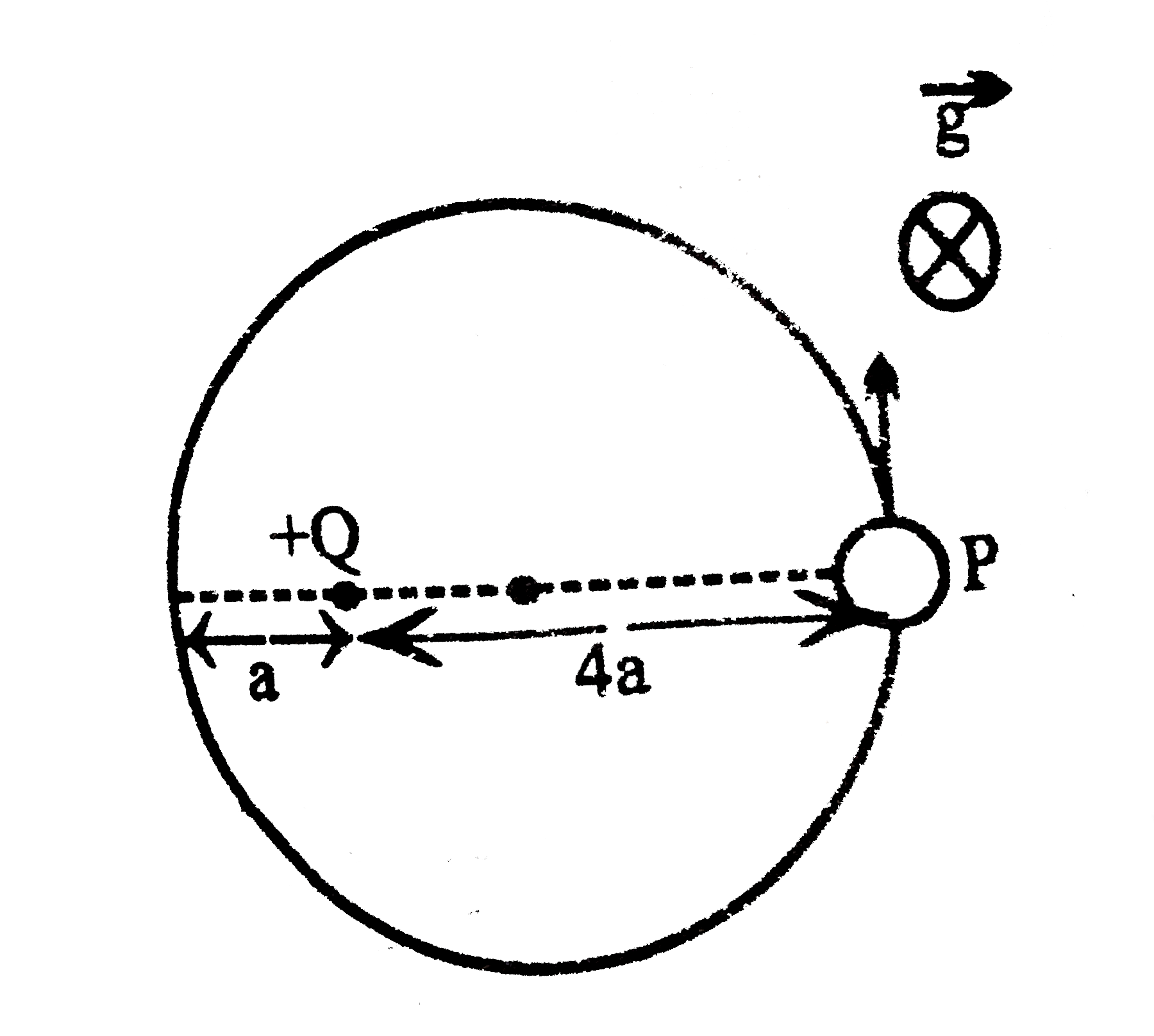
The diagram show a small bead of mass `m` carrying charge `q`. The bead can freely move on the smooth fixed ring placed on a smooth borizontal plane . In the same pane a charge ` +Q` has also been fixed as shown. The potential at the point ` P` due to ` +Q` is `V` . The velocity which the bead should projected from the point `P` so that it can complete a circle should be greater than .

A

` sqrt ( (6qV)/(m))`

B

`sqrt ((qV)/(m))`

C

` sqrt( (3qV)/(m))`

D

none

Text Solution

Verified by Experts

The correct Answer is:

A

From energy conservation
` QV + 1/2 mu^2 =Q. 4 V + 0 rArr 1/2 mu^2 = 3 QV`
` rArr u = sqrt ( 6 QV)/m` .
Promotional Banner

Similar Questions

Explore conceptually related problems

A particle of charge q is projected from point P with velocity v as shown. Choose the correct statement from the following.

A very long straight wire carries a current I. At the instant when a charge +Q at point P has velocity vecV , as shown, the force on the charge is

A charge "Q" of mass "m" is at rest on a smooth horizontal plane.Another identical particle is projected with a velocity v towards it from long distance then

The minimum velocity v with which charge q should be projected so that it manages to reach the centre of the ring starting from the position shown in figure is

Two beads A & B of equal mass m are connected by a light inextensible to move on a connected to move on a frictionless ring in vertical plane. The beads are released from rest as shown. The tension in the cord just after the release is:

A particle of mass m carrying a charge -q_(1) starts moving around a fixed charge +q_(2) along a circulare path of radius r. Find the time period of revolution T of charge -q_(1) .

A bead is free to slide down on a smooth wire rightly stretched between points A and B on a vertical circle of radius 10 m . Find the time taken by the bead to reach point B , if the bead slides from rest from the highest point A on the circle. .

A particle of mass m carrying charge q is projected with velocity v from point P toward aninfinite line of charge from a distance a . Its speed reduces to zero momentarily at point Q , which is at a distance a//2 from the line of charge. If another particle with mass m and charge -q is projected with the same velosity v from P toward the line of charge, what will be its speed at Q ?

Eight charges each of value q each are placed on a ring of radius R placed in x-y plane with origin at centre -q charge having mass m is projected from z = oo towards the centre of the ring with velocity v. The velocity of -q when it reaches the centre of ring is (neglect gravity)-
